
 English
 Français
 Español
 Português
 BTC
BTC
 ETH
ETH
 LTC
LTC
 BCH
BCH
 USDT
USDT
 DOGE
DOGE
 DASH
DASH
 USDC
USDC
 XRP
XRP
 XMR
XMR
 TRX
TRX
 BNB
BNB
 SHIB
SHIB
 SOL
SOL
 DAI
DAI
 ZEC
ZEC
 ETC
ETC
 POL
POL
 ADA
ADA
 XLM
XLM
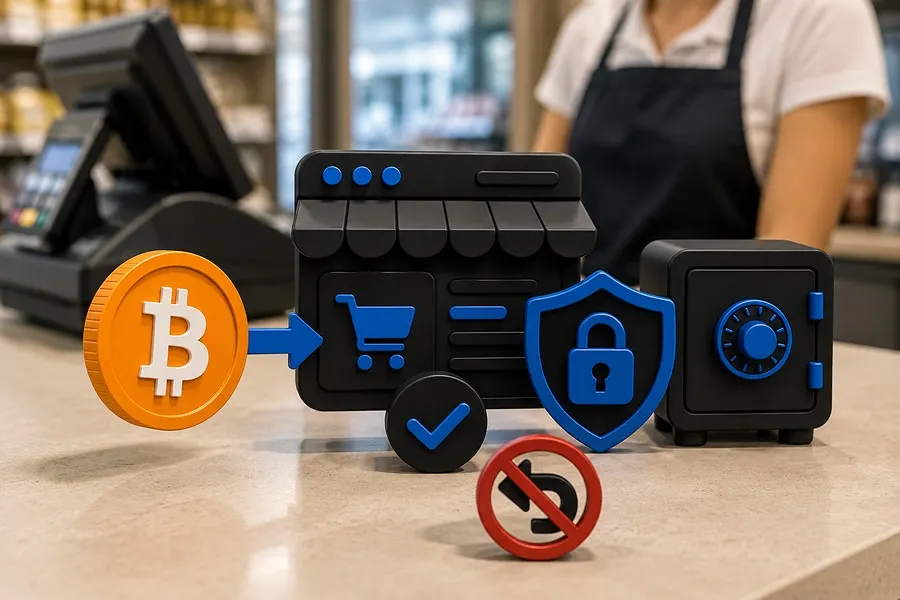
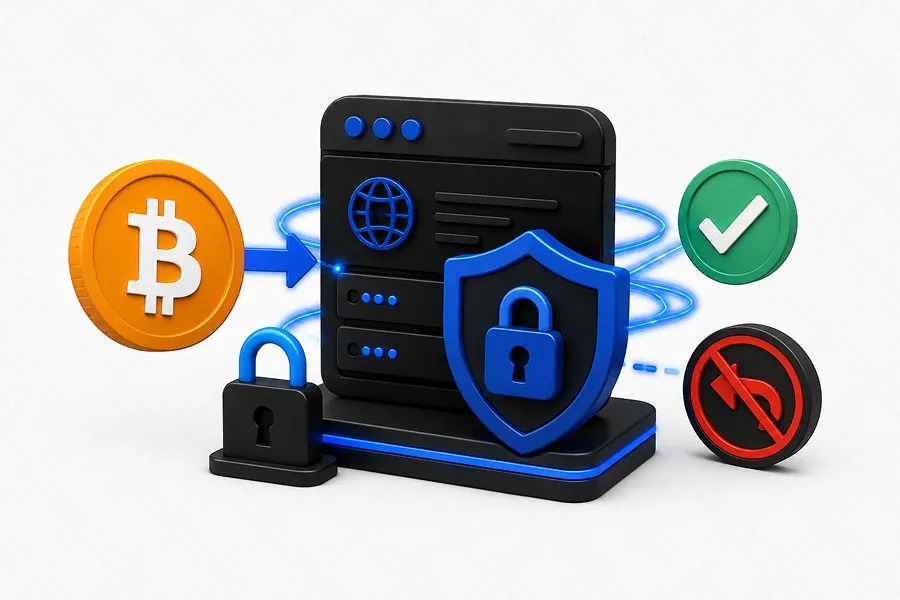
A credit card payment has a safety rope. A bank can pull it back. A customer can dispute it. A processor can freeze the charge. A Bitcoin payment works more like cash pushed through a locked slot. Once the network confirms it, the money moves. No clerk can open the slot from the other side. No bank can press undo.
That makes crypto useful for merchants. It also makes each weak point sharper.
If an attacker breaks into your checkout, swaps a wallet address, steals an API key, or takes over an admin account, the damage can move fast. The funds may leave before your team sees the alert.
For merchants who accept Bitcoin, website security is not a back-office task. It protects the cash register, the vault, and the customer counter at the same time.
Why Irreversible Payments Change The Risk
A normal online checkout can fail in many ways. A card can be stolen. A buyer can dispute a charge. A processor can block a strange payment. These controls do not fix every loss, but they slow the fall.
Bitcoin removes much of that cushion.
When a buyer sends Bitcoin to the wrong address, the coins do not bounce back. When malware changes the merchant wallet during checkout, the payment may still look valid to the customer. When an attacker drains a hot wallet, no bank desk can reverse the transfer.
This changes the job of the merchant.
You must stop the theft before the payment leaves. You must treat your website like the front door of a jewelry store, not like a brochure. The checkout page, admin panel, wallet links, plugins, forms, and APIs all sit close to money.
Small bugs can become direct losses.
A weak login can give an attacker the keys to your order system. A broken access rule can expose customer data. A hidden flaw in a payment flow can send funds to the wrong wallet. A stale plugin can open a side door.
This is why many crypto merchants add application security audit services before they scale Bitcoin payments. A careful audit tests the web app like an attacker would. It checks the doors, windows, locks, and alarms before real funds pass through them.
For Bitcoin-accepting merchants, security is not only about data. It is about where the money lands.
Where Attackers Look First
Attackers do not start with the hardest lock. They test the loose handle.
A Bitcoin merchant may spend time choosing a payment gateway, wallet, or exchange account. That matters. But attackers often enter through plain web parts that teams touch every day.
They look for weak spots that sit close to the payment flow:
Checkout Pages: A changed wallet address can send funds to the wrong place.
Admin Panels: A stolen password can let an attacker edit orders, refunds, plugins, or payment settings.
API Keys: Leaked keys can expose payment data or connect attackers to third-party tools.
Plugins And Extensions: Old code can act like an unlocked service door.
User Accounts: Weak session rules can let attackers take over customer profiles.
Forms And Upload Fields: Poor checks can let bad files or commands reach the server.
Webhooks: Fake or altered payment notices can confuse order status and fulfillment.
Hot Wallet Links: Any system tied to live funds needs strict limits and close watch.
Each item may look small on its own. Together, they form the path from a visitor’s click to your money.
Good security starts by walking that path. Step through the checkout. Check who can change wallet data. Review who can approve orders. Test how the site handles failed payments, duplicate notices, and strange input.
An attacker only needs one weak joint. A merchant needs the whole chain to hold.
How Small Web Flaws Become Payment Losses
A web flaw does not need to touch Bitcoin code to hurt a Bitcoin merchant. It only needs a path to the checkout, the order record, or the wallet setting.
Think of the site as a shop with many rooms. The cash drawer sits in one room. But a thief may enter through a back window, a storage door, or a broken vent. Once inside, the drawer becomes easy to reach.
The same pattern applies online.
Weak Point | What Can Go Wrong | Why It Matters For Bitcoin Merchants |
Weak Admin Login | An attacker enters the control panel. | They can change payment settings or view order data. |
Stale Plugin | Old code lets attackers run commands. | They can alter checkout pages or plant malware. |
Leaked API Key | A secret key appears in logs or code. | Attackers can read payment data or abuse connected tools. |
Poor Access Control | Users see or change data they should not touch. | Attackers can tamper with orders or customer accounts. |
Unsafe Webhook Handling | Fake payment notices pass as real. | The store may ship goods before funds arrive. |
No Change Alerts | Wallet or payment settings change without notice. | Theft can continue for hours or days. |
The same pattern applies online.These failures often look quiet at first. The site still loads. Orders still appear. Customers still pay. But the money may move through a damaged pipe.
A merchant should test each pipe before traffic grows. Check who can change payment details. Log every change. Limit each key. Patch every plugin. Confirm every webhook. Watch the checkout after each update.
With Bitcoin, the safest loss is the one that never leaves.
Why Trust Depends On Control
Customers do not see your server logs. They do not inspect your code. They judge what they can touch: the checkout page, the payment address, the order email, and the delivery notice.
If those parts feel clean, fast, and stable, trust grows. If one part breaks, trust leaks out.
Bitcoin raises the stakes because the customer also takes risk. A buyer must send funds to the right address. They must trust that your site shows the correct amount. They must trust that your order system sees the payment and marks it properly.
A broken checkout does not look like a small bug to them. It looks like a lost coin.
“For crypto merchants, trust is not a slogan. It is the result of every payment detail working exactly as promised.”
This is why control matters.
Control means you know who can edit wallet settings. You know which tools touch payment data. You know when code changes. You know how your site reacts when a payment is late, partial, duplicated, or sent from a strange source.
Control also means you remove loose parts before they fail. Old plugins, shared passwords, broad admin rights, and silent setting changes all weaken the store.
A secure Bitcoin checkout should feel like a locked counter in a busy shop. Customers can pay with ease, but no one can reach behind the glass.
Treat The Checkout Like The Vault
Bitcoin can make payments faster, wider, and harder to dispute. That is a real strength. It also removes the soft padding that card systems provide.
For a Bitcoin-accepting merchant, the website is not just a sales page. It is the route to the money. Every login, plugin, form, webhook, API key, and wallet setting can affect where funds land.
This is why security must come before volume. Patch old code. Limit access. Watch payment settings. Test the checkout under strange conditions. Review every tool that touches orders or funds.
Do not wait for a quiet bug to become a public loss.
Crypto payments reward speed and finality. Your security must match both. A secure site protects the merchant, the buyer, and the trust that keeps each order alive.
