
 English
 Français
 BTC
BTC
 ETH
ETH
 LTC
LTC
 BCH
BCH
 USDT
USDT
 DOGE
DOGE
 DASH
DASH
 USDC
USDC
 XRP
XRP
 XMR
XMR
 TRX
TRX
 BNB
BNB
 SHIB
SHIB
 SOL
SOL
 DAI
DAI
 ZEC
ZEC
 ETC
ETC
 POL
POL
 ADA
ADA
 XLM
XLM
Ask most people what Monero is for and they will describe a technology: ring signatures, stealth addresses, a blockchain that reveals nothing. Ask a Monero holder and, increasingly, they will describe a shopping list. In 2026 the private coin that exchanges keep delisting has quietly become one of the more usable currencies in crypto, and the range of things it buys has widened well beyond the VPN subscriptions that defined its early years.
This is an educational tour of how Monero is being used today, category by category, with the practical details a first-time spender needs. No businesses are named; the directories linked at the end list hundreds of them with trust labels and reviews.
How Monero is used in 2026: the numbers
Merchant trackers counted roughly 1,400 businesses accepting XMR in September 2026, with around 40 added in a single month. XMR itself trades in the mid-$500s with a market value above $10 billion, close to the top ten by market capitalisation.
The pattern of use is distinctive. Bitcoin is mostly held; stablecoins are mostly moved between exchanges; Monero is disproportionately spent. Three properties explain why. A Monerotransaction costs a few cents in network fees and confirms in about two minutes per block. It cannot be reversed, so merchants carry no chargeback risk and can serve customers card processors decline. And it leaves no readable record on chain: the sender, the receiver and the amount are all hidden, so a purchase is visible only to the store that ships the parcel.
Regulation has accelerated the trend rather than reversing it. Binance delisted Monero in February 2024, dozens of platforms followed in 2025, and the EU's anti-money-laundering rules will bar regulated exchanges from handling it after 10 July 2027. Owning and spending XMR stays legal; what disappears is the easy cash-out. Holders with fewer places to sell have more reason to spend, and merchant numbers have grown every month since.
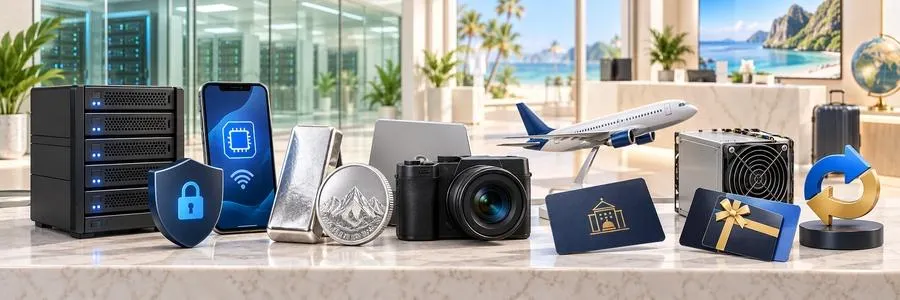
What you can buy with XMR, category by category
Web hosting, domains and servers. The largest category by far, with well over 150 providers on the main Monero directory alone. VPS plans, dedicated servers, domain registration and SSL certificates are all routinely paid in XMR, and a number of hosts require no email address at all. For many developers this is the only Monero purchase they ever need to make.
VPNs and privacy services. Around forty VPN providers accept Monero, and the best-known offers a discount for paying in it. Encrypted email, private messaging and file hosting sit in the same bracket, natural companions to a currency built around not leaving a trail.
eSIMs and phone numbers. One of the fastest-growing niches. Travel eSIMs covering more than 200 countries, and virtual phone numbers for verification codes, can be bought in XMR in minutes with no card on file. For travellers and remote workers this is arguably Monero's most practical everyday use.
Precious metals. A small but expanding group of bullion dealers accept Monero directly for LBMA-certified gold, silver and platinum, priced at live spot plus a published premium and shipped insured in unmarked packaging. With gold roughly a quarter below its January 2026 record and central banks buying at a record pace, this has become the classic "exit to the physical world" for private savings.
Apple products. The manufacturer does not take crypto, so independent resellers do, and buying an iPhone or a laptop with XMR is now a mainstream request. Look for sealed products with the manufacturer's warranty, a price lock at checkout, and returns refunded at fiat value.
Electronics, consoles, cameras, watches and perfume. General lifestyle retailers accepting Monero carry everything from mirrorless cameras and games consoles to smartwatches, fragrances and electric scooters, with insured worldwide shipping and conventional warranty terms. When a bottle of perfume can be bought in XMR without a second thought, the currency has crossed into ordinary money.
Flights, hotels and travel. The category that surprises people most. Booking platforms now settle airfares and hotel stays in Monero, with prices shown in dollars and a fee of cents instead of a card's foreign-transaction charge. It is also the purchase people least want on a card statement.
Mining hardware. Monero is mined on ordinary CPUs, but many holders want exposure to other proof-of-work coins without going through an exchange. Specialist stores sell ASIC and GPU hardware for crypto, and some will host the machine for you at wholesale power rates. Treat "cloud mining" offers with suspicion; buying a serial-numbered machine you own is the honest version.
Gift cards. Dozens of gift-card services bridge Monero to mainstream retail: pay in XMR, receive a card for a big-box store, a streaming service or a food-delivery app. It is the least private option, since the retailer still sees the card, but it makes the practical answer to "what can I buy" close to "anything."
Swaps and exchanges. Not a purchase, but the on-ramp. Hundreds of non-custodial swap services convert Bitcoin or stablecoins to XMR with no account and no identity check, from aggregators that compare rates across providers to single-purpose swappers that run inside the Tor Browser with JavaScript off. With regulated exchanges leaving, this is how most new Monero is acquired.
Where to find merchants
Because Monero's blockchain shows nothing, its economy runs on curated directories rather than search engines. Three privacy-focused ones are worth bookmarking.
• XMRList — the most complete Monero directory, with several hundred businesses, swaps, wallets, VPNs and nodes, each labelled Verified, Admitted, Questionable or Scam, plus verified-order reviews and a Tor mirror.
• KYCless — a curated, community-ranked shortlist of no-KYC swaps, VPNs, eSIMs and privacy services, useful for choosing a specific provider quickly.
• NoKYC.app — a broader no-KYC index that gives every listing a privacy score out of ten and an explicit KYC level, covering hosting, wallets, privacy tools and more.
Monero has spent a decade being described as money nobody could spend. In 2026 it buys servers, phones, silver, cameras, flights and mining rigs, from businesses that ship worldwide and publish their terms. The technology did not change much. The shops caught up.
