
 English
 Español
 Français
 Português
 BTC
 ETH
 LTC
 BCH
 USDT
 DOGE
 DASH
 USDC
 XRP
 XMR
 TRX
 BNB
 SHIB
 SOL
 DAI
 ZEC
 ETC
 POL
 ADA
 XLM
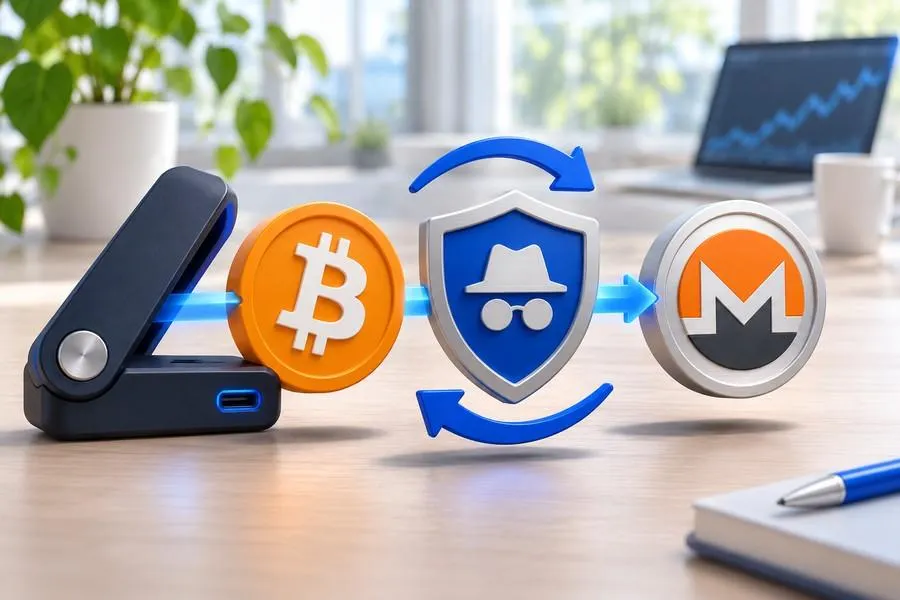
Most people who want to swap Bitcoin for Monero already know why. Bitcoin is transparent by design, and every coin carries its history with it, while Monero hides amounts, senders and receivers by default. The tricky part is getting from one to the other. Many large exchanges have dropped XMR pairs, and most of the ones that kept them ask for ID first, which ties your new Monero to your name before it even reaches your wallet.
This guide walks through the practical ways to move BTC to XMR without KYC, compares the main routes side by side, and shows the exact steps for the quickest one.
Three routes from BTC to XMR, compared
In 2026 a Bitcoin holder has three realistic options: an instant swap service, a peer-to-peer atomic swap, or a decentralized P2P marketplace. For most people the instant route is the easiest place to start. You can, for example, swap BTC to XMR on 0trace with no account and no email, only a Monero payout address. On 0trace the acceptor of your order, the side that actually takes your BTC and sends out the XMR, is the service itself, paying from its own liquidity instead of passing the trade to a third-party desk that might ask for documents halfway through.
Here is how the three routes stack up for a typical btc to xmr trade:
Route | Typical time | Cost | Main trade-off |
Instant swap service | 30–60 min | Service fee built into the quote | You trust the operator for one swap |
Atomic swap (eigenwallet) | Usually under 1 h | Maker markup + network fees | Desktop app, more steps |
P2P DEX (Haveno networks) | Hours | Trade fee + security deposit | Slower, two exploits in 2026 |
The pattern is simple: speed and simplicity favor instant swaps, while atomic swaps remove the middleman at the cost of convenience.
What you need before you swap
Whichever route you choose, get these ready first. Most failed or delayed swaps come down to skipping one of them.
- A Monero wallet you control. Download it from the official Monero downloads page or use a well-known option such as Feather or Cake Wallet, and check the file hashes the project publishes.
- A fresh XMR receiving address, ideally a subaddress, copied straight from the wallet rather than from an old chat or note.
- Bitcoin in a self-custody wallet, so you set the network fee yourself and can see exactly when the transaction leaves.
- A rough amount in mind. Instant services have a minimum and a per-order cap; at the time of writing 0trace's floor is around $105 worth of BTC.
- Tor Browser if you'd like to keep your IP address out of the picture. Several no-KYC exchanges, 0trace included, run .onion mirrors.
Step by step: convert BTC to XMR with an instant swap
The flow looks almost the same on any instant exchange. Using 0trace as the example:
- Open the BTC → XMR pair and enter how much Bitcoin you want to send. The receive field shows the XMR you'll actually get, with the service fee and network cost already taken out.
- Paste your Monero address and compare the first and last six characters with your wallet. A payout to the wrong address cannot be reversed.
- Save the order ID and the signed Guarantee. 0trace issues a PGP-signed document with the deposit address and quoted terms, and you can verify it offline before paying.
- Send BTC to the generated deposit address, on the Bitcoin network only. Pick a normal fee so the transaction doesn't sit in the mempool for hours.
- Wait for confirmations. 0trace needs three Bitcoin confirmations, roughly half an hour in normal conditions, and the XMR usually arrives within minutes after that.
- Check the balance in your Monero wallet and keep the signed Receipt until you're happy with the result.
One detail worth knowing: the rate floats until your deposit confirms, so the final figure can move slightly from the first quote. If you send a bit more or less than planned, the payout is recalculated from the amount that actually arrived.
When an atomic swap or a P2P trade makes more sense
If you'd rather not trust any operator, even for half an hour, look at trustless atomic swaps. The best-known tool is eigenwallet, formerly UnstoppableSwap, with BasicSwap as a more technical alternative. It's a desktop app where independent makers buy your Bitcoin and pay you in Monero, and the protocol is built so that either both sides complete or you can claim your BTC back. Some makers hold back a small anti-spam deposit from a refund, which is normally returned later. The trade-offs are real: there are more steps, each maker adds its own markup, and if a swap stalls you have to reopen the app within a roughly 24-hour refund window or risk losing the BTC. In return, nobody ever holds both coins at once.
Haveno-based marketplaces are the third route. They use multisig escrow and are one of the few non-custodial places to trade XMR against fiat as well as BTC. Go in with your eyes open, though. RetoSwap, the biggest Haveno network, was exploited twice in May and June 2026, losing about $2.7 million in XMR in the first incident, and paused trading both times before reopening in late June.
Whatever route you use, run a small test swap first, never reuse a deposit address from an old order, and move the XMR to your own wallet instead of leaving it on any platform.
So which way should you swap BTC to XMR?
For most Bitcoin holders, an instant no-KYC swap is the right call. Set up your own Monero wallet, generate a fresh address, send BTC from self-custody, and you'll typically hold private XMR within the hour without handing over a single document. Pick an atomic swap through eigenwallet when cutting out the middleman matters more to you than speed. Treat Haveno markets with caution until their security record settles down.
One thing doesn't change across all three routes. The privacy you gain from moving btc to xmr is only as strong as the wallet the coins land in, so the swap should start and end with keys that you, and only you, control.
