
 English
 Français
 BTC
 ETH
 LTC
 BCH
 USDT
 DOGE
 DASH
 USDC
 XRP
 XMR
 TRX
 BNB
 SHIB
 SOL
 DAI
 ZEC
 ETC
 POL
 ADA
 XLM
Tax season hits crypto investors differently this year. The IRS now receives a broker's version of your digital asset sales before you file, and per-wallet cost basis rules mean your old tracking method no longer works.
The short answer: CoinLedger is our best overall pick for 2026, thanks to the smoothest TurboTax workflow and a dedicated Form 1099-DA reconciliation dashboard. Koinly, CoinTracker, CoinTracking, ZenLedger, and Summ all make strong alternatives depending on where your portfolio lives.
Quick Comparison: The 6 Best Crypto Tax Software at a Glance
Tool | Best For | Entry Price | Top Tier | Free Tier |
|---|---|---|---|---|
TurboTax filers & 1099-DA reconciliation | $49 (100 tx) | $199+ Pro | Tracking & gains preview | |
Koinly | International users & beginners | $49 (100 tx) | $279+ (10,000 tx) | Up to 10,000 tx preview |
CoinTracker | Coinbase-only portfolios | ~$59 (100 tx) | ~$599 (10,000 tx) | Tracking & gains preview |
CoinTracking | High-volume traders | $49/yr (200 tx) | $899/yr unlimited | Tracking & gains preview |
ZenLedger | US filers who want phone support | $49 (100 tx) | $399 (15,000 tx) | Tracking & gains preview |
Summ | Small, simple portfolios | $49 (100 tx) | $499 (100,000 tx) | Tracking & gains preview |
Entry pricing is nearly identical across the board — roughly $49 per tax year. The real differences show up in coverage, DeFi handling, and 1099-DA reconciliation. All six follow the same model: free to import and preview your gains, paid to download the report, priced by transaction count.
1. CoinLedger — Best Overall for 2026
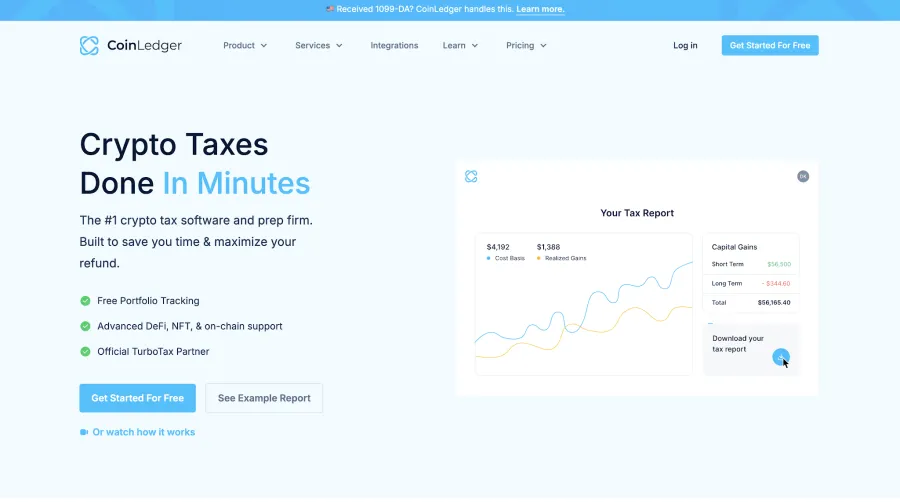
Independent reviewers back this pick from two directions. Coin Bureau ranks CoinLedger best for Form 1099-DA reconciliation, and Count On Sheep names it best for TurboTax filers who want the shortest path from import to filing. For a tool that quietly works in both categories, that's meaningful validation.
Pricing stays simple: free portfolio tracking with unlimited exchange and wallet syncs, then one-time per-tax-year reports — $49 Hobbyist (100 transactions), $99 Investor (1,000), $199+ Pro (3,000), and $499 Unlimited (10,000+). Every plan comes with a 14-day money-back guarantee.
The feature set covers what most filers need: 1,000+ integrations across exchanges, wallets, and blockchains; support for 20,000+ cryptocurrencies; IRS Form 8949, income, capital gains, and audit trail reports; tax-loss harvesting tools; and FIFO, LIFO, HIFO, and adjusted cost basis methods. Missing cost basis detection flags problem transactions instead of silently filling them with $0.
Two things set it apart this year. First, the dedicated Form 1099-DA Dashboard lets you compare broker-reported proceeds against your imported transaction history — exactly the reconciliation workflow the new IRS reporting regime demands. Second, CoinLedger supports per-wallet cost basis for Rev. Proc. 2024-28 compliance and exports directly to TurboTax Online and Desktop, TaxACT, H&R Block Desktop, and TaxSlayer.
If you want human help, Expert Review costs $699 and Done For You service starts at $3,500. The platform holds a 4.7/5 rating across 1,200+ reviews.
2. Koinly — Best for International Users & Beginners
Koinly runs $49 for 100 transactions up to $279+ for 10,000, and its free tier is the most generous here — import up to 10,000 transactions and preview your gains before paying anything.
Coverage is its headline strength: 800+ exchanges, wallets, and blockchains. Guided reconciliation tools handle transfer matching, spam token detection, and negative-balance warnings, which matters enormously when you're stitching together messy on-chain history.
International filers get country-specific reports for 20+ jurisdictions — Form 8949 and Schedule D for the US, Capital Gains Summary for the UK, and equivalents elsewhere. If you filed in multiple countries or you're new to crypto tax software entirely, Koinly's guided flow is hard to beat.
The honest limitation: transactions count cumulatively across tax years, which can inflate your pricing tier, and there's no unlimited plan for very large portfolios.
3. CoinTracker — Best for Coinbase-Only Portfolios
CoinTracker is the official Coinbase tax partner for the sixth year running, and that integration shows. Pricing runs roughly $59 for 100 transactions to $599 for 10,000, with Full Service handled returns from $3,499.
You get 600+ integrations, a dedicated 1099-DA portal, TurboTax and H&R Block exports, and the ability to share your account directly with a CPA. If your activity concentrates on Coinbase, the pipeline from exchange data to filed return is about as frictionless as it gets.
The caveat: DeFi reconciliation lags behind Koinly. Portfolios spread across DEXs, lending protocols, and NFT marketplaces will need more manual cleanup.
4. CoinTracking — Best for High-Volume Traders
The oldest tool on this list — running since 2012 — CoinTracking is also the only annual subscription model: $49/year for 200 transactions up to $899/year for unlimited. For traders executing thousands of trades, that unlimited tier is the most cost-effective option available.
The depth is real: 400+ import options, 25+ report types, and 2.2 million investors served. The wallet-by-wallet Reallocation Report directly addresses Rev. Proc. 2024-28 compliance, which matters now that universal cost basis tracking has ended.
The trade-off is a dated interface and a steep learning curve. Casual buy-and-hold investors will find it overkill — this is a tool built for people whose trade logs look like trading terminal exports.
5. ZenLedger — Best for US Filers Who Want Phone Support
ZenLedger prices at $49 Silver (100 transactions), $199 Gold (5,000), and $399 Platinum (15,000) per tax year.
Its differentiator is simple: this is one of the few platforms where getting a human on the phone is actually realistic. When your transaction history has genuine problems — missing transfers, disputed gains — talking to a support person beats waiting on email tickets. TurboTax integration and tax-loss harvesting reports round out the package.
Coverage and DeFi depth trail Koinly, so complex on-chain portfolios may still require cleanup work.
6. Summ — Best for Small, Simple Portfolios (Worth Watching)
Formerly Crypto Tax Calculator, Summ runs $49 for 100 transactions up to $499 for 100,000 — and that 100,000-transaction ceiling is the most generous on this list. It offers automatic 1099-DA comparison and holds official tax partner status with Coinbase, MetaMask, OKX, and Phantom.
The novel perk: one subscription covers every tax year back to 2013. If you're doing a multi-year cleanup for past unfiled years, that single-price model can save hundreds.
It's also the newest tool with the shortest track record, and its aggressive auto-categorization still needs manual review at scale.
What Actually Changed for 2026: Form 1099-DA & Per-Wallet Cost Basis
Two regulatory shifts make tool choice genuinely different this year.
Form 1099-DA is live. As the IRS explains on its Form 1099-DA page, US brokers began reporting gross proceeds from digital asset sales for transactions on or after January 1, 2025. Basis reporting phases in for "covered" assets acquired after 2025. Two consequences follow: the IRS now sees a broker's (incomplete) version of your activity before you file, and DeFi and DEX platforms are currently not required to issue the form — so the IRS picture of your on-chain activity may be substantially missing.
Per-wallet cost basis is mandatory. Under Rev. Proc. 2024-28, documented on the IRS digital assets guidance page, universal cost basis tracking ended January 1, 2025. You must now track basis wallet-by-wallet, and your old universal-method data doesn't migrate itself.

Here's a concrete example of how this breaks. Suppose you bought 1 ETH at $2,400 on an exchange, transferred it to MetaMask, then sold it for $3,100. If you only connect the MetaMask wallet, your software has no record of the original purchase — so it reports a $3,100 gain instead of the correct $700. That's a 4x overstatement of your tax bill from a missing data source.
The takeaway applies regardless of which tool you pick: connect every exchange and wallet you've ever used, including closed exchanges, and choose software with missing-cost-basis warnings rather than silent $0 fills.
Frequently Asked Questions
Is there completely free crypto tax software?
No major tool gives you a downloadable, filing-ready report for free. Free tiers cover portfolio tracking and gains previews only. The realistic minimum to actually file is around $49 per tax year.
Can TurboTax do my crypto taxes?
TurboTax can file your return, but it can't calculate your gains across platforms — it imports from one exchange only. If you traded on multiple exchanges, wallets, or DeFi protocols, you need a dedicated tax tool to generate the aggregated report first.
Do I still need crypto tax software if my exchange sends a Form 1099-DA?
Yes. Each 1099-DA covers only one broker's activity, and it typically shows missing or $0 basis for coins you transferred in. Reconciling the form against your full transaction history is exactly what these tools are built for.
Why does my crypto tax software show missing cost basis?
Usually one of three causes: a connected wallet or exchange is missing, an exchange you used has since closed, or transfers between your own accounts aren't matched. Each one breaks the cost basis chain and inflates your reported gains.
Which crypto tax software is best for DeFi and NFTs?
Koinly leads for DeFi depth, thanks to its transfer matching and spam detection. For NFT-heavy portfolios, verify your marketplace (OpenSea, Blur, Magic Eden) is supported before committing — coverage varies by chain.
The Bottom Line
Match the tool to your actual transaction footprint, connect every wallet before you pay, and reconcile against any 1099-DA forms you receive. For most US filers heading into TurboTax in the 1099-DA era, CoinLedger is the shortest path from import to filed return — while Koinly, CoinTracker, CoinTracking, ZenLedger, and Summ each win a specific niche worth considering.
