
 English
 Español
 Français
 Português
 BTC
 ETH
 LTC
 BCH
 USDT
 DOGE
 DASH
 USDC
 XRP
 XMR
 TRX
 BNB
 SHIB
 SOL
 DAI
 ZEC
 ETC
 POL
 ADA
 XLM
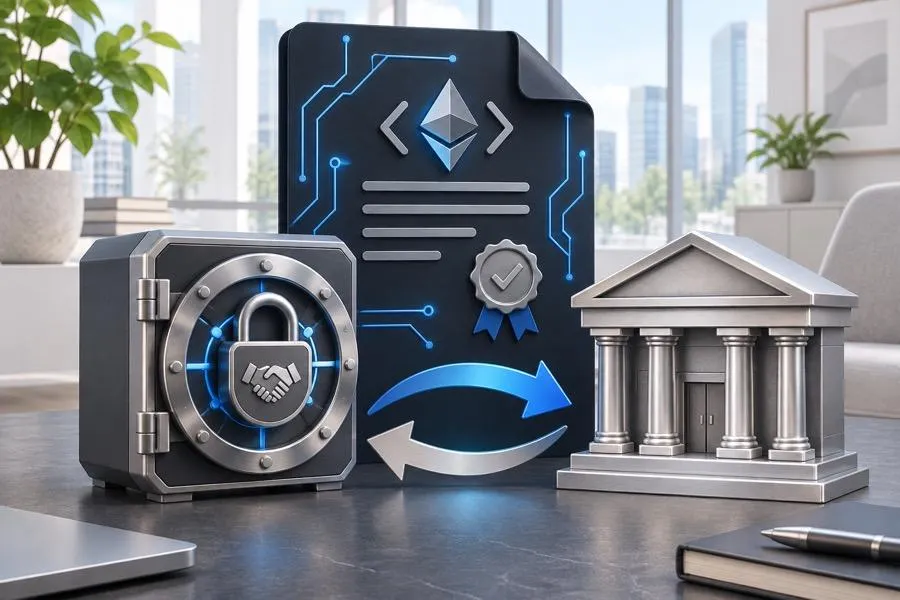
A machine-parts supplier in Ohio is about to ship a pallet of hydraulic fittings to a distributor in Ho Chi Minh City, and it sends the buyer an invoice for $10,000. That one invoice settles the smart contract debate better than any white paper I've read. Smart contracts beat traditional rails on settlement and programmability. They lose on reversibility, compliance and accounting. So the right answer depends on which of those five things your business actually needs, and most companies have never written that list down.
I've built payment products on both sides of this line. Card checkouts with chargeback queues. Wire reconciliation for a B2B marketplace where half the support tickets were short-pays. Later, a handful of stablecoin escrow contracts that held real money for counterparties who'd never met. Teams pick a rail because it's new or familiar, then learn what they gave up at the first dispute.
So let's follow the same $10,000 down two roads, then count what each costs that the sales deck leaves out.
Route A: the bank wire / ACH / card
Most overseas buyers will pay this by international wire, so that's the main trace. ACH and cards come in at the end, because each changes who carries the risk.
Step 1, initiation (hour 0)
The distributor's accounts payable clerk opens the bank portal and types in the supplier's account number, bank address and SWIFT code. SWIFT is the messaging network banks use to instruct each other across borders. It moves instructions, not money. The money follows through correspondent accounts banks keep with each other.
Step 2, fees and FX (hour 0 to 1)
The buyer's bank charges an outgoing wire fee. If the buyer pays from a dong account, the bank converts at its own rate, with a spread that rarely shows up as a line item. One or two correspondent banks in the middle may take a deduction of their own. That's how a $10,000 invoice becomes a $9,960 deposit and an awkward email about the missing $40. The World Bank's Remittance Prices Worldwide database puts the global average cost of sending money abroad at 6.36% of the amount sent, in data updated in August 2025. It tracks small consumer transfers, so a $10,000 business wire usually lands well below it. The World Bank doesn't make that claim for business wires. It's my own reading.
Step 3, settlement (hour 1 to day 2)
Here the banks have improved. Swift reported in October 2024 that 90% of cross-border payments on its network reach the destination bank within an hour, but only 43% are credited to the end customer's account within that hour. The gap is the last mile: the receiving bank's compliance checks, cut-off times, weekends and manual repairs when a beneficiary name doesn't match. In my experience the slow ones were sent at 4 p.m. on a Friday, or carry a typo.
Step 4, confirmation (day 1 to 2)
Swift gpi gives every payment a tracking reference, so the buyer can see where the money sits. The supplier's receivables team still matches deposits to invoices by hand when remittance details get truncated along the chain, which they often do.
Step 5, disputes (after credit)
Once the supplier is credited, a wire is effectively final. The sending bank can file a recall, but it only works if the receiving bank and the supplier agree to send money back. Good for the supplier. For the buyer, protection lives in the purchase contract and the courts, not in the payment. That gap is the first thing companies shopping for smart contract development services want to close: a way for the buyer to hold money back until the goods arrive, without the supplier losing certainty that it's coming.
The ACH variant
ACH is the US batch network that moves payroll and bill payments between bank accounts. It's cheap and dull, which is a compliment. An overseas buyer without a US bank account usually can't use it.
The card variant
The buyer pays with a corporate card on the supplier's payment page. It's the fastest to start and the most expensive for the supplier, and it brings the chargeback with it: a forced reversal that the cardholder's bank files on the customer's behalf. Under Visa's rules, a cardholder generally has 120 days to raise a dispute. That's four months during which the $10,000 isn't quite the supplier's money.
This is what I call the reversibility trade. Every payment rail quietly decides who can undo a payment, for how long, and on whose word. Cards give the buyer a long undo window. Wires give almost none. A smart contract gives exactly the undo you wrote into the code, and not one hour more.

Route B: a stablecoin escrow smart contract
Same invoice, same companies. This time the terms say the buyer deposits 10,000 USDC into an escrow contract, the supplier ships once it sees the deposit, and the funds release when the buyer confirms delivery or after 14 days with no dispute raised. Escrow is the pattern I suggest first to any business testing on-chain payments, because it's short, well understood and relatively cheap to audit.
Step 0, setup (days before)
Both parties need wallets and a KYC-verified account at a regulated on-ramp, such as an exchange or the issuer itself. The contract is deployed once and reused for every order. I build these on OpenZeppelin's audited libraries rather than from scratch. Writing your own token-transfer logic is how people end up in post-mortems.
Step 1, initiation (minute 0)
The buyer converts dong to USDC on its on-ramp. Notice what moved. The FX conversion still happens, just at an exchange instead of a bank, and the spread is still there. Then the buyer signs two transactions: one approving the escrow contract to pull the tokens and one making the deposit.
Step 2, fees (minute 0 to 1)
The buyer pays gas, the fee network validators charge to process a transaction. On a layer-2 network such as Base, or on Solana, that's normally a trivial cost. On Ethereum mainnet during a busy hour it can be noticeably more. There's no correspondent bank taking a slice, and the supplier receives the full 10,000.
Step 3, settlement (seconds to minutes)
The deposit is final once the block confirms. The supplier can see 10,000 USDC locked in the contract, something no wire has ever offered: proof the buyer committed the money before a single fitting leaves the dock. It works at 3 a.m. on a Sunday.
Step 4, confirmation and release (day 5 to 19)
The release condition is the whole product. In this version it's simple: the buyer signs a confirmation, or the 14-day timer runs out. Fancier builds use an oracle, a service that feeds outside data like carrier tracking into the contract. Oracles are where I've watched most of the real-world complexity hide.
Step 5, disputes
The only dispute process is the one you coded. Ours had a dispute flag that froze the timer and handed the decision to an arbiter address both sides agreed on at signing. No arbiter in the code, no dispute process. One caveat people forget: Circle and Tether can freeze addresses for sanctions or law-enforcement reasons. So an on-chain payment is irreversible by you, not irreversible by everyone.
Step 6, off-ramp
The supplier sells the USDC for dollars and withdraws to its bank account by ACH or wire. Route B ends on Route A.
Each route wins a different fight
Side by side, the trade-offs get concrete.
Factor | Traditional rails | Smart contract (stablecoin escrow)
|
Fees | Wire fee, correspondent deductions, FX spread, or card processing fees | Gas, plus on-ramp and off-ramp spreads |
Settlement time | Minutes to two days, bank hours and cut-offs apply | Seconds to minutes, around the clock |
Reversibility | Card: long dispute window. Wire: near-final, recall needs consent | Only what the code allows, plus issuer freezes |
Programmability | Close to none. Conditions live in paper contracts | Conditional release, milestones, timeouts, splits |
Compliance burden | Mostly carried by your bank | Largely yours: wallet screening, records, travel rule data via your providers |
Accounting | Cash, booked the way it's always been booked | Digital asset treatment still being clarified |
A few dated numbers make the table less abstract.
- Swift, October 2024: 43% of cross-border payments credited to the end customer within an hour.
- World Bank, August 2025 update: 6.36% average cost of sending money abroad.
- a16z crypto, October 2025: stablecoins processed $46 trillion in annual transactions, or $9 trillion adjusted, a volume the report compares to Visa and PayPal.
The adjusted figure is the one I'd quote to a CFO, since it tries to filter out bot-driven and other inorganic volume. Even that number says stablecoin settlement is no longer a hobby.
Traditional rails win wherever someone might need to unwind a payment, wherever a bank's compliance team is doing work you'd otherwise pay for, and wherever your auditor wants a boring year. Smart contracts win wherever timing and conditions matter more than undo: escrow, milestone payments, mass payouts and anything that must settle on a Saturday.
"Smart contracts make banks obsolete."
That's the line you hear at every crypto conference, usually a few hours before the panel on bank partnerships. Look at Route B again. The USDC the buyer deposited is backed by reserves sitting in bank deposits and short-dated Treasury bills. The supplier's last step is a bank withdrawal. Smart contracts replace the messaging and the conditional logic. They don't replace the balance sheet. Not obsolete. Rearranged.
The hidden costs sit off-chain
The fees in Route B are tiny. The real costs live in the work around the payment.
Gas spikes
Gas is priced by demand for block space. A transaction that costs pennies on an ordinary Tuesday can cost far more when a hyped token launch clogs the network. Pick a cheaper network for routine payments and never hard-code a fee assumption into your pricing.
Custody
Somebody holds the keys. If it's the controller's laptop, you have a business continuity problem. Most companies I've worked with end up with a multi-party computation wallet from a provider like Fireblocks, or a qualified custodian. That brings approval policies and a monthly bill nobody put in the business case.
Audits
A plain escrow contract is small enough to review properly. Every custom rule, such as partial releases, widens the audit, and every change after launch means another review. Budget for audits as a recurring line.
Accounting and tax
In the US, there's still no settled answer on whether stablecoins count as cash equivalents. On August 18, 2026, FASB issued a proposed update that would add examples showing when a stablecoin can qualify, focused on a direct, on-demand redemption right with the issuer and one-to-one reserves in short-term liquid assets. Comments are due November 19, 2026. Until a final standard lands, ask your auditor before you treat a USDC balance like a checking account. The IRS treats digital assets as property, so every conversion is a disposal someone has to record, even when the gain is a fraction of a cent.
KYC/AML and sanctions screening
In Route A, the bank screened both parties against sanctions lists before the money moved. In Route B, OFAC sanctions rules still apply to you, and the screening is yours to arrange. That means checking counterparty wallet addresses with a tool like Chainalysis or TRM Labs, keeping records and making sure your on-ramp handles travel rule data. None of this is hard. All of it is work the bank used to do for a fee you'd stopped noticing.
Regulation now has dates attached
For years the legal status of business stablecoin payments was vague. That's changed.
In the US, the GENIUS Act, the first federal framework for payment stablecoins, was signed on July 18, 2025. It requires issuers to back tokens one-to-one with high-quality liquid reserves and to run AML and sanctions programs. The law takes effect on January 18, 2027, or 120 days after regulators issue final rules, whichever comes first. Regulators missed the one-year rulemaking deadline in July 2026, with the main rule packages from the OCC, FDIC and Treasury still at the proposal stage. Plan for the January 2027 date.
In the EU, MiCA's rules for e-money tokens, the category most dollar and euro stablecoins fall into, have applied since June 30, 2024. The rules for crypto service providers followed on December 30, 2024, with national transition windows that ran no later than mid-2026. If our buyer were in Germany instead of Vietnam, the choice of stablecoin would matter, because tokens without MiCA authorization were pulled for EU customers on major platforms from late 2024 into 2025.
A three-condition rule
I've stopped asking clients whether they want blockchain. I ask whether three conditions hold. If all three do, a smart contract is the better rail for that payment flow. If even one fails, use the bank and spend the budget elsewhere.
- Your counterparties will hold stablecoins, not just pass through them. If the supplier converts every USDC to dollars the minute it lands, you've paid two spreads and added a custody problem to save a wire fee. The math works when at least one side also pays its own suppliers on-chain, so the money stays put for a while.
- The release condition can be checked by a machine. A signed delivery confirmation, a timestamp or a tracking event a contract can read. If deciding whether the goods were acceptable takes a human looking at photos of dented fittings, you're building a slower letter of credit with fewer lawyers, and the arbiter becomes the real product.
- You can live with the reversibility trade, and your finance team can book it. That means accepting the coded undo as the only undo, an auditor who's comfortable with your treatment, and owning the sanctions screening. If any of those makes your controller wince, the wire is still the right answer this year.
The best payment rail is the one whose failure you've already planned for, not the fastest one.
