
 English
 Français
 BTC
BTC
 ETH
ETH
 LTC
LTC
 BCH
BCH
 USDT
USDT
 DOGE
DOGE
 DASH
DASH
 USDC
USDC
 XRP
XRP
 XMR
XMR
 TRX
TRX
 BNB
BNB
 SHIB
SHIB
 SOL
SOL
 DAI
DAI
 ZEC
ZEC
 ETC
ETC
 POL
POL
 ADA
ADA
 XLM
XLM

Crypto theft has become one of the fastest-growing categories of financial crime, and yet the tools used to fight it have matured just as quickly. What used to be a near-hopeless situation for victims — funds gone the moment they left a wallet — is now, in a meaningful share of cases, a recoverable one. The shift didn't come from a single breakthrough. It came from blockchain forensics becoming a genuine discipline, with its own methodology, tooling, and professional standards.
Why Crypto Theft Behaves Differently From Traditional Theft
When money is stolen from a bank account, the trail usually stops at the point of withdrawal. Blockchain theft works in reverse: every transaction is permanently recorded on a public ledger. The thief's biggest advantage — speed — is also their biggest liability, because every hop a stolen coin makes leaves a fingerprint. The challenge for investigators isn't finding the data; it's interpreting it fast enough, and coordinating a response before the trail goes cold at an off-ramp.
This is why blockchain forensics firms think in terms of a race against time rather than a slow investigative process. A theft reported within hours has a fundamentally different recovery outlook than one reported after a week, by which point funds have often passed through several intermediary wallets, decentralized exchanges, and potentially a mixing service.
The Core Toolkit: How On-Chain Tracing Actually Works
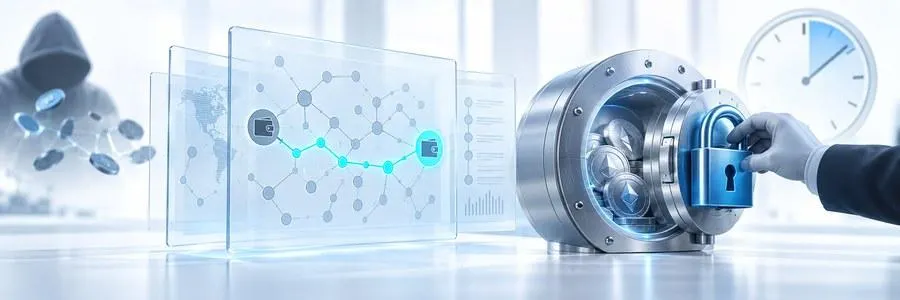
At the center of any investigation is transaction graph analysis. Every wallet address that receives stolen funds becomes a node; every transaction becomes an edge connecting nodes. Investigators build out this graph transaction by transaction, watching where value flows, how it splits, and where it eventually converges — often at a centralized exchange, since that's typically where crypto gets converted back to fiat or consolidated into a spendable form.
Clustering heuristics help investigators group addresses that likely belong to the same entity, even when a thief deliberately spreads funds across dozens of wallets to obscure the trail. Common-input-ownership heuristics, change address detection, and behavioral pattern matching all play a role here. None of these techniques are exotic — most are publicly documented — but applying them correctly, at scale, in real time, under time pressure, is where experience separates a competent investigation from a wasted one.
Cross-Chain Tracing: Bridges, Mixers, and Chain-Hopping
Modern thieves rarely keep stolen funds on a single chain. Cross-chain bridges let them move value from Ethereum to a sidechain, then to a different Layer 2, then potentially back again — each hop designed to break the simple linear trail a less sophisticated investigator might expect. Mixing services like Tornado Cash add another layer, breaking direct on-chain linkage between deposit and withdrawal.
Neither technique is unbeatable. Bridge transactions still leave metadata — timing correlation, amount correlation, and off-chain relay data can often reconnect the dots on the other side. Mixers reduce traceability but rarely eliminate it entirely, especially when combined with exchange-side KYC data once funds re-enter a regulated on-ramp or off-ramp. This is precisely where forensics stops being a purely technical exercise and starts requiring relationships — with exchanges, with stablecoin issuers, and in serious cases, with law enforcement.
The Freeze Window: Why the First 48 Hours Matter
Tracing funds is only half the job. The other half is getting them frozen before they're cashed out or laundered further. Centralized exchanges and stablecoin issuers like Tether have internal compliance teams that can freeze funds tied to reported theft — but only if they're notified with enough specificity and speed to act before withdrawal.
This is why the first 48 hours after a theft are consistently described as the critical window. Once funds sit in an exchange's hot wallet awaiting freeze confirmation, the odds of recovery rise sharply. Once they've been withdrawn and converted, the odds fall just as sharply. A forensics team's value is measured largely by how quickly it can go from "theft detected" to "formal freeze request filed with the right entity, with the right evidence attached."
Working With Exchanges and Stablecoin Issuers
Freeze requests aren't informal emails. Exchanges require a documented chain of custody: proof of the theft, the specific transaction hashes involved, the destination wallet addresses, and often a police report or case reference number. Larger exchanges have dedicated compliance liaison teams for exactly this purpose, and firms that work with them regularly develop faster channels than a first-time requester would have access to.
Stablecoin issuers occupy a unique position here, since USDT and USDC can technically be frozen at the smart contract level — a capability that has become one of the most effective tools against crypto theft, precisely because so much stolen value ultimately gets converted into stablecoins to preserve value before further laundering.
Law Enforcement Coordination
Forensics firms don't replace law enforcement — they accelerate it. Police and financial crime units often lack the specialized on-chain tooling or bandwidth to run a full trace themselves, especially across multiple jurisdictions. A forensics report that arrives already structured — wallet clusters identified, exchange destinations flagged, timeline documented — can compress what might otherwise take weeks of investigative groundwork into days.
This matters because freeze requests filed by law enforcement carry more institutional weight with exchanges than requests filed by a victim alone. Firms that maintain working relationships with both sides — investigators and law enforcement — bridge a gap that otherwise slows recovery down considerably.
A Documented Pattern: How a Freeze Actually Happens
StarCompliance has documented cases that follow a fairly consistent pattern once the process works as intended: theft is reported, on-chain tracing identifies the destination wallet cluster within hours, a freeze request is filed with the receiving exchange alongside supporting evidence, the exchange's compliance team confirms and locks the funds, and a formal legal process — sometimes involving law enforcement — determines the path to returning assets to the victim. Each step depends on the previous one happening fast, which is why the tracing phase is treated with the same urgency as the freeze phase itself.
Choosing a Forensics Partner
Not every firm claiming to offer "crypto recovery" operates this way. Victims should look for a few concrete signals: a transparent, documented process rather than vague promises; willingness to assess a case honestly, including telling a victim when recovery odds are low; direct relationships with exchanges rather than reliance on public support tickets; and a track record that can be independently verified rather than taken on faith.
What Victims Should Do Immediately
If funds have just been stolen, the priority order matters: document every transaction hash and wallet address involved, avoid interacting further with the compromised wallet, file a police report as soon as possible, and contact a forensics team immediately rather than waiting to see if funds "come back on their own." Every hour of delay measurably reduces the odds of a successful freeze.
Conclusion
Blockchain forensics has moved from a niche technical curiosity to a functioning, if still maturing, industry with real recovery outcomes. The public, permanent nature of blockchain data — once seen purely as a privacy tradeoff — has turned into the very thing that makes modern crypto theft traceable in ways traditional financial crime often isn't. For victims, understanding this process isn't just informative; it directly shapes how quickly and effectively they can respond when it matters most.
