
 English
 Français
 BTC
BTC
 ETH
ETH
 LTC
LTC
 BCH
BCH
 USDT
USDT
 DOGE
DOGE
 DASH
DASH
 USDC
USDC
 XRP
XRP
 XMR
XMR
 TRX
TRX
 BNB
BNB
 SHIB
SHIB
 SOL
SOL
 DAI
DAI
 ZEC
ZEC
 ETC
ETC
 POL
POL
 ADA
ADA
 XLM
XLM
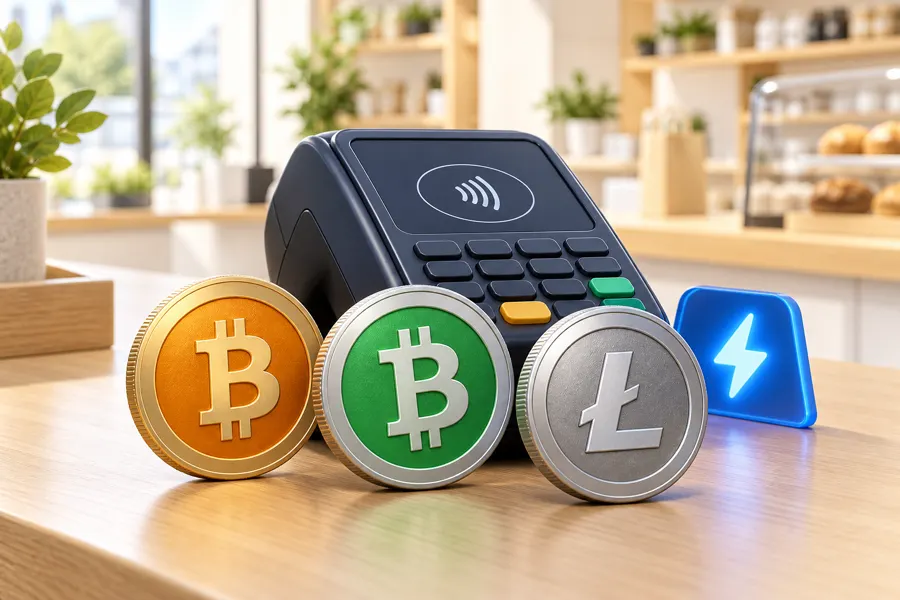
A coffee shop in Ljubljana doesn't care about your thesis on digital gold. It cares whether the payment clears before the next customer walks in. That's the entire test. Not market cap, not Twitter sentiment, not whichever coin your portfolio happens to be overweight in this month.
Cryptwerk's own merchant directory lists thousands of businesses accepting crypto, and the coin mix tells a story that most price charts don't. Bitcoin dominates by sheer name recognition. But Bitcoin Cash and Litecoin keep showing up in categories where speed actually matters: cafes, gift cards, hosting, VPN services. So which one wins when the question isn't "which coin will 10x" but "which coin gets goods into the customer's hands without both sides checking a block explorer for twenty minutes"?
Let's actually run the numbers.
Transaction Fees: The Only Metric Merchants Actually Feel
Bitcoin's base layer fee has been a moving target for over a decade. During quiet periods it can sit under a dollar. During congestion, and there's always congestion eventually, it's spiked past $30 in past cycles. A merchant selling a $12 item cannot absorb that. Full stop.
Bitcoin Cash was built specifically to solve this. Bigger blocks, fees that typically sit fractions of a cent, and settlement that doesn't choke under load. According to Bitcoin Cash Adoption Analytics on Cryptwerk, the category spread of BCH-accepting merchants skews heavily toward retail and digital goods, exactly the kind of high-frequency, low-ticket business where a $2 fee would kill margin.
Litecoin sits in the middle. Fees are low, usually a few cents, but not as consistently negligible as BCH. It's the compromise coin. Faster than Bitcoin, cheaper than Bitcoin, but without the fee floor that BCH has engineered into its block size policy.
Confirmation Speed: Where the Real Difference Shows Up
Here's the part most comparisons skip. Bitcoin averages a 10-minute block time, and merchants processing anything above a trivial amount usually want at least one or two confirmations before releasing goods. That's 10 to 20 minutes minimum. For a hotel booking, fine. For a hot food order, unworkable.
Litecoin cuts that to roughly 2.5 minutes per block. Bitcoin Cash keeps Bitcoin's 10-minute target but compensates with larger blocks and, increasingly, zero-confirmation acceptance for smaller amounts through tools built around Cash App's ecosystem and similar wallets.
None of them touch the sub-second experience of a Lightning Network payment riding on top of Bitcoin. Decrypt reported on Block's Lightning-powered Bitcoin merchant rollout, which effectively lets millions of Square sellers accept BTC without ever touching the slow base layer. That's the honest answer here: raw BTC is clunky for checkout, but Lightning-wrapped BTC is a different animal entirely.
Merchant Adoption: Numbers Over Narrative
Market cap says Bitcoin should win everywhere. Adoption data says otherwise. Cryptwerk's own Bitcoin Cash market listings show a merchant base concentrated in digital goods, hosting, and services where BCH's fee structure is a genuine selling point rather than a marketing line.
Litecoin's adoption curve looks different again. It's been around since 2011, longer than BCH, and it's earned a reputation as the "tested" alternative. Older merchants who added crypto payments back in 2015 or 2016 often kept Litecoin support even after adding newer coins, simply out of inertia and because it's never broken on them.
Bitcoin remains the default because customers ask for it by name. Nobody walks into a shop asking to pay in Bitcoin Cash. They ask for Bitcoin, and the merchant either has BTC support or explains why they're offering BCH instead. That branding gap is real and it's not closing anytime soon.
Stablecoins Are Quietly Changing the Whole Conversation
It would be dishonest to compare these three coins as if the merchant payments conversation ended there. It didn't. PYMNTS covered how stablecoins became genuinely useful for merchants through 2025, and the trend has only accelerated into 2026. USDT and USDC solve the volatility problem that BTC, BCH, and LTC all share: a merchant pricing goods in dollars doesn't want to check the exchange rate every hour.
That doesn't make BTC, BCH, or LTC irrelevant. It just means the three-way comparison in this piece is really a subset of a bigger shift. Oliver Wyman's analysis of stablecoin-driven merchant transactions makes the case that stable-value rails are becoming the default for recurring commerce, while volatile coins like the three compared here increasingly serve as the on-ramp rather than the final settlement layer.
Low-Fee Coins in High-Volume Entertainment Payments
This is where the fee and speed tradeoffs stop being theoretical. Entertainment platforms processing thousands of small transactions an hour face the exact same math a coffee shop does, just at higher volume and often with less patience for a slow confirmation. A ticketing platform, a streaming tip jar, a digital collectibles marketplace: all of them need a coin that clears fast and doesn't eat the transaction in fees.
Gaming and gambling platforms sit at the sharpest end of this problem because deposit and withdrawal frequency is so high. Plenty of operators in that space, including bitcoin online casinos, have gravitated toward the same fee-efficient rails that BCH and Lightning-wrapped BTC merchants rely on, precisely because a player cashing out $40 doesn't want $8 of it eaten by network fees. It's the identical calculation a market stall in Manila makes when it chooses BCH over base-layer BTC.
Gambling carries real financial risk, and anyone engaging with it should only wager money they can afford to lose (support is available through BeGambleAware.org for anyone concerned about their play). But the underlying payments lesson holds regardless of the platform: fee-efficient coins win in high-frequency environments, full stop.
Which Coin Actually Wins for Everyday Merchants
Bitcoin wins on brand recognition and now, thanks to Lightning integration, on speed too, provided the merchant has bothered to set it up. Bitcoin Cash wins on raw fee efficiency and predictable settlement for high-volume, low-ticket sales. Litecoin wins on maturity and consistency, the boring reliable option that's rarely the flashiest pick but rarely lets a merchant down either.
If pressed for one answer: for a small business processing frequent, low-value transactions in 2026, Bitcoin Cash still makes the most practical sense on fees alone. But it's not winning the popularity contest, and probably won't anytime soon. Merchants who want customer recognition without base-layer BTC's fee volatility should be looking hard at Lightning-enabled Bitcoin setups, not writing off BTC entirely.
eMarketer's rundown of 2025's crypto trends noted rising consumer comfort with crypto payments broadly, which suggests the winner in 2026 won't be decided by ideology. It'll be decided by whichever rail is invisible enough that customers stop thinking about it.
Frequently Asked Questions
Does Bitcoin Cash have lower fees than Bitcoin in 2026? Yes, consistently. BCH's larger block size keeps network congestion low, so fees typically sit at a fraction of a cent even during busy periods. Base-layer Bitcoin fees fluctuate far more and can spike sharply when network demand rises, which is the core reason merchants processing frequent small payments often prefer BCH.
Is Litecoin faster than Bitcoin for merchant payments? Litecoin's block time is roughly 2.5 minutes compared to Bitcoin's 10 minutes, so confirmations arrive noticeably quicker on the base layer. It's not as fast as Lightning-wrapped Bitcoin transactions, but for merchants without Lightning infrastructure, Litecoin offers a meaningful speed advantage over standard BTC.
Why do some merchants still prefer Bitcoin despite slower confirmations? Customer familiarity is the biggest factor. Shoppers recognize Bitcoin by name far more than any alternative, so merchants often keep BTC support even when Lightning setup takes extra effort, simply because turning away a customer asking for Bitcoin specifically costs more than the fee tradeoff.
Are stablecoins replacing BTC, BCH, and LTC for everyday payments? Not entirely, but they're reshaping the landscape. Stablecoins solve the price volatility problem that all three coins share, making them attractive for recurring purchases. Many merchants now use volatile coins as an entry point while settling in stablecoins, rather than choosing one over the other.
Which coin should a new merchant choose first? For most small businesses starting out, Bitcoin Cash offers the simplest low-fee, low-friction setup for frequent transactions. Merchants expecting higher customer demand for brand-name Bitcoin should pair BTC with a Lightning-enabled payment processor rather than relying on the slower base layer alone.
