
 BTC
BTC
 ETH
ETH
 LTC
LTC
 BCH
BCH
 DOGE
DOGE
 USDT
USDT
 DASH
DASH
 USDC
USDC
 XRP
XRP
 XMR
XMR
 TRX
TRX
 BNB
BNB
 SHIB
SHIB
 SOL
SOL
 DAI
DAI
 ZEC
ZEC
 ETC
ETC
 POL
POL
 ADA
ADA
 XLM
XLM
Banks, car dealers, payment firms and central banks are putting crypto and digital-currency payments into customer-facing channels.
The latest adoption news centres on the places where a payment starts: a banking app, a vehicle showroom, a merchant checkout or a payment-provider integration. Coinbase and Stablecore are offering community banks and credit unions a route to custody, trading and stablecoin payments without rebuilding their platforms. In Bolivia, Toyota distributor Toyosa has extended its vehicle-payment options to Bitcoin alongside USDT. Singapore's dtcpay has closed a funding round to develop its stablecoin merchant network, while the European Central Bank has invited online and mobile merchants to test a beta digital euro. The products do not share one settlement rail or regulatory model. They do show how payment providers are bringing digital assets into services that customers and businesses already use. Merchants weighing how to accept crypto payments as a merchant need to assess the provider, custody model, supported assets and local payment rules together.
Coinbase and Stablecore Connect Community Banks to Custody, Trading and Stablecoin Payments
Coinbase partnered with Stablecore to give community and regional U.S. banks and credit unions a way to offer crypto custody, trading and stablecoin payments through their existing banking platforms. Coinbase's announcement says Stablecore's integration footprint could reach more than 3,000 institutions. Amarillo National Bank is already among the financial institutions working with the partnership.
The model puts a bank in front of the customer while Coinbase provides the digital-asset layer behind the service. Each institution still decides which functions it will offer and which customers can use them. The announcement does not mean that every connected bank has switched on all features. It does give smaller institutions a route to assess crypto services without building separate custody and trading stacks. Customers comparing crypto finance services will need to check their own bank's rollout, account conditions and asset availability.
Toyosa Adds Bitcoin to Toyota Purchases in Bolivia Alongside Its USDT Payment Option
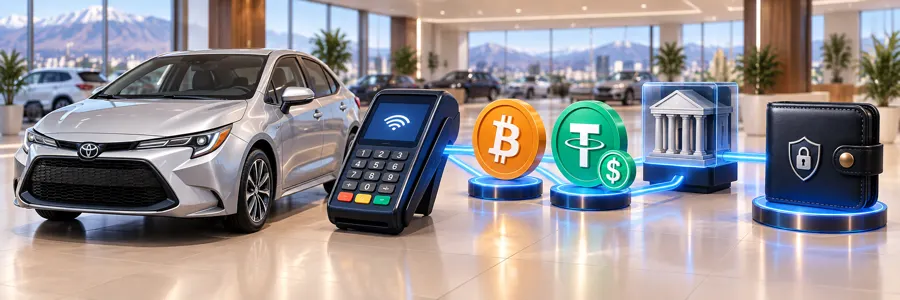
Toyosa, Toyota's distributor in Bolivia, has added Bitcoin to its vehicle-payment options alongside USDT. The company already provides a dedicated USDT payment flow for vehicles, parts and services. That page identifies Towerbank as its financial partner and BitGo as the digital-asset infrastructure provider, and it guides customers through selecting a network and scanning a QR code at the dealership.
Adding Bitcoin gives buyers a second crypto asset at a high-value physical purchase. The payment still needs a quoted vehicle price, a supported network and a compliant handoff to the dealer. Those details matter more than the headline claim that a car can be bought with crypto. The rollout gives prospective buyers a concrete example of a retail business adding payment choices beyond a traditional bank transfer or card. Other shops accepting cryptocurrency may face the same decisions around settlement speed, price conversion and refund handling.
dtcpay Closes a $25 Million Round With SBI to Expand Its Merchant Stablecoin Network

Singapore-based dtcpay completed a $25 million Series A round with SBI Group joining as a strategic investor. In its funding announcement, dtcpay said it will use the capital to expand its product suite and merchant network, including a revised enterprise portal and consumer functions in its app. Vertex Ventures Southeast Asia & India led the initial tranche earlier this year.
The funding supports work that merchants rarely see at checkout: business onboarding, settlement operations, payment integrations and support. dtcpay already offers stablecoin payment tools for businesses, so the round concerns scale rather than the release of one new checkout feature. A merchant can compare the company with other crypto payment gateways by checking supported assets, settlement currency, regional availability and contractual terms. The company also references a stablecoin-to-fiat Visa card for customers in Singapore, placing the merchant network beside a familiar spending route through crypto cards.
The ECB Opens Its Digital-Euro Pilot to Online and Mobile Merchants for 2027 Testing
The European Central Bank opened applications for euro-area e-commerce and mobile-commerce merchants to join its digital-euro pilot. The ECB call says selected businesses will test beta digital-euro payments in remote-commerce settings and help validate the payment experience and operational processes. Merchants must establish or adapt a relationship with an acquiring pilot payment-service provider.
The 12-month pilot is planned for the second half of 2027, and it does not mean the digital euro has been issued. The ECB still ties any issuance decision to the required European legislation. The event belongs in a crypto-payment roundup because it tests the merchant-acceptance layer: acquiring, checkout design and business operations. It also gives payment providers a visible benchmark for the systems they must connect when public and private digital-money options reach the same checkout. Businesses that already offer Bitcoin payments can use the pilot's requirements to compare their existing acceptance process with a central-bank-led model.