
 English
 Español
 Français
 Português
 BTC
 ETH
 LTC
 BCH
 USDT
 DOGE
 DASH
 USDC
 XRP
 XMR
 TRX
 BNB
 SHIB
 SOL
 DAI
 ZEC
 ETC
 POL
 ADA
 XLM
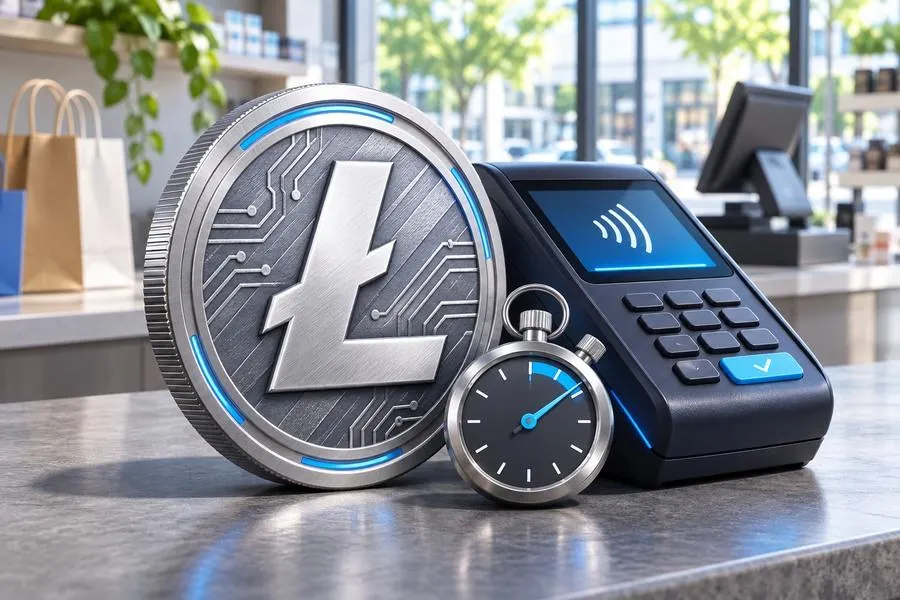
Fifteen years is a long life for a cryptocurrency.
Litecoin went live on October 13, 2011, built by Charlie Lee as a faster, cheaper sibling to Bitcoin, and by its anniversary this October the network had processed more than 416 million transactions without a single reported outage. Lee marked the occasion with a statement that could double as a mission brief: "When I launched Litecoin in 2011, I wanted to build a faster, cheaper network for everyday transactions. Fifteen years later, that's still the job."
The numbers behind that claim look sturdy at first glance. The Foundation reported more than a million transactions a week through 2026, including 4.9 million in September alone, with average fees between $0.003 and $0.01. Market capitalization stood around $5 billion at the anniversary. If you want a second opinion on the fee story, check out these sites and compare: CoinShares put the average Litecoin transaction at $0.005 as of February 2025, against $0.96 for Bitcoin, $0.70 for Ethereum, $0.05 for Avalanche, and $0.01 for Solana. Cheap is cheap, whichever way you slice it.
The Speed Case, and Where It Cracks
The core pitch has never changed. Blocks arrive roughly every 2.5 minutes against Bitcoin's 10, a comparison Fidelity repeats in its own educational material. Litecoin was designed as an altcoin for improved speed and cost, and on the base layer it still delivers both. Its own website touts sub-cent fees and settlement it calls almost instantaneous, though that phrase deserves some skepticism; a 2.5-minute block interval is fast for a proof-of-work chain, but "almost instantaneous" is doing promotional work there.
The problem is that the competition moved. CoinShares points out that Lightning Network development erased much of Litecoin's historical speed edge over Bitcoin, since Bitcoin payments can now settle in seconds with sub-cent fees off-chain while keeping Bitcoin's larger network and brand. Fidelity goes further, noting that other cryptocurrencies process transactions in seconds outright, and that Litecoin has not achieved Bitcoin's level of adoption. TRON and Solana beat it on speed and cost too, according to an August 2026 report on Litecoin withdrawals. It has never actually been the fastest or cheapest rail available. What it has is support almost everywhere, which the same report calls a different kind of advantage.
That advantage is real but narrower than the anniversary press materials suggest. The practical use case, per that report, is moving value between platforms where both endpoints support LTC: cheaper than Bitcoin, more predictable than Ethereum, settling faster than either. It also fills gaps where stablecoins are unavailable on a particular route, though it carries price volatility in transit that a dollar-pegged instrument does not. Anyone who has moved funds between exchanges knows this rhythm. Litecoin as plumbing, not as a destination.
Relevance, Measured Honestly
Here is where the story gets uncomfortable. BitQuery's on-chain analysis, published in late October, found Litecoin averaging 260,072 active addresses per day in September 2026, its lowest monthly figure since October 2023. The same analysis notes the network carries 4.5 times as many transactions as Dogecoin and Dash combined, and still settles a steady stream of small payments, most under $100, for fees that are a fraction of a cent. But the trajectory is shrinking, not growing. Low cost alone does not prove expanding adoption; it can just as easily describe a habit fading slowly.
The economics underneath raise their own question. Miners collected roughly $14,000 in total fees for the entire month, per BitQuery's estimate. Celebrate the near-zero user fees all you like, but a security budget that thin is a long-term question nobody in the promotional material answers.
Payment-processor data cuts both ways. BitPay reported that Litecoin accounts for over 25% of all cryptocurrency payments it processes, with average miner fees under a penny, which is genuinely impressive until you remember it describes one processor's book of business, not the network as a whole. No independent, network-wide merchant or payment-processor figures were available to confirm broader adoption. The Motley Fool, writing in The Globe and Mail back in July, put the sharpest version of the doubt plainly: survival and relevance are two very different things in the crypto market. Stablecoins, Lightning, and newer chains now serve the everyday-payment job Litecoin was built for, often faster and without the volatility.
So is it still relevant? My read: yes, but only in the narrow sense. The network runs, it is cheap, it is listed nearly everywhere, and it remains a dependable intermediate rail for shifting value between platforms. Kanalcoin's May analysis framed it similarly, a specialized tool rather than a dominant payment currency, with real-world Lightning adoption uneven enough that Litecoin's predictability still counts for something. What it is not, on current evidence, is a growing payments network. Fifteen years without downtime is an achievement, but it is not the same thing as a future.
