
 BTC
BTC
 ETH
ETH
 LTC
LTC
 BCH
BCH
 DOGE
DOGE
 USDT
USDT
 DASH
DASH
 USDC
USDC
 XRP
XRP
 XMR
XMR
 TRX
TRX
 BNB
BNB
 SHIB
SHIB
 SOL
SOL
 DAI
DAI
 ZEC
ZEC
 ETC
ETC
 POL
POL
 ADA
ADA
 XLM
XLM

A major poker tournament can look out of reach when the entry fee costs hundreds or thousands of dollars. Satellite tournaments change that equation. Instead of paying the full buy-in, players compete for a much smaller entry fee with the chance to win a seat in a larger event.
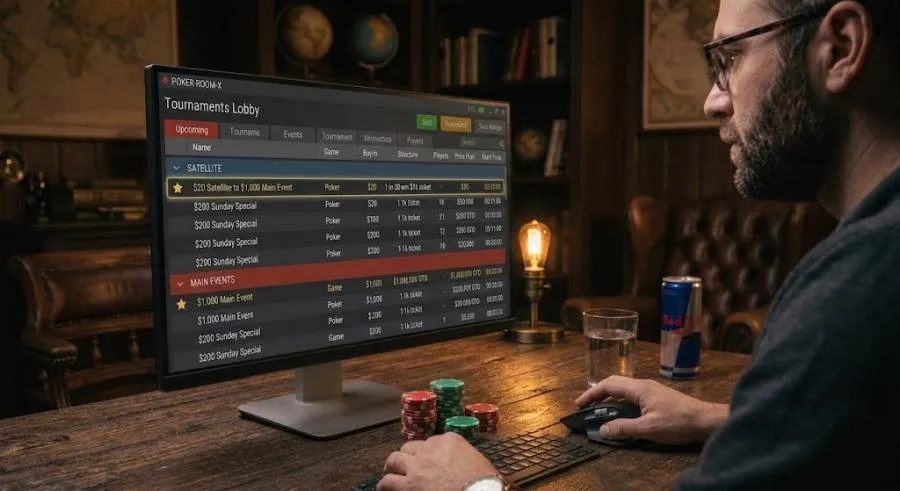
That makes BCPoker satellite tournaments particularly interesting for players who want to test themselves in bigger fields without committing a major part of their bankroll to one tournament. The route is not easy, and there is no guarantee of qualification, but the structure gives players an alternative to paying the full price from the start.
What Is a Poker Satellite Tournament?
A satellite is a tournament in which the main prize is usually an entry to another, more expensive tournament. Rather than competing primarily for a cash prize, players are trying to secure a seat.
For example, imagine a major online tournament with a $1,000 buy-in. An operator might run a $20 satellite where the winner receives a $1,000 tournament entry. Depending on the structure, several players could receive seats instead of just one.
This is the basic idea behind a satellite qualifier poker format: a smaller event acts as a qualification stage for a larger one.
The appeal is obvious. A player who would never be comfortable spending $1,000 on a single tournament can potentially reach the same event through a much smaller initial investment. The catch is that the satellite itself can attract plenty of competition, so the low buy-in should not be confused with an easy path.
How Satellite Tournaments Work in Poker
The mechanics are generally straightforward. A satellite has its own buy-in and prize structure, with prizes linked to the target tournament. Take a $25 satellite with 100 players competing for three seats into a $1,000 tournament, plus possibly some smaller cash prizes for those who don't qualify.
If three seats are available, the tournament doesn't necessarily reward players the same way a conventional event would. Once qualification gets close, accumulating chips and simply surviving can matter more than chasing every possible pot.
The exact rules vary between tournaments. Some satellites award a single seat, while larger fields may distribute several entries. Others use multiple qualification stages, letting players enter an inexpensive feeder event and progress to another satellite before reaching the main tournament.

Online Poker Satellites Make the Route More Accessible
The growth of online poker satellites has made this format particularly convenient. Players do not necessarily need to travel to a casino or poker festival just to attempt qualification. A satellite can be played from home, often alongside other online tournaments.
Online satellites also make it possible to experiment with different buy-in levels. A player might start with a small feeder event, gain experience with satellite structures, and gradually move toward more competitive qualification tournaments.
That progression can be useful because satellite play requires a slightly different mindset from a standard tournament.
Why Satellite Strategy Is Different
In a normal tournament, chips have a relatively direct relationship with your ability to accumulate prizes. In a satellite, the relationship changes once enough chips have been collected to put a player in a strong qualifying position.
Suppose a satellite awards five seats and you are sitting with a large stack while several opponents are close to elimination. Calling a marginal all-in may not make sense even if you believe you have the better hand. Losing could destroy your chance of qualifying, while winning may add chips that provide little additional practical benefit.
This is where poker satellite strategy becomes particularly important.
Players need to consider more than the strength of their cards. Stack sizes, the number of remaining players, the number of available seats, and the stacks of opponents all affect the value of taking a risk.
Playing for a Seat Instead of a Cash Prize
One of the biggest adjustments is psychological.
In a regular tournament, finishing second instead of first can mean a substantial difference in prize money. In a satellite, the difference between finishing in a qualifying position and finishing just outside it can be much more significant than the difference between having the largest stack and the second-largest stack.
A useful satellite mindset includes:
- Watching how many seats remain available.
- Comparing your stack with opponents who are close to qualification.
- Avoiding unnecessary confrontations when survival has greater value.
- Applying pressure to shorter stacks when the situation allows it.
- Remembering that chips are a means to qualification, not the final objective.
This does not mean folding every playable hand. A short stack still needs opportunities to build a stack, and waiting indefinitely can leave too little room to manoeuvre. The important point is that the value of risk changes as qualification approaches.
The Real Cost of a “Cheap” Entry
Satellites are often described as a cheap way into poker tournaments, but that phrase needs some qualification.
A $20 satellite does not mean a player can reliably enter a $1,000 tournament for $20. The majority of participants will not receive the target seat, and repeated attempts can add up quickly.
Players should therefore treat satellite buy-ins as genuine tournament expenses rather than assuming the low entry price removes financial risk.
It is also important to check exactly what the prize provides. A seat may cover the tournament entry but not travel, accommodation, additional fees, or other expenses associated with attending a live event. Online tournaments may have fewer such complications, but their individual terms still matter.
Satellites Are About Opportunity, Not a Shortcut
The biggest attraction of satellites is the opportunity they create. They give recreational and developing players access to tournaments that might otherwise sit outside their normal bankroll. Tools like the BC Poker app make it easier than ever to find and register for satellites that fit your schedule and budget.
At the same time, satellites reward discipline. A player cannot simply enter a cheap qualifier and expect to reach the main event. Variance remains part of tournament poker, and even strong decisions can end with elimination.
The best way to win a seat poker satellite players can rely on is to treat each event as its own tournament with its own strategic demands — learn the payout structure, understand how many seats are available, monitor stack sizes, and adjust the level of risk as qualification gets closer.
Conclusion
Satellite tournaments have changed the way players can approach major online poker events. Instead of treating a large buy-in as the only route to a prestigious tournament, players can use smaller qualifying events to compete for a seat.
Understanding how satellite tournaments work poker formats, recognising the difference between accumulating chips and securing qualification, and adapting strategy around stack sizes can make the experience far more informed.
Satellites are not guaranteed shortcuts, but they offer something valuable: access. For players willing to accept the competition and variance, a relatively small tournament entry can create a realistic opportunity to sit in an event that would otherwise be financially out of reach.