
 English
 Français
 Español
 Português
 BTC
BTC
 ETH
ETH
 LTC
LTC
 BCH
BCH
 USDT
USDT
 DOGE
DOGE
 DASH
DASH
 USDC
USDC
 XRP
XRP
 XMR
XMR
 TRX
TRX
 BNB
BNB
 SHIB
SHIB
 SOL
SOL
 DAI
DAI
 ZEC
ZEC
 ETC
ETC
 POL
POL
 ADA
ADA
 XLM
XLM
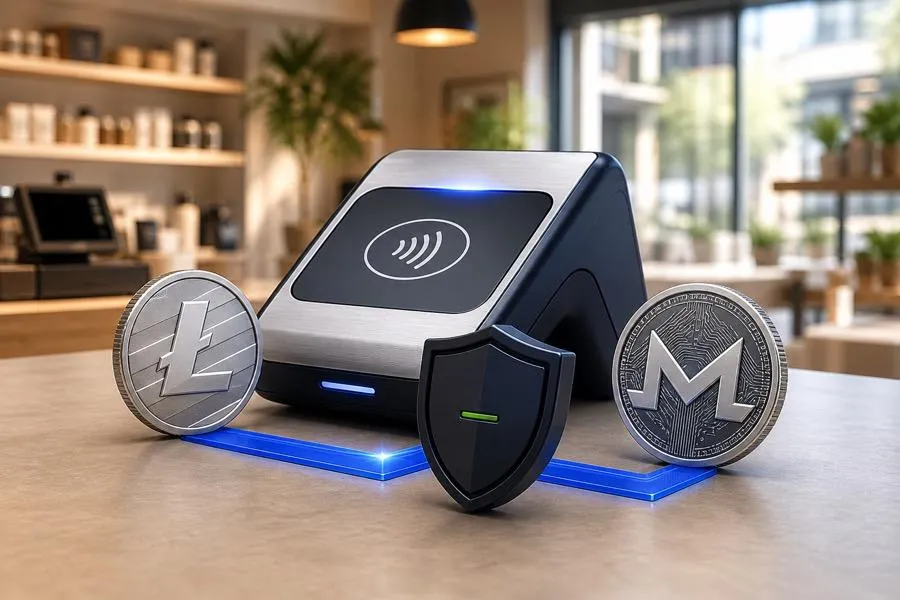
Litecoin and Monero approach crypto payments from very different technical starting points. LTC has broad payment support and established liquidity, while XMR makes transaction privacy part of the protocol itself. For users and merchants in 2026, the choice comes down to how much payment access and privacy each use case requires.
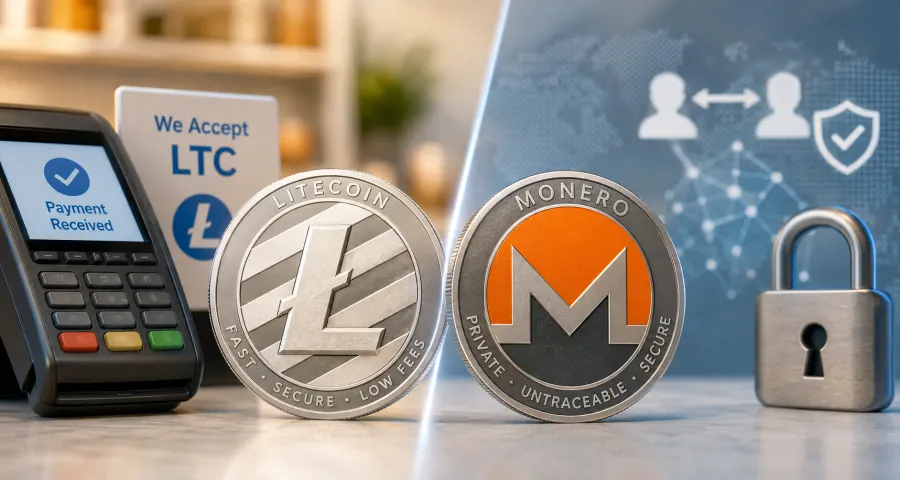
Litecoin vs Monero for Payments in 2026
Litecoin has been used for payments since 2011 and targets a new block roughly every 2.5 minutes. Its payment ecosystem includes wallets, exchanges and processors that have supported LTC for years. BitPay, for example, supports Litecoin for merchant payments and settlement.
This creates a familiar payment flow. A customer can pay in LTC, the processor can confirm the transaction and the merchant can choose how to receive the proceeds. A business that accepts LTC does not necessarily need to keep LTC on its balance sheet.
The same infrastructure also matters when users move between payment assets. Someone receiving LTC for an ordinary transaction may later need a privacy-focused asset for a different payment. An exchange LTC to XMR route through ChangeNOW can handle that conversion without requiring the two payment situations to use the same asset.
Monero starts from a different assumption. Its standard transactions use ring signatures, stealth addresses and RingCT to conceal the sender, recipient and amount. Privacy is therefore part of the ordinary XMR payment rather than a separate transaction mode.
That changes the use case. A supplier payment can reveal an invoice value on a transparent blockchain. A personal payment can reveal information about a user's spending history. Monero is designed to keep those details out of ordinary public-chain analysis.
Litecoin Payments: Speed, Fees and Merchant Settlement
Payment Speed and Confirmation
Litecoin's 2.5-minute block target is useful for payments because a merchant does not have to wait as long between blocks as it would on Bitcoin's 10-minute schedule.
The block interval still does not determine when a payment is considered final. A merchant selling a low-value item may accept a transaction with limited confirmation requirements. A business handling a large invoice can wait longer before releasing goods or treating the payment as settled.
That distinction matters more than the headline block time. A faster block schedule can shorten the confirmation process, while the merchant still controls the risk tolerance around a particular transaction.
Transaction Fees and Total Payment Cost
Litecoin has historically been inexpensive to transact with. Litecoin documentation has described average transaction fees below one cent, although the amount depends on network conditions and transaction size.
The blockchain fee is only one part of the cost for a merchant. A processor can charge a service fee, while converting LTC into fiat can introduce a spread. Withdrawal and settlement terms can also affect the final amount received.
Consider a simple retail payment. A customer pays $500 worth of LTC. The merchant may never hold the coins for long enough to take meaningful market exposure because the processor converts the payment during settlement. In this case, the relevant cost is the combined processing and conversion expense rather than the Litecoin network fee alone.
Merchant Support and Fiat Settlement
BitPay provides a concrete example of how this works. Its payment infrastructure supports LTC and offers merchants different settlement choices, including local currency.
This changes the role Litecoin plays on the merchant side. The business can offer a crypto payment method while keeping its accounting and treasury operations in fiat. The customer gets the option to pay with LTC, while the merchant can avoid making a long-term decision about holding the asset.
For a merchant evaluating Litecoin, the practical checklist is fairly short:
confirmation requirements for the transaction value;
processor and conversion fees;
available settlement currencies;
exposure to LTC price movements;
service availability in the merchant's jurisdiction.
These factors determine the payment experience more directly than network specifications viewed in isolation.
Monero Privacy and Litecoin MWEB
Why Monero Privacy Changes the Payment Use Case
Monero's privacy architecture covers the main pieces of information that public blockchains usually expose. Ring signatures make it difficult to identify the actual spender among possible signers. Stealth addresses create one-time destinations. RingCT hides transaction amounts.
The result is a ledger that gives an outside observer far less information about an ordinary payment.
Fungibility follows from the same design. On a transparent blockchain, the history associated with an output can remain visible and may be examined by businesses or compliance systems. Monero makes that type of transaction-history screening considerably harder because the public ledger does not reveal the same information about individual payments.
For a private P2P transfer, this can be the deciding factor. A user sending money to another person may care more about transaction confidentiality than processor support or fiat settlement.
A regulated merchant faces a different calculation. Privacy can protect commercially sensitive information, yet businesses operating under transaction-monitoring rules may need to account for the limited information available from the blockchain.
What Litecoin MWEB Adds
Litecoin's MimbleWimble Extension Blocks provide an optional privacy route. Users can move LTC into MWEB and make transactions with additional confidentiality, while ordinary Litecoin transactions remain transparent.
That makes MWEB useful for users who want more privacy without making every Litecoin transaction private. It also creates a practical distinction from Monero. A Litecoin user has to choose the MWEB route. Monero applies its privacy architecture to standard transactions.
MWEB also faced a serious security test in 2026. Litecoin developers reported an exploited validation vulnerability involving an MWEB peg-out of more than 85,000 LTC. The affected funds were largely recovered and fixes were released. A subsequent invalid-chain event was also removed through a reorganization.
The incident does not provide a basis for judging the security of the entire Litecoin network. It does show why an optional privacy layer deserves separate scrutiny when it is considered for payment use.
Regulation, Stablecoins and Payment Adoption
The difference between Litecoin and Monero becomes more visible when a user needs access to regulated services.
Kraken stopped XMR trading and deposits for clients in the European Economic Area on October 31, 2024, citing regulatory changes. The case matters because the underlying Monero network continued operating. What changed was the user's access to a major regulated intermediary.
For someone who acquires XMR through a regulated exchange and later converts it into another asset, that access can be part of the payment workflow. A restriction at any point in the chain can make the asset harder to use even when the blockchain itself remains available.
The wider payment market adds another complication. Stablecoins are becoming a significant settlement option for businesses that want digital transfers without taking direct exposure to the price of a volatile asset. Current crypto payment coverage also points to closer links between stablecoins, financial applications and cross-border settlement. These crypto payment trends give merchants another reason to compare payment assets on settlement terms rather than transaction speed alone.
For a business invoicing in dollars, this can be decisive. LTC can provide a low-cost crypto payment rail, while a stablecoin can keep the payment value closer to the invoice value. XMR adds privacy, yet its regulatory accessibility can be more limited.
Three 2026 Scenarios
Base case. Litecoin keeps a broader merchant role through processors, wallets and exchanges. Monero continues to serve users who value private P2P payments, with access to regulated services varying by jurisdiction. Stablecoins continue to attract merchants that prioritize predictable settlement.
Optimistic case. Litecoin gains additional merchant usage as payment infrastructure becomes easier to integrate. Monero benefits if regulators and payment providers establish clearer frameworks for privacy-preserving transactions.
Stress case. Stablecoins capture more merchant settlement volume while additional regulated platforms restrict XMR. Litecoin keeps stronger infrastructure access, although merchants may still favor stablecoins when price stability matters more than the properties of a native crypto asset.
Which Is Better for Payments in 2026?
There is no single winner across every payment scenario.
For a merchant that wants an established processor, low network fees and the option to settle outside the asset, Litecoin currently has the stronger case. Its payment infrastructure is easier to fit into a conventional checkout and settlement process.
For a private P2P transfer, Monero has the stronger technical fit. Sender, recipient and amount receive protection by default, and the public ledger offers much less information for transaction-history analysis.
A third situation changes the comparison again. A business that cares primarily about predictable invoice value may prefer a stablecoin over either LTC or XMR.
The useful distinction in 2026 is therefore practical. Litecoin is better positioned for broad merchant payments. Monero makes more sense when payment privacy is itself a requirement. Neither asset removes the need to consider settlement, regulation or price exposure before choosing a payment method.
FAQ
Can a merchant accept Litecoin without holding it?
Yes. Payment processors such as BitPay can handle the payment and provide settlement options that allow a merchant to receive local currency rather than retain LTC.
Does a 2.5-minute Litecoin block mean instant payment?
No. The block interval affects how often transactions can be confirmed. Merchants still decide how many confirmations they require for a particular payment.
Are Litecoin's low network fees the full cost of a payment?
No. Processor charges, conversion spreads and settlement costs can affect the amount a merchant ultimately receives.
Why would someone choose Monero for a payment?
Privacy can be the main reason. Monero's standard transaction design hides information that would remain visible on a transparent blockchain.
Is MWEB equivalent to Monero privacy?
No. MWEB is an optional Litecoin privacy layer. Monero applies its privacy mechanisms to standard transactions.
Does Monero's privacy affect merchant adoption?
It can. Regulated businesses may need transaction information for compliance processes, while Monero is specifically designed to make much of that information unavailable on the public ledger.
Can Litecoin be used for private payments?
Yes, through MWEB. Standard Litecoin transactions remain transparent.
Are stablecoins a stronger payment option for some merchants?
Yes. Businesses that prioritize predictable settlement value may prefer stablecoins because they reduce direct exposure to the price movements of LTC or XMR.
Disclaimer
This article is for informational purposes only and does not constitute financial, investment, legal or tax advice. Cryptocurrency networks, payment services and regulatory requirements can change. Readers should verify current information and assess their own circumstances before making decisions involving digital assets.
