
 BTC
BTC
 ETH
ETH
 LTC
LTC
 BCH
BCH
 DOGE
DOGE
 USDT
USDT
 DASH
DASH
 USDC
USDC
 XRP
XRP
 XMR
XMR
 TRX
TRX
 BNB
BNB
 SHIB
SHIB
 SOL
SOL
 DAI
DAI
 ZEC
ZEC
 ETC
ETC
 POL
POL
 ADA
ADA
 XLM
XLM

Crypto users often need two things that traditional exchanges do not solve well: a direct way to swap assets across networks and a way to put idle tokens to work without handing custody to a platform. YiFi Swap routes trades across CEX, DEX, and private rails to find a competitive route for a given pair. YiFi Private Swap routes swaps through two off-chain partners and an intermediate asset to make sender and receiver wallets unlinkable on-chain.
A standard swap requires a receiving address rather than an account. YiFi Earn is a non-custodial DeFi yield layer that uses one-click deposits to enter on-chain strategies while approvals go to the underlying protocol contracts. YiFi Earn has its own data layer that collects strategy metrics formatting raw blockchain-level data, and represents it in strategy interfaces or provides it via API.
What Is YiFi and How Does It Work?
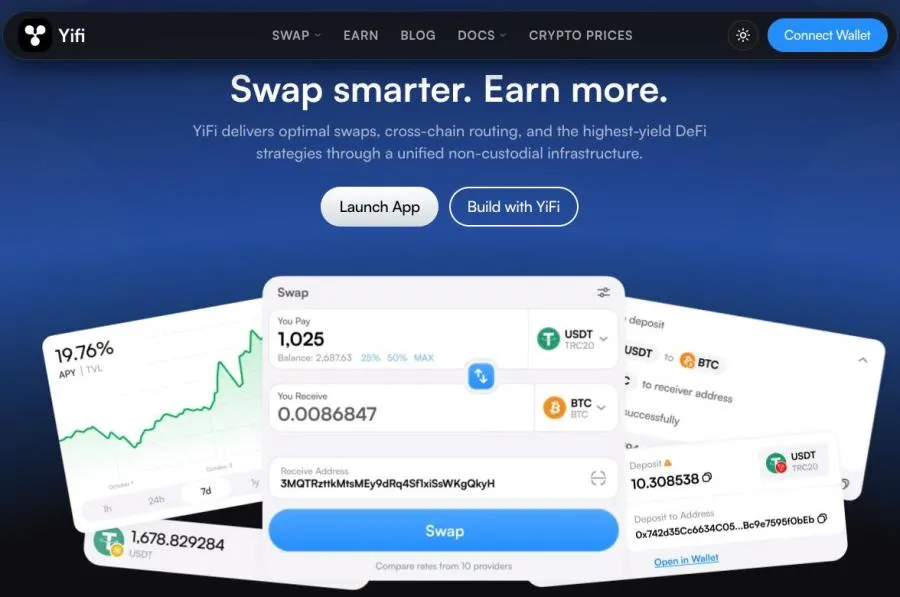
YiFi combines two product lines under one non-custodial model: YiFi Swap and YiFi Earn.
YiFi Swap continuously compares quotes across CEX, DEX, and private partners for every pair and routes the trade through whichever one returns the best price at that moment – the user isn't locked into one rail by default. For pairs where the sender and receiver wallets shouldn't be linkable on-chain, that same routing layer can send the trade through two off-chain partners and an intermediate asset instead of a direct transfer.
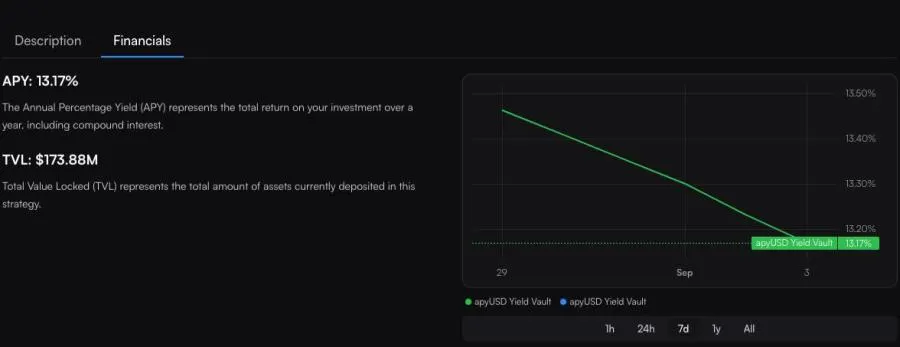
YiFi Earn gives users a single place to compare and choose yield strategies. For each strategy, YiFi pulls APY, TVL, and other metrics directly from the chain, analyzes them, and curates the result into a public strategy catalogue. Once a wallet deposits, Earn tracks that position's yield, accumulated returns, and transaction history in real time.
The platform should be viewed as a routing layer rather than a custodian. In the Swap product, user provides a destination address and that’s enough to perform crypto exchange, he doesn’t necessarily need to create an account. In Earn, protocol approvals are granted to the underlying smart contracts instead of YiFi.
Non-Custodial by Design: What YiFi Never Touches
YiFi does not hold swap funds in custody or require an account for a standard swap. For CEX-rail and Private swaps, funds may pass through partner exchange wallets on the way to the receiving address – but they never rest in YiFi's custody at any point in the route.
The same principle applies to Earn. YiFi does not receive user approvals for the deposited assets. Approvals are granted to the relevant protocol contracts, while private keys and withdrawal rights remain outside YiFi.
This distinction is visible at the wallet level. Users can inspect which contracts receive approvals before interacting with a strategy. The architecture makes YiFi a routing and aggregation layer rather than a wallet holding customer assets.
YiFi Swap: How Private Routing Works

YiFi Private Swap is designed for cases where a user needs to move from one asset to another without creating a direct, easily readable on-chain path between the source and destination wallets.
The route uses two off-chain partners and an intermediate asset on a separate network. The first part of the transaction moves assets toward the routing process. The intermediate leg then breaks the direct blockchain relationship between the sender and receiver. The final leg sends the target asset to the destination wallet.
This architecture matters because privacy comes from the structure of the route rather than from pooling customer deposits. The service does not need to hold a shared pool of user funds to create the separation.
Private Mode vs Stealth Mode: Which to Choose?
YiFi provides two routing modes with different tradeoffs.
Private mode is the stronger choice when the routing model itself is the main requirement. The Monero hop adds an additional privacy layer through Monero’s transaction model, including stealth addresses and ring signatures. The tradeoff is time and potential volatility during the XMR leg.
Stealth mode is more appropriate when execution speed matters more. It avoids the same XMR volatility exposure, but its privacy assumptions rely more heavily on the opacity of centralized liquidity venues.
For users specifically moving BTC to XMR, Private mode is the more relevant option. For a faster stablecoin-based route, Stealth mode provides a simpler path.
Supported Coins and Popular Pairs
The reason to use a swap service is often the pair itself. BTC to XMR is a good example because direct XMR liquidity is less widely available on centralized exchanges than it once was, and users can encounter exchanges where the asset or a direct pair is unavailable.
YiFi’s Private Swap supports major assets and cross-chain routes, with the platform currently stating coverage of 20,000+ assets across 200+ networks.
For exact pair availability, the relevant route pages can be used within the discussion of each pair, including BTC, XMR, ETH, ZEC, XRP, LTC, USDT, USDC, and more.
How to Swap BTC to XMR on YiFi
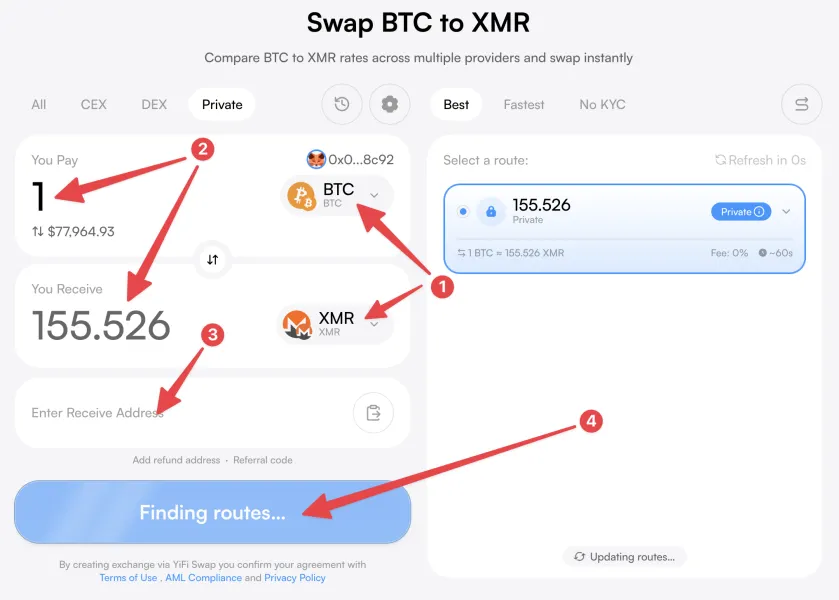
A BTC to XMR swap starts with the destination wallet rather than an account registration flow.
The user selects BTC as the source asset and XMR as the target, enters the receiving address, reviews the quoted route, and sends the required BTC.
The transaction then passes through the routing architecture before XMR is delivered to the destination address. Users should allow for blockchain confirmation time on both ends.
How Long a Private Swap Takes
YiFi’s stated overall range is 3 to 15 minutes, but individual pairs can take longer because confirmation times depend on the source and destination networks.
USDT on TRON is typically around 1 to 2 minutes, while BTC and XMR can require 10 to 30 minutes depending on confirmation conditions.
A quoted 3 to 15 minute average should therefore not be read as a guarantee for every pair. A BTC to XMR transaction can take longer than a fast stablecoin route.
The six median values should be supplied by the product team for both Private and Stealth routing where both modes support the pair. They should not be estimated from the general 3 to 15 minute range.
What a Private Swap Costs
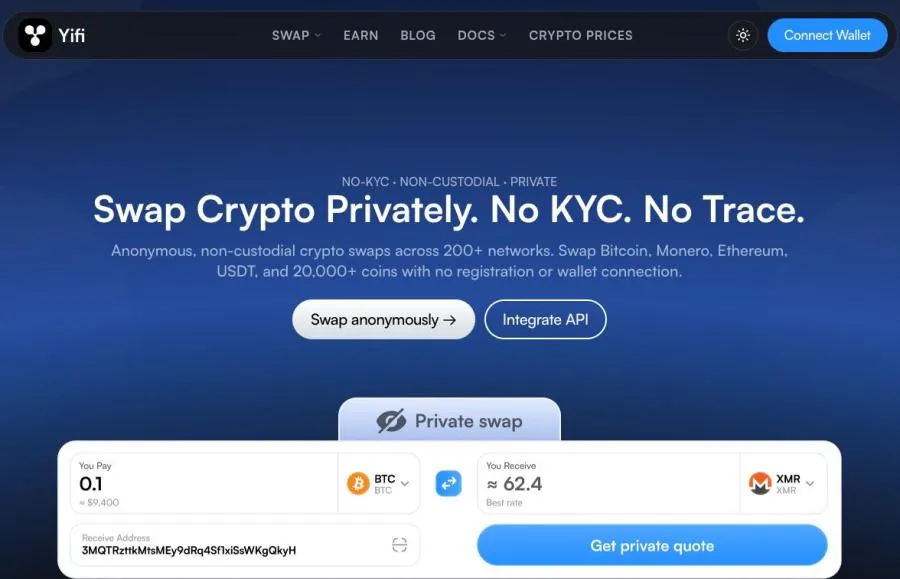
Alt: "YiFi private swap form for BTC to XMR"
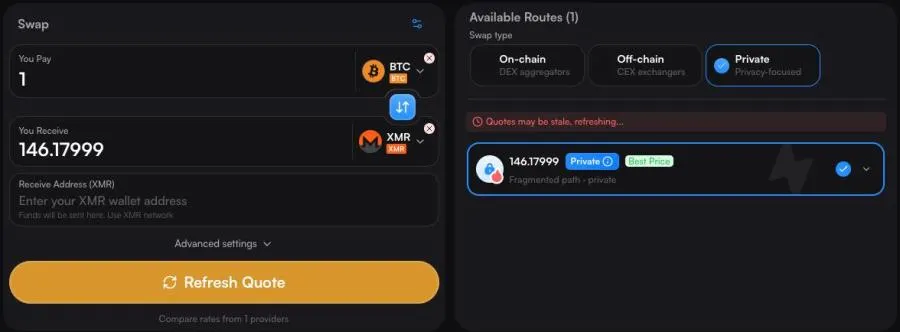
Alt: "BTC to XMR quote screen on YiFi"
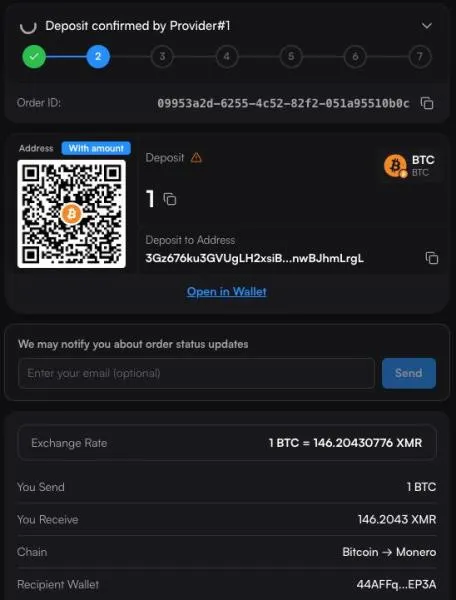
Alt: "YiFi swap status tracking page"
YiFi does not add a platform fee on top of the partner rate; network fees still apply.
One Non-Custodial Stack, Two Entry Points
YiFi Private Swap and YiFi Earn solve different problems, but their underlying relationship with the user is the same. YiFi acts as a router and aggregator rather than a custodian.
Consider a user who swaps BTC into USDT through a private route and receives the USDT in their own wallet. The assets can stay there, or the user can move them into a DeFi strategy through YiFi Earn.
The second step does not require transferring the assets into YiFi custody. A Zap can combine the required swaps, bridges, and deposits into a single transaction, while approvals go to the underlying protocol contracts.
That is the practical connection between the two products. One handles the private movement of assets. The other handles access to DeFi yield while maintaining the same non-custodial model.
YiFi Earn: How DeFi Yield Works Here
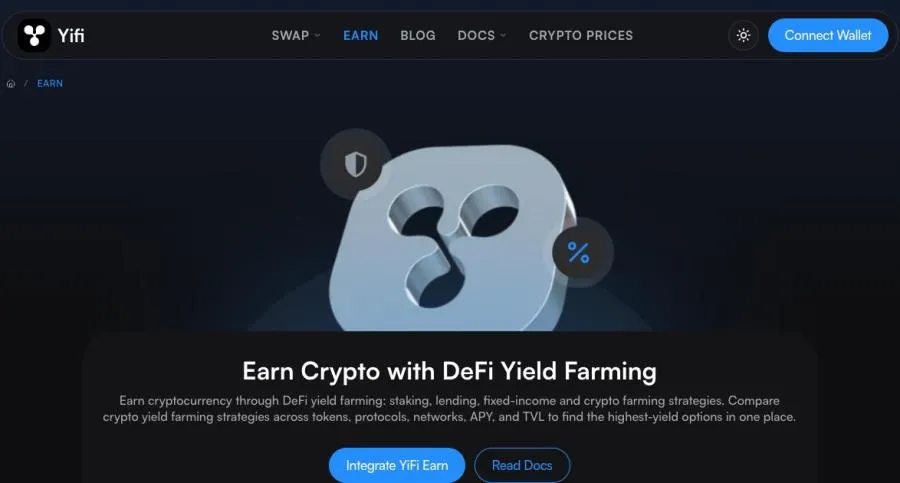
Source: YiFi Earn
YiFi Earn is a DeFi yield aggregator. The product brings protocol strategies into a single interface and simplifies entry into those strategies through one-click deposits.
The underlying return is determined by the DeFi protocol and its strategy composition, not by YiFi. APY is variable and can change as market conditions and protocol parameters change.
Strategy Catalogue: Protocols, APY and TVL
The Earn catalogue includes strategies built around protocols such as Aave, Lido, and Morpho. The exact set of currently active strategies, supported chains, assets, APY values, and TVL should come from the current client export.
What a Zap Is and What It Costs
A Zap combines several DeFi actions into one transaction. Instead of manually swapping, bridging, approving, and depositing through separate interfaces, the user reviews a single route and confirms it.
The Zap fee is stated as 0.3% to 0.5%, depending on the strategy, and the fee is shown before confirmation.
For a $10,000 deposit, a 0.3% Zap fee equals $30.
The route also exposes the expected transaction path before confirmation, and slippage can be constrained by the user’s selected parameter.
The Zap fee is separate from underlying protocol and network costs.
How to Exit a Strategy
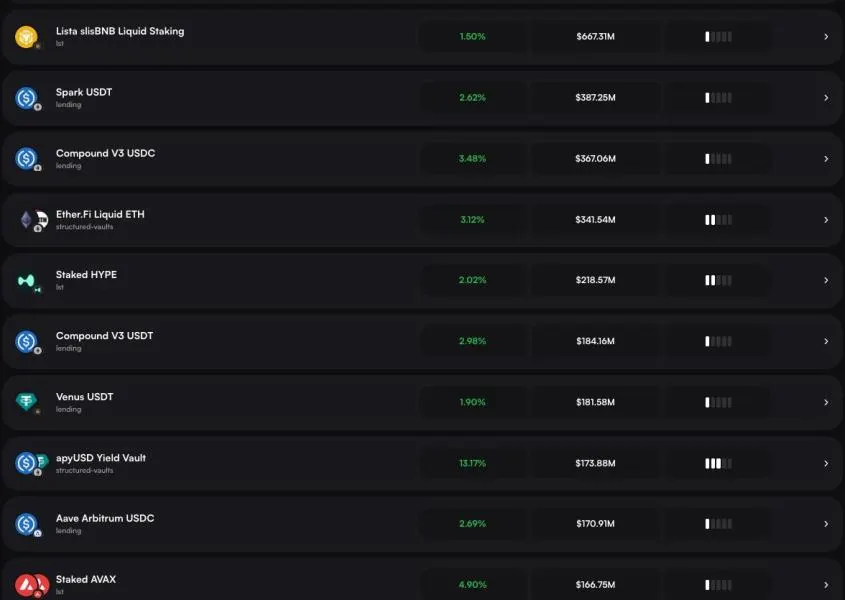
Alt: "YiFi Earn DeFi strategy catalogue"
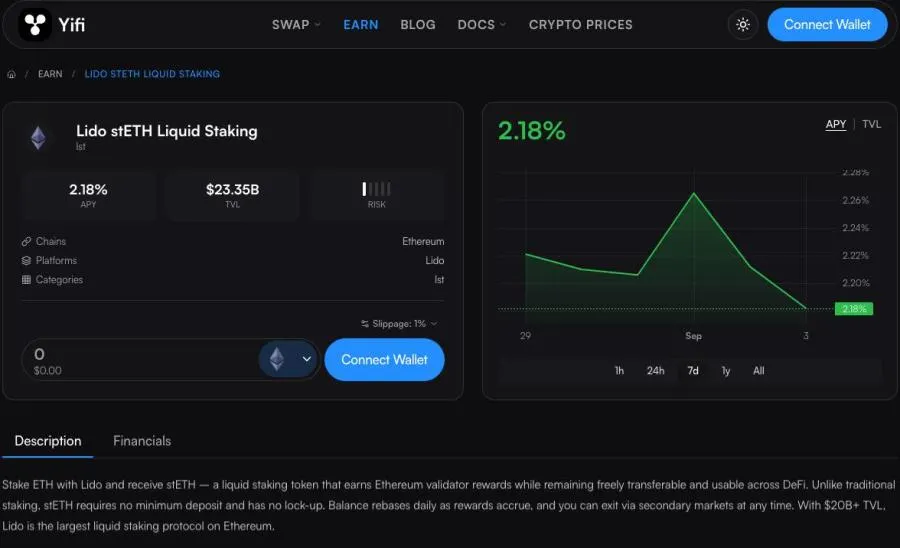
Alt: "YiFi strategy card showing current strategy"
Alt: "YiFi Zap confirmation screen showing fee"
Strategy exits can be performed through the same deposit / withdrawal interface, with the strategy components unwound and the selected asset returned to the user.
Supported Chains and Assets
The swap product and Earn product use different coverage metrics and should not be treated as one network list.
For Swap, YiFi states coverage of 20,000+ assets across 200+ networks, including Bitcoin, Ethereum, Monero, Tron, Solana, BNB Chain, Polygon, Avalanche, and Litecoin.
YiFi Earn currently focuses on EVM-compatible environments including Ethereum, Base, Binance Smart Chain, HyperEVM, Arbitrum, Polygon, Avalanche, Sonic and others.
Assets referenced for Earn include USDT, USDC, BTC, ETH, and HYPE.
YiFi for Wallets and Developers
YiFi also provides infrastructure for wallets and other integration partners. The developer-facing stack includes Swap API and Earn API capabilities, a ready-made widget, and white-label strategy interfaces.
Earn integrations can expose strategy filters based on asset, network, and APY range. The partner setup also includes a portal for tracking integration activity.
Both YiFi Swap and Earn Partner programs offer up to 50% revenue share on fees.
On-Chain Fee Distribution
YiFi uses a FeeSplitter contract to distribute partner fees on-chain. The contract is deployed across EVM networks. Partners can claim earnings directly from the FeeSplitter contracts without submitting any withdrawal request to withdraw it since YiFi is fully non-custodial.
The distribution and claims can be checked through blockchain explorers and the Partner API. This makes the payout layer independently inspectable on-chain rather than relying only on an affiliate dashboard.
YiFi vs Other Services
A useful comparison needs to separate private swaps from DeFi yield aggregation because they address different user needs.
Private Swap Comparison
The main distinction is the routing architecture. YiFi’s Private mode uses XMR as an intermediate asset, while Stealth mode uses USDT or USDC and relies on the opacity of centralized liquidity.
Earn Comparison
Who Should Use YiFi?
YiFi is relevant to users making one-off crypto swaps without opening an account, users looking for pairs that are unavailable on a preferred exchange, and users specifically working with XMR.
The Private Swap product can also fit cross-chain transfers where the user wants a routing architecture that separates the source and destination wallets. Earn is more relevant to users who already hold assets such as stablecoins or ETH and want a simpler route into DeFi strategies.
For wallets and B2B integrators, the API, widget, white-label interfaces, and on-chain fee distribution provide an additional use case.
Limitations to Keep in Mind
YiFi does not provide fiat conversion, an order book, or traditional limit orders.
Private routing can take longer than a direct swap. Private mode can also introduce approximately 0.8% to 1.0% exposure to XMR price movement during the intermediate leg.
Additional verification may be requested in some circumstances, depending on size, or asset-specific conditions.
Earn carries the underlying smart contract, market, and liquidity of the selected protocol. APY is variable rather than guaranteed. Non-EVM networks are not currently supported in Earn, and the Zap fee is charged in addition to underlying protocol and network costs.
Frequently Asked Questions
Is YiFi non-custodial?
Yes. YiFi does not hold user funds in custody, and Earn approvals are granted to underlying protocol contracts rather than YiFi. Users retain control of their wallets and private keys throughout the process.
Can I swap crypto on YiFi without an account?
Yes, you can use YiFi Swap to exchange crypto for crypto without creating an account. To perform CEX-rail and Private swap it’s enough to provide the destination wallet. To make a DEX swap, you need to connect the wallet and sign the swap transaction.
How do I swap BTC to XMR on YiFi?
Select BTC as the source, XMR as the destination, enter the receiving XMR address, and review the route before sending BTC. Private mode is the relevant routing option when privacy is the main requirement.
What is the difference between Private mode and Stealth mode?
Private mode uses XMR as the intermediate asset and provides the stronger privacy model at the cost of additional time and potential XMR volatility. Stealth mode uses USDT or USDC and is faster, but its privacy model is weaker.
Is YiFi a mixer?
No. YiFi does not rely on pooling customer deposits as the privacy mechanism. The separation comes from routing through off-chain partners and an intermediate asset.
How long does a private swap take?
YiFi states an overall range of about 3 to 15 minutes, but individual pairs can take longer. USDT on TRON can clear in around 1 to 2 minutes, while BTC and XMR can take 10 to 30 minutes depending on confirmations.
What is a Zap and how much does it cost?
A Zap combines the required swaps, bridges, approvals, and deposits into one transaction. The Zap fee is 0.3% to 0.5%, depending on the strategy, and the fee is shown before confirmation.
Can I withdraw from an Earn strategy at any time?
Yes. Exiting uses the same Zap mechanism in reverse.
The Bottom Line
YiFi is best understood as a non-custodial routing and aggregation layer with two distinct entry points.
YiFi Swap focuses on cross-chain asset movement and privacy-focused routing, including BTC to XMR and other pairs that may be difficult to access through a traditional exchange. YiFi Earn focuses on on-chain yield data and DeFi strategies access through one-click deposits.
For users who need either private swaps or simplified access to DeFi strategies, the two products address separate problems through the same core model: YiFi routes transactions and strategies without taking custody of the user’s assets.