
 BTC
BTC
 ETH
ETH
 LTC
LTC
 BCH
BCH
 DOGE
DOGE
 USDT
USDT
 DASH
DASH
 USDC
USDC
 XRP
XRP
 XMR
XMR
 TRX
TRX
 BNB
BNB
 SHIB
SHIB
 DAI
DAI
 SOL
SOL
 ZEC
ZEC
 ETC
ETC
 POL
POL
 XLM
XLM
 ADA
ADA

Volvo tested supplier token payments while Visa, Circle, Fireblocks, and Augustus expanded the infrastructure connecting crypto with business finance.
Volvo Tests a Proprietary Token and Connects Supplier Payments With Traceability

Volvo Group tested a proprietary cryptocurrency inside a closed blockchain environment for transactions involving the company, material suppliers, and transport providers. The experiment connected payment activity with logistics records, turning a supplier transaction into part of the same auditable workflow used to track movement and origin.
The test was described by Ivan Branco, Head of Information Management, AI and Analytics for Volvo Group's logistics operations in Belgium, in a Cardano Foundation interview published July 14. The discussion covered Volvo's internal exploration of a proprietary currency, the need to verify country-of-origin data, and the costs companies can face when supply-chain records do not satisfy compliance requirements.
This remains an internal exploration rather than a public cryptocurrency or production payment product. Its adoption value lies in the business process: a manufacturer is testing whether programmable value can coordinate several commercial parties while preserving traceability. If the model proves more efficient than separate payment and logistics databases, it could give corporate blockchain services a clearer role in procurement and supplier settlement.
Visa Opens a Stablecoin Platform and Gives Institutions Wallet and Minting Controls

Visa launched the Visa Stablecoin Platform on July 16, giving financial institutions, fintech companies, and crypto businesses a managed environment for minting, redeeming, holding, and transferring stablecoins. Open USD, or OUSD, is the first supported asset, and the platform initially entered beta testing with selected clients.
The official Visa announcement says the product includes Wallet-as-a-Service infrastructure, connectivity for minting and burning OUSD, bank-account integration, audit logs, allow lists, and dual approval for sensitive actions. Institutions can use Visa-managed wallets or connect existing wallets, then apply policies defining who can initiate and approve transfers.
Visa also made the platform interoperable with its existing stablecoin settlement, money-movement, and stablecoin-linked card products. This is significant for adoption because a bank does not have to treat stablecoins as an isolated blockchain experiment. It can connect them to treasury, liquidity, settlement, and card workflows that already serve merchants and payment providers.
Circle and Fireblocks Unite USDC Balances and Extend Fiat Payouts to More Than 50 Countries
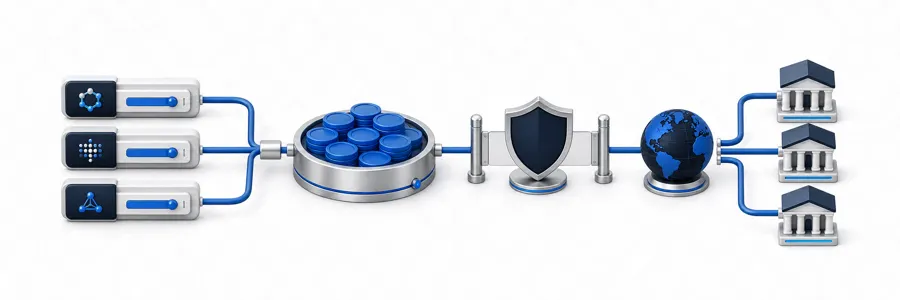
Circle Gateway and Circle Payments Network became natively accessible through Fireblocks, allowing institutional users to manage a unified multichain USDC balance and route stablecoin-funded payouts into local fiat currencies in more than 50 countries. The integration combines Circle's settlement rails with Fireblocks' existing wallet, authorization, and compliance controls.
In the Fireblocks product announcement, Gateway replaces separately prefunded USDC pools with a virtual wallet that aggregates balances across supported networks. Incoming USDC can enter the unified balance automatically, while transfers can deploy liquidity to another supported chain without requiring a destination-chain gas token.
Circle Payments Network handles a different part of the flow. A payment company can send USDC from its Fireblocks wallet while the recipient receives local currency through participating payment providers. Fireblocks says the route can replace correspondent-bank delays, NOSTRO prefunding, and corridor-by-corridor reconciliation, while retaining counterparty allow lists, sanctions screening, travel-rule data, and multi-party approvals.
For businesses using USDC, the practical result is less fragmented liquidity and fewer separate integrations. For crypto payment gateways, it creates a path from an onchain balance to compliant local settlement without rebuilding the policy layer for every network or destination market.
Augustus Raises $180 Million and Builds 24/7 Dollar Clearing With Stablecoin Rails
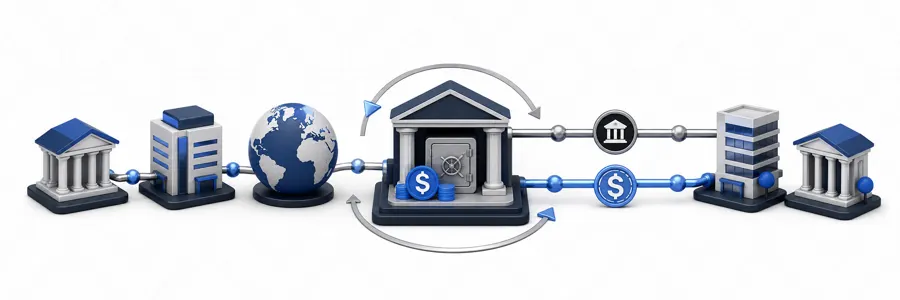
Augustus raised a $180 million Series B at a $1 billion valuation to build a clearing bank connecting international fintech companies and banks with US dollar accounts, conventional payment rails, and stablecoins. Tiger Global led the round, joined by Hummingbird, QED, and founders from companies including Nubank, Ramp, Circle, and Deel.
The company's July 21 funding announcement says its API-first platform supports operating accounts, FBO accounts, named virtual accounts, Swift, ACH, SEPA, and stablecoin transactions. Augustus plans to invest further in its Marble core-banking platform, which uses automation and AI to support faster settlement and continuous availability.
The financing follows conditional approval from the US Office of the Comptroller of the Currency to establish Augustus Bank, N.A. Augustus says it is already processing billions for customers including Kraken and will use the new capital to serve institutions in Latin America, Southeast Asia, the Middle East, and Africa.
Together, the five events show payment adoption moving into operational layers rather than consumer speculation. Volvo is testing programmable settlement inside procurement; Visa is packaging stablecoin controls for institutions; Circle and Fireblocks are connecting USDC to local payouts; MoonPay is simplifying deposits; and Augustus is combining bank clearing with stablecoin rails. Businesses preparing to accept crypto payments increasingly have infrastructure options covering funding, compliance, liquidity, settlement, and reconciliation—not just checkout.