
 English
 Français
 Español
 Português
 BTC
BTC
 ETH
ETH
 LTC
LTC
 BCH
BCH
 USDT
USDT
 DOGE
DOGE
 DASH
DASH
 USDC
USDC
 XRP
XRP
 XMR
XMR
 TRX
TRX
 BNB
BNB
 SHIB
SHIB
 SOL
SOL
 DAI
DAI
 ZEC
ZEC
 ETC
ETC
 POL
POL
 ADA
ADA
 XLM
XLM
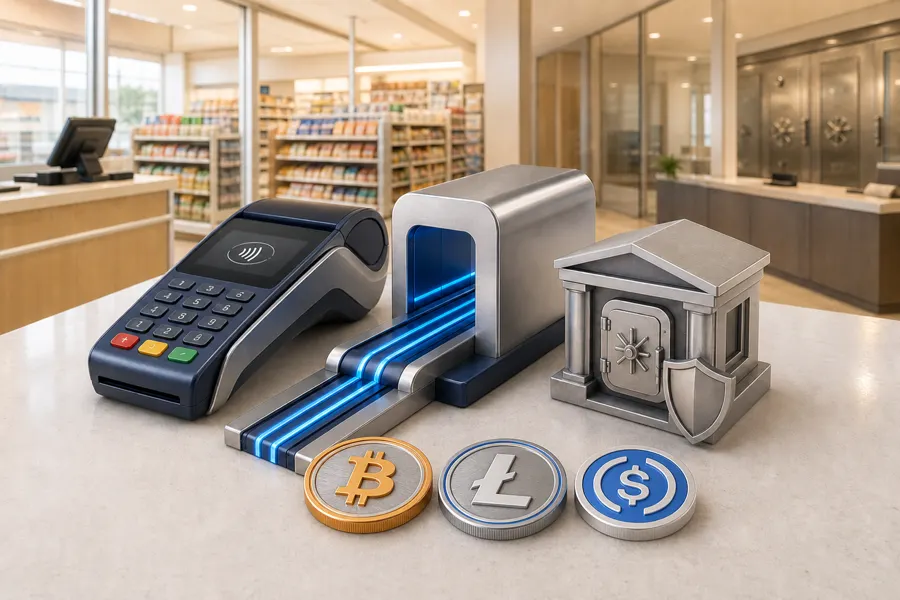
Mastercard, Lawson and Circle moved stablecoins deeper into payment rails, retail checkout and regulated financial infrastructure.
Mastercard Completes Its BVNK Acquisition and Brings Stablecoin Settlement Into Its Payments Network

Mastercard has completed its acquisition of BVNK, bringing a provider of stablecoin payment infrastructure into its global payments network. The move gives Mastercard a direct route to services used for on-chain payments, merchant settlement, payouts and treasury operations rather than treating stablecoins as a separate experiment beside card and bank rails.
BVNK’s infrastructure is designed to help businesses hold, move and settle value between fiat money and stablecoins. Inside a large payment network, that capability can be used to connect existing merchant, acquirer and corporate workflows with faster digital-asset settlement where the use case and regulation permit it.
For merchants and payment providers, the practical signal is integration. Businesses that want to accept crypto payments as a merchant need reliable conversion, settlement, compliance and reporting alongside the payment experience. The acquisition puts stablecoin operations closer to the systems that already process mainstream payments and may increase demand for interoperable crypto payment gateways.
Lawson Adds USDC, USDT and JPYC to a Tokyo Checkout Trial

Japanese retailer Lawson has expanded its stablecoin payment pilot to include USDC, USDT and JPYC through a second point-of-sale test at two Tokyo stores. The project tests whether customers can use wallet-based stablecoins within an ordinary retail checkout flow instead of only in online or crypto-native services.
The pilot matters because it joins three different payment options in one physical-store environment: the dollar-backed USDC, the dollar-backed USDT and the yen-denominated JPYC. The outcome will depend on more than blockchain confirmation: the checkout flow, wallet usability, local compliance, refunds and how the transaction reaches the merchant’s accounting and settlement systems all matter.
Lawson is testing the operational layer that separates a token transfer from an everyday purchase. If such pilots can work through familiar terminals and staff workflows, they give shops accepting cryptocurrency a more concrete path to evaluate stablecoins as one payment option among cards, cash and QR payments.
Circle Adds a New York Trust Charter and Extends Its Regulated USDC Framework

Circle has secured a New York trust charter after receiving approval to establish a national trust bank, expanding the regulated framework around its USDC infrastructure. The additional state-level footing is aimed at strengthening the institutional custody and trust structure that supports a stablecoin used across payments, exchanges and on-chain financial services.
For enterprises, the relevance is not simply another authorization. Regulated trust structures can define how client assets are safeguarded, how services are supervised and which counterparties are able to use them. That is important when stablecoins move from retail wallet transfers into corporate treasury, custody and settlement workflows.
The milestone does not change the need for a business to assess its own legal and operational requirements. It does, however, add another regulated component to the stack around USDC, helping banks, fintech firms and crypto finance services evaluate stablecoin infrastructure through more familiar governance and custody models.
Bank of Italy Finds That On- and Off-Ramps, Not Blockchain Fees, Drive Many Remittance Costs

The Bank of Italy has found no consistent cost advantage for stablecoin remittances, concluding that fiat conversion costs and payment infrastructure explain many of the differences in price and settlement time. The finding shifts attention from the blockchain transaction fee to the full route a payment takes before and after its on-chain leg.
In practice, a cross-border payment can still involve currency conversion, wallet or exchange access, compliance checks, local payout partners and different operating hours. A low network fee therefore does not automatically make a transfer cheaper once the sender and recipient must enter or leave the crypto system.
That is a useful constraint for businesses building with stablecoins. The strongest use cases are likely to be the corridors where the full route is simpler, liquidity is available and the recipient can use or convert funds efficiently. Payment providers should compare the complete cost of the service, not just the on-chain fee, while users seeking Bitcoin payments or stablecoin spending should check the terms of the wallet, exchange and merchant involved.
