
 English
 Français
 Español
 BTC
BTC
 ETH
ETH
 LTC
LTC
 BCH
BCH
 USDT
USDT
 DOGE
DOGE
 DASH
DASH
 USDC
USDC
 XRP
XRP
 XMR
XMR
 TRX
TRX
 BNB
BNB
 SHIB
SHIB
 SOL
SOL
 DAI
DAI
 ZEC
ZEC
 ETC
ETC
 POL
POL
 ADA
ADA
 XLM
XLM
When people talk about blockchain being transparent, they usually mean one thing: the transaction history is public. Anyone can look up any wallet address and see exactly what went in and what went out. That openness makes blockchain fundamentally different from traditional financial systems, where your bank knows everything but you know very little about anyone else's activity.
But transparency isn't the same as protection. These two things often get confused, and that confusion leads people to make risky decisions under the assumption that a public ledger automatically makes a system safe. Understanding where the actual line sits can help you transact with a clearer head.

How a Public Ledger Actually Works
Every transaction recorded on a blockchain gets added to a chain of data blocks. Each block contains a batch of transactions, a timestamp, and a cryptographic link to the block before it. Once the network confirms a block, nobody can alter that record without changing every block that follows — and on a large network, that's computationally impossible for any single actor to pull off.
This structure means records are permanent and verifiable. If someone sends you crypto and the transaction gets confirmed, it happened. Nobody can quietly reverse it or pretend it didn't occur. For anyone worried about falsified records or retroactive tampering, that permanence is a genuine feature.
What Transparency Does — and Doesn't — Protect You From
The public nature of a blockchain ledger provides real accountability in specific situations. It makes it difficult to fake transaction histories, tamper with supply chain records, or hide fund flows in certain financial applications. But there are meaningful gaps in what it actually prevents.
Here's what blockchain transparency does NOT cover:
Identity: Wallet addresses are pseudonymous. The ledger shows a transaction between two addresses, not between two named people. You can see what happened, but not necessarily who did it.
Contract validity: A smart contract can execute perfectly on-chain while still containing unfair or deceptive terms. Code correctness and consumer fairness are completely separate questions.
Off-chain behavior: Many platforms use blockchains for settlements but conduct their actual operations off-chain. Transparency in the ledger doesn't automatically carry over to how the company handles disputes, stores user data, or runs its business.
Verifying the blockchain record is only one layer of due diligence. Who controls the platform, what jurisdiction it operates under, and whether regulators actively oversee it — those questions still matter just as much.
Blockchain in Practice: Real-World Consumer Applications
Some of the clearest uses of blockchain-based transparency appear in industries where trust has historically been thin. Online gambling is a strong example. Several of the top casino sites in Canada now integrate blockchain for provably fair gaming systems, where players can independently verify the randomness of outcomes through cryptographic proofs. That's a meaningful step for an industry where rigging accusations have long been common — and largely impossible to disprove before blockchain existed.
Similar models apply to decentralized prediction markets, peer-to-peer lending platforms, and tokenized asset exchanges. In each case, blockchain gives users a way to verify specific claims: that a game wasn't rigged, that a loan contract was executed as agreed, that a token transfer happened exactly as described. The keyword is “specific.” Blockchain confirms what the ledger says happened. It doesn't confirm that the overall operation is honest, licensed, or legally compliant.
Smart Contracts and What They Can Guarantee
Smart contracts automate agreements by encoding conditions directly into code. When a condition gets met, the action executes automatically, without a middleman. That makes outcomes deterministic and removes certain types of human error — or deliberate human interference.
But what exactly does a smart contract guarantee?
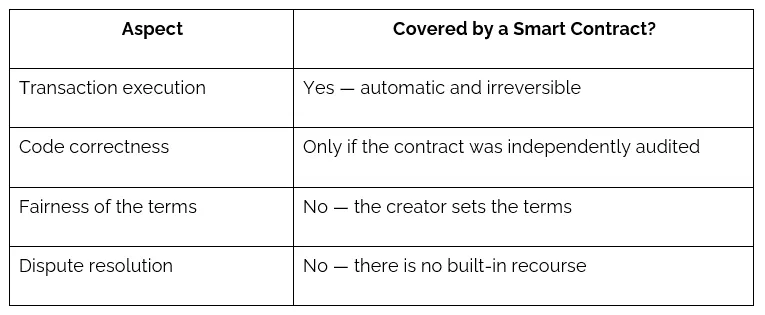
A smart contract can guarantee that a payment is released when conditions are met. It cannot guarantee that those conditions were fair to begin with, or that you had any meaningful ability to negotiate them.
Steps to Take Before Any Blockchain Transaction
A few practical checks can prevent the most common losses before you commit any funds.
Look up the project's audit history. Reputable blockchain projects commission independent smart contract audits and publish the results.
Verify the platform's regulatory status. Even blockchain-based services need licenses in most jurisdictions. Look this up through official regulatory databases, not links the platform itself provides.
Start with a small test transaction. Before committing significant funds, send a minimal amount first to confirm the process works as you expect.
Take irreversibility seriously. Once a blockchain transaction is confirmed, no support team can reverse it.
Blockchain technology creates genuine accountability through permanent, public records. But accountability is a technical property, not a legal one. Consumer protection requires legal frameworks, regulatory oversight, and users who understand exactly what they are agreeing to before they confirm a transaction.
