
 English
 Français
 BTC
BTC
 ETH
ETH
 LTC
LTC
 BCH
BCH
 DOGE
DOGE
 USDT
USDT
 DASH
DASH
 USDC
USDC
 XRP
XRP
 XMR
XMR
 TRX
TRX
 BNB
BNB
 SHIB
SHIB
 SOL
SOL
 DAI
DAI
 ZEC
ZEC
 ETC
ETC
 POL
POL
 ADA
ADA
 XLM
XLM
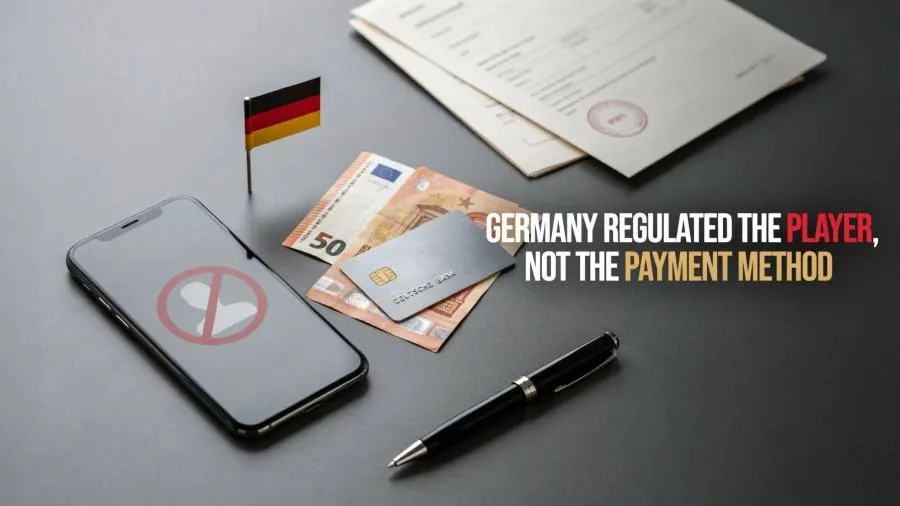
Most gambling regulation aims at the money. Germany aimed one layer up, at the person moving it, and that changes what a payment method can and cannot do.
Regulators who want to slow down online gambling almost always reach for the rails. Block the card codes. Lean on the banks. Order the payment providers to refuse the merchant. It is the obvious lever, and it is the one crypto is famously awkward for, because a rail with no gatekeeper has nobody to serve the order on.
Germany did something else. It built a national database that tracks the player.
The result is the most interesting payments experiment in European gambling, and it is not really about payments at all.
The cap follows the identity, not the money
Under Germany's Interstate Treaty on Gambling, a player can deposit a maximum of €1,000 per month across every licensed operator in the country. Not per site. In total.
That works because of LUGAS, the cross-state monitoring system that logs deposits in real time and lets operators check a player's national total before accepting the next one. It has been running since January 2023, operated by the public-sector IT provider Dataport on behalf of the GGL, the joint gambling authority of the federal states. By 2025 it was covering more than 60 licensed operators and roughly five million registered players.
Two details make it sharper than it first sounds.
The limit can be raised, to €10,000 or in rarer cases €30,000, but only with documented proof of financial capacity, and the highest tier is restricted to a small fraction of any operator's active players. And enforcement sits with the operator rather than the database. LUGAS records and reports. If a casino accepts a deposit past the cap, the casino is the one in breach.
Why the payment method stops mattering
Here is the part worth sitting with, especially on a site about spending crypto.
At a licensed German operator, it makes no difference whether you fund your account with a bank transfer, a card, an e-wallet or a coin. The constraint is applied before the payment is accepted, against your identity, using a national total that already includes everything you deposited elsewhere that month. Change the rail and the number does not move.
This is why the German case is instructive well beyond gambling. Almost every argument about crypto and financial controls assumes the control lives on the rail. Move the control to a verified identity and the rail becomes a detail. Crypto does not route around a rule that was never applied to the payment in the first place.
It also means the honest answer to "can I use crypto to deposit more in Germany" is no, at least not at a licensed site, and the reason has nothing to do with the coin.
Which is why a German-language comparison ends up asking a different set of questions than an English one. Search in German for krypto casinos and the useful results lead with licence status, how an operator handles the national deposit total, and what verification looks like before the first deposit rather than after the first withdrawal. Coin support comes last, because in that market the constraints are national rather than technical.
July 2026: the limits became personal
For five years the other famous German number was the stake cap: €1 per slot spin, alongside a mandatory five second minimum between spins.
That changed on 1 July 2026. The flat cap was replaced with a tiered system. Players under 21 stay at €1. Adults over 21 can stake up to €3. Up to €5 is available to players who have been registered for at least 90 days and have shown no signs of harmful play in that window. Operators have to check a customer's history through LUGAS before granting a higher tier, and keep monitoring afterwards.
It was the first time the regulator had used its power to adjust stake limits since the market opened, and licensed operators welcomed it loudly.
Look past the numbers and the design is the story. Your permissions are now priced from your record. The same infrastructure that caps deposits by identity now sets stake ceilings by behaviour, which makes the database less a compliance tool than the thing that decides what product you are allowed to see.

The number nobody agrees on
All of this rests on one contested figure: how much German gambling actually happens inside the licensed market.
The GGL puts channelisation at around 77% for 2025. The German online casino association argues the real figure is closer to 50% overall, and somewhere between 20% and 40% for online slots specifically, disputing the sampling behind the official number.
That gap is the entire policy argument, and it is about to matter more, because the first full statutory review of the treaty is under way. A regulator sitting on the better dataset going into that review is not an accident, and the LUGAS expansion announced in July 2026 reads exactly that way. The GGL has also said its analytical capabilities will widen further from 2027.
Enforcement, meanwhile, has been getting harder rather than easier. A March 2025 Federal Administrative Court ruling curtailed the regulator's ability to order IP blocking against telecommunications providers, on the grounds that the treaty's wording no longer matched the law it referenced. The lever aimed at the route lost some of its reach. The lever aimed at the person did not.
One more thing worth stating plainly
German law treats taking part in unlicensed gambling as a criminal matter for the player, not only for the operator. That is unusual in Europe, and it changes the calculation in a way no payment method affects. Anyone reading about the German market from outside it should know that before drawing conclusions about where the other half of the activity goes.
The rest of the crypto economy in the country is a separate and much more ordinary story, which the map of crypto in Germany covers better than any gambling rulebook.
The model other regulators are watching
Identity-layer regulation is expensive. It needs a national database, real-time reporting from every licensee, and a regulator willing to defend it in court. Germany built one and has spent five years arguing about whether it worked.
The mechanism itself, though, does something no payment-side control manages. It survives a change of rail. Any jurisdiction watching crypto payments arrive at crypto casinos and wondering how to keep its consumer protections intact has a working example now, along with a live argument about the cost, which is a licensed market that spent five years complaining it could not compete with what sits outside it.
That trade is the real German lesson. You can regulate the player instead of the payment. It works. Then you have to decide what you are willing to pay for it.