
 English
 Español
 Français
 Português
 BTC
 ETH
 LTC
 BCH
 USDT
 DOGE
 DASH
 USDC
 XRP
 XMR
 TRX
 BNB
 SHIB
 SOL
 DAI
 ZEC
 ETC
 POL
 ADA
 XLM

A crypto aggregator is a service that collects prices from many trading venues and shows, or routes your swap to, the one that returns the most coins.
Instead of opening five platforms to compare rates, you ask once and get a ranked answer.
The term covers two different products. A DEX aggregator routes trades across on-chain liquidity pools. An exchange aggregator compares offers from instant swap services. They solve the same problem with different mechanics, costs and risks, and this guide walks through both.
Key takeaways
- A crypto aggregator compares prices across venues, then executes the swap or hands it to the provider you pick.
- DEX aggregators such as 1inch, Jupiter, CoW Swap and KyberSwap work on-chain through a connected wallet.
- Exchange aggregators compare swap services and work through a deposit address, which makes swaps between unrelated blockchains possible.
- Neither type sets the price. The underlying venue does, so every quote still depends on liquidity, network fees and timing.
What is a crypto aggregator?
Liquidity in crypto is fragmented. The same pair trades at slightly different prices on hundreds of venues: decentralized exchanges, centralized exchanges and instant swap services. On a thinly traded pair, the gap between the highest and lowest quote can reach several percent.
An aggregator sits on top of those venues. It requests quotes, subtracts the known costs and ranks what is left. Some aggregators execute the trade for you. Others pass you to the provider you selected.
Aggregation is not limited to swaps: bridge aggregators compare cross-chain routes, and yield aggregators compare lending rates. This article covers the two types people usually mean by "crypto aggregator": DEX aggregators and exchange aggregators.
The two main types of crypto aggregators
DEX aggregators
A DEX aggregator searches decentralized exchanges on one blockchain, or on several compatible ones. You connect a wallet, pick two tokens, and a routing algorithm splits the order across liquidity pools so that no single pool moves the price too far against you.
Well-known examples are 1inch, CoW Swap, KyberSwap and Velora on Ethereum-compatible chains, and Jupiter on Solana. Everything settles on-chain through smart contracts, and you pay network gas for the transaction.
Exchange aggregators
An exchange aggregator compares instant swap services instead of liquidity pools. You enter the pair and the amount, see offers from several providers side by side, choose one and send coins to the deposit address it gives you. The provider then sends the other coin to the wallet address you entered.
SwapSpace is one example: a non-custodial crypto exchange aggregator that lists more than 3,500 coins and shows both fixed-rate and floating-rate offers from partner services. The aggregator never holds your funds. The swap is executed by the provider you select.
Because the handoff happens through a deposit address, the two coins do not have to live on the same blockchain. A Bitcoin to Monero swap, which a DEX aggregator on Ethereum cannot route natively, is an ordinary request here.
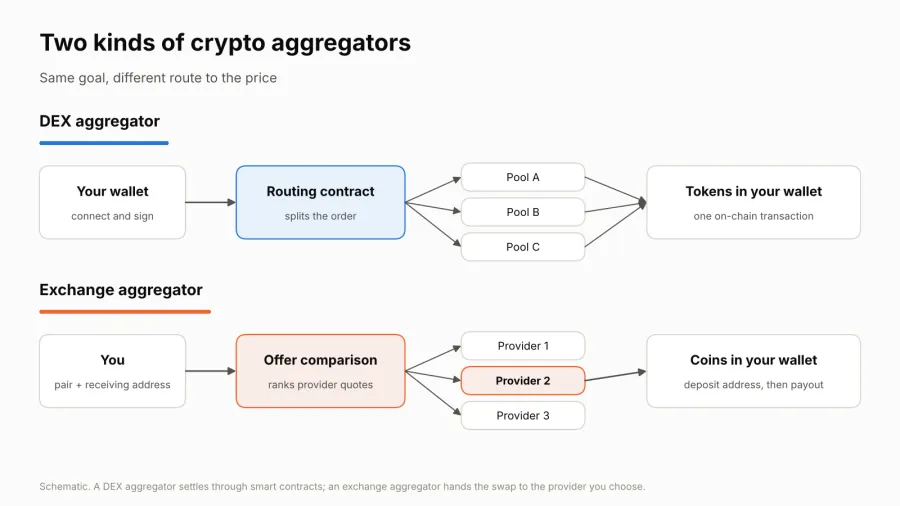
DEX aggregator vs exchange aggregator: side by side
| DEX aggregator | Exchange aggregator | |
|---|---|---|
| What it compares | Liquidity pools and market makers on decentralized exchanges | Offers from instant swap services |
| How you start | Connect a wallet and sign a transaction | Enter an amount and a receiving address |
| Where it settles | In one on-chain transaction | Deposit to the provider, payout to your wallet |
| Assets covered | Tokens on the chains the aggregator supports | Coins across unrelated blockchains, including Bitcoin and Monero |
| Custody during the swap | You keep the tokens until the transaction executes | The provider holds the coins while it processes the swap |
| Pricing | Pool prices plus gas, with a slippage limit you set | Provider quote at a fixed or a floating rate |
| Typical time | Seconds to a few minutes | A few minutes to about an hour, depending on confirmations |
| Main risks | Smart-contract bugs, token approvals, MEV | Provider reliability, rate changes on floating offers |
One practical rule follows from the table. If both tokens sit on the same chain and you already use a wallet there, a DEX aggregator is the direct route. If the coins live on different blockchains, or you prefer not to connect a wallet to a web app, an exchange aggregator is usually simpler.
How aggregators find a price
Smart order routing on DEX aggregators
Liquidity pools quote worse prices as an order grows, an effect called price impact. A routing engine checks hundreds of pools, splits the order into parts and sends each part where the impact is lowest. It also accounts for gas, because a route through five pools can cost more in fees than it saves in price.
Newer designs go further. Intent-based systems such as CoW Swap's batch auctions and 1inch Fusion let professional market makers compete to fill your order. They also shield it from MEV, the practice of bots trading ahead of a visible transaction.

Offer comparison on exchange aggregators
An exchange aggregator sends your pair and amount to each connected swap service and receives a quote back. It lists the offers by the amount you would receive, with the estimated time and the rate type:
- Floating rate. The final amount follows the market until your deposit confirms. You may receive a little more or a little less than the estimate.
- Fixed rate. The provider locks the amount for a short window. You get exactly what was quoted, usually at a slightly less favourable rate, because the provider prices in the risk.
Slippage in one sentence
Slippage is the difference between the price you were quoted and the price you received. On a DEX aggregator you cap it with a tolerance setting. On an exchange aggregator you remove it by choosing a fixed rate.
Who leads the aggregator market in 2026
On Ethereum, the DEX aggregator ranking changed hands this year. In April 2026 KyberSwap held about 31% of volume, CoW Swap 22% and 1inch 15%, according to The Block. On Solana, Jupiter handles more than half of all DEX trading volume. Decentralized venues as a whole now account for roughly 14% of spot trading.
The underlying idea has not changed since the first aggregators appeared. As 1inch co-founder Sergej Kunz put it:
"In 2019, 1inch solved fragmentation for takers with aggregation."
Sergej Kunz, 1inch blog
Kunz has gone further and predicted that centralized exchanges will become front ends for decentralized liquidity within five to ten years. That is one founder's forecast, not a settled outcome, but it shows where aggregator builders think the market is heading.
What a swap through an aggregator costs
| Cost | DEX aggregator | Exchange aggregator |
|---|---|---|
| Network fee | Gas for the swap transaction, paid by you | Fee for sending your deposit; the payout fee is built into the quote |
| Service fee | Often none; some charge a small fee or keep positive slippage | Included in the provider's rate, not charged separately |
| Price impact | Grows with order size relative to pool depth | Reflected in the quote; large orders get a worse rate |
| Slippage | Up to the tolerance you set | None at a fixed rate; possible at a floating rate |
| Also check | Failed transactions still cost gas | Minimum and maximum amounts differ by provider |
The number that matters is the amount that arrives in your wallet. Compare that figure, not the headline rate.
How to choose a crypto aggregator
- Start from the coins. Same chain: a DEX aggregator. Different chains, or a coin without smart contracts such as Bitcoin or Monero: an exchange aggregator.
- Check coverage. Make sure the pair, the network and the amount you need are supported.
- Compare the received amount. Run the same swap on two aggregators before a large trade.
- Decide on the rate type. Fixed if you need certainty, floating if you accept small movement in either direction.
- Look at the track record. Years in operation, audits for smart contracts, public reviews and responsive support.
- Test small. Send a small amount first whenever you use a new route.
Risks to keep in mind
- Smart-contract risk. DEX aggregators ask you to approve token spending. Revoke approvals you no longer need.
- Counterparty risk. With an exchange aggregator, the selected provider holds the coins for the duration of the swap, and providers may run compliance checks on some transactions.
- Address and network errors. A payout sent to the wrong network or address is usually lost. Check both before confirming.
- Phishing. Fake aggregator sites copy real ones. Type the address yourself or use a bookmark.
FAQ
What is a crypto aggregator in simple terms?
A price-comparison service for crypto swaps. It checks many venues at once and shows, or uses, the one that gives you the most for your coins.
Is a DEX aggregator better than an exchange aggregator?
Neither is better in general. A DEX aggregator suits tokens on the same blockchain and users whose wallet is already connected to DeFi. An exchange aggregator suits swaps between different blockchains and users who prefer a deposit address.
Do aggregators charge fees?
Most DEX aggregators charge little or nothing on top of gas, though some keep part of any price improvement. Exchange aggregators are paid by partner services, so the cost is included in the rate you see.
Is using a crypto aggregator safe?
An aggregator reduces price risk, not all risk. Smart-contract bugs, provider failures and user errors remain possible. Use established services, check addresses and test with small amounts.
Can I swap Bitcoin through an aggregator?
Yes, through an exchange aggregator, which works with native BTC. A DEX aggregator can only handle wrapped versions of Bitcoin that exist as tokens on its chains.
Bottom line
A crypto aggregator saves the work of comparing venues by hand. Use a DEX aggregator for token swaps inside one ecosystem and an exchange aggregator for swaps across blockchains, and judge both by the amount that reaches your wallet.
