
 BTC
BTC
 ETH
ETH
 LTC
LTC
 BCH
BCH
 DOGE
DOGE
 USDT
USDT
 DASH
DASH
 XRP
XRP
 USDC
USDC
 XMR
XMR
 TRX
TRX
 BNB
BNB
 SHIB
SHIB
 DAI
DAI
 ZEC
ZEC
 SOL
SOL
 ETC
ETC
 POL
POL
 XLM
XLM
 ADA
ADA
Privacy has become a more urgent issue in crypto because the market is no longer small, technical, or easy to disappear inside. People now enter crypto through services that ask for identity checks, track account activity, and connect wallet use with personal profiles. That has pushed user privacy in crypto out of the margins and into everyday use.
Blockchain transparency is part of the problem. Public records can make networks easy to audit, but that does not mean users are truly private. A wallet address may not show a name, yet repeated activity, platform logins, and identity checks can still make behaviour easier to trace. That is why privacy in crypto now affects ordinary users as much as large holders or highly technical traders. This article explains why privacy matters more in 2026, what changed and where the biggest risks now sit.
Everyday Crypto Access
Privacy in crypto is shaped as much by daily behaviour as by blockchain design. It starts with ordinary actions: opening an exchange account, passing identity checks, checking balances on the same device, and moving funds between wallets that can be linked over time. That becomes easier to see when public narratives form around visible assets, and the epstein bitcoin story is a useful example of how attention can keep clustering around Bitcoin even when no verified evidence supports the claim. The point is not the rumour itself, but the fact that Bitcoin’s public ledger, media coverage, and repeated user interaction make the asset easy to follow, discuss, and analyse from many angles. In 2026, that kind of visibility matters because routine crypto use leaves more traces across platforms than it did in earlier market stages.
For ordinary users, the privacy issue rarely begins with advanced tracking tools. It begins when one account is used to buy BTC, the same wallet is checked across several apps, and later transfers are tied back to an exchange profile or device history. A person does not need to hold a large balance to become more visible than expected. As crypto moved into everyday finance, privacy risks became less technical and much more ordinary.
The Difference Between Transparency, Anonymity, and Privacy
These items are often blurred together, but they are not the same. Transparency means activity can be seen. Anonymity means the person behind that activity cannot be identified. Privacy means personal financial behaviour is not easy to trace, connect, or expose.
A public blockchain is transparent by design. Anyone can inspect wallet addresses, transaction history, and fund flows. That can look anonymous at first, because addresses do not usually contain real names. But that still does not guarantee privacy.
The difference becomes clearer like this:
- Transparent: the transaction record is open to anyone
- Anonymous: the identity behind the action cannot be tied to a real person
- Private: outside observers cannot easily build a full picture of someone’s financial behaviour
This is where many users get it wrong. They see a wallet address instead of a personal name and assume the activity is private. In reality, once a wallet is linked to an exchange account, a repeated login, or a known payment, the pattern can start to reveal much more than expected.
A simple example helps. Cash is often private because there is little record attached to the payment. A bank card is less private because the payment passes through named accounts and visible intermediaries. Public blockchain activity sits in between: the transaction is visible to everyone, while the identity behind it may stay unclear only until enough outside data fills the gap.

Risks for Crypto Users
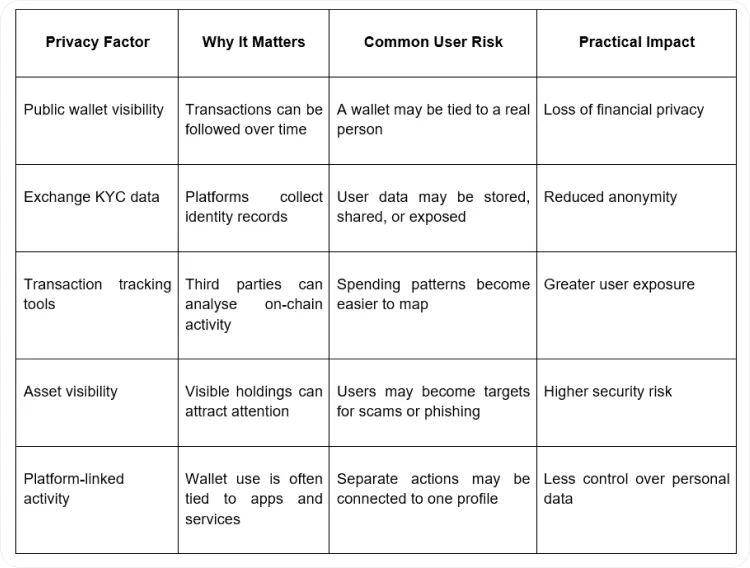
Privacy risk in crypto often shows up in small, ordinary moments. A wallet address gets reused. An exchange keeps identity documents on file. A scammer spots a public transaction and sends a fake support message minutes later. None of this needs a major breach to become a problem.
Some risks are especially common:
- Exchange KYC: users hand over names, documents, and sometimes proof of address
- Wallet exposure: one reused address can reveal a long trail of activity
- Transaction tracing: outside firms can follow fund movement across chains and services
- Phishing: visible activity can make users easier targets
- Data linking: exchange accounts, wallets, devices, and apps can be tied together
These matter even for small holders. A person does not need a large balance to lose privacy. A few routine transfers can already reveal patterns: when funds move, which services are used and how often one wallet interacts with another.
For exapmle: someone buys BTC on a regulated exchange, sends it to a wallet, later moves part of it to another service. Each step seems minor. Taken together, those steps can connect a real identity, a wallet history and a spending pattern.
Common Risks
Why Privacy Matters for Financial Autonomy
Privacy is not only about hiding information. It is also about keeping a basic level of control over money, decisions and daily financial life. When holdings, transfers or wallet patterns become easy to read, that control starts to weaken. A person may think they are simply moving funds, but in practice they may also be showing habits, timing and exposure to anyone with enough data.
That creates a security issue first. Visible balances can attract phishing attempts, fake support messages, impersonation or direct pressure after a transfer becomes public. Small wallets can still reveal useful information: which exchange a person uses, how often they move funds, and how active they are on-chain.
Privacy also shapes trust. People are less likely to use a financial system with confidence if every action feels easy to watch, connect or profile. Financial autonomy depends on more than access to an asset. It also depends on the ability to hold, move and manage funds without exposing more personal information than necessary. That is one reason user privacy in crypto matters beyond technical design alone.
If one wallet is tied to a named exchange account and later used across several services, the user may lose more than anonymity. They may lose room to act quietly, test a new tool or move funds without building a visible pattern over time. In that sense, privacy in crypto supports both personal safety and independent decision-making.
Regulation, Platforms and New Privacy Reality
Not long ago, crypto privacy sounded like something only technical users worried about. Now it is part of ordinary use. The question is no longer just what the blockchain shows. It is also what the exchange collects, what the wallet app logs, and how much of that trail stays attached to the user over time.
That shift matters because most people do not meet crypto at protocol level. They meet it through account sign-ups, ID checks, app dashboards, withdrawal rules, and internal risk controls. A transfer may happen on-chain, but the surrounding record is often built somewhere else. The system is more structured now, and in some respects that does help with safety. But it also means privacy is harder to keep separate from compliance, so the debate in 2026 is no longer a niche argument about ideals.
Final Thoughts
Crypto privacy feels different now because crypto itself feels different. It is no longer a corner of the internet used mainly by people who knew exactly what they were doing. It sits much closer to everyday finance, and that changes what privacy means in practice.
A few things raised the pressure at once. Blockchains stayed open, more people started using crypto through familiar apps and exchanges, and regulation grew around the whole space. Put together, that means more trails, more records, and fewer chances to act without leaving some trace behind. Privacy is no longer just a technical topic for developers or long-time holders. It has become part of normal user risk.
