
 BTC
BTC
 ETH
ETH
 LTC
LTC
 BCH
BCH
 DOGE
DOGE
 USDT
USDT
 DASH
DASH
 XRP
XRP
 USDC
USDC
 XMR
XMR
 TRX
TRX
 BNB
BNB
 SHIB
SHIB
 DAI
DAI
 ZEC
ZEC
 SOL
SOL
 ETC
ETC
 POL
POL
 XLM
XLM
 ADA
ADA
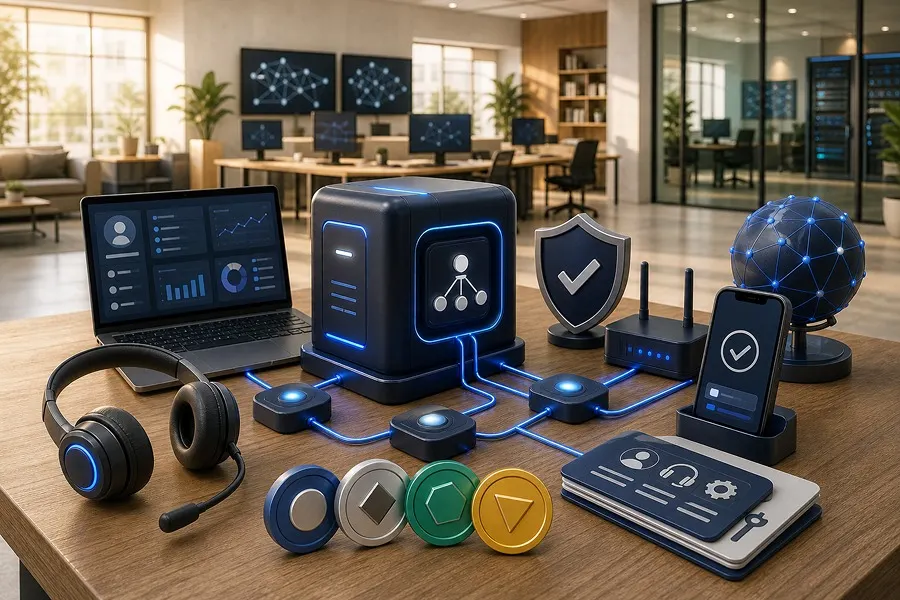
Decentralized organizations have no head office, no IT closet down the hall, and no help desk you can walk up to with a dead laptop. They still run treasuries, ship code, and host governance votes around the clock. More than 13,000 DAOs now operate globally, holding over $21.4 billion in liquid treasury assets, according to 2025 CoinLaw figures. When a contributor in Buenos Aires loses access to a multisig wallet at 3 AM Singapore time, the old playbook falls apart.
That gap is exactly why remote support for decentralized organizations has quietly become the most important infrastructure layer these teams have. Here is what the new frontier looks like.
Key Takeaways
Decentralized teams have no central office, so remote IT help is a baseline operational need, not a perk.
Contributors span continents, devices, and chains, which classic single-site helpdesks cannot cover.
Signing keys and treasury access sit on personal devices, pushing the security bar above ordinary corporate IT.
Cross-platform reach, unattended access, and strong session encryption are now must-have buying criteria.
Support has shifted from a productivity tool into core infrastructure for everyday Web3 operations.
What Makes a Decentralized Organization Different
A distributed team is a normal company whose staff happen to live in different cities. A decentralized organization works on another model entirely. Ownership and decision rights sit with token holders or community members instead of one corporate entity.
That single difference reshapes IT. There is rarely a central HR function handing out laptops, no procurement desk buying software licenses, and no contract that lets anyone mandate device policy.
Contributors are sovereign participants. They plug in, vote, ship work, and get paid in tokens. This setup keeps spreading, as Cryptwerk's coverage of crypto adoption in daily life shows: grassroots, multilingual networks now coordinate real money without a traditional employment paper.
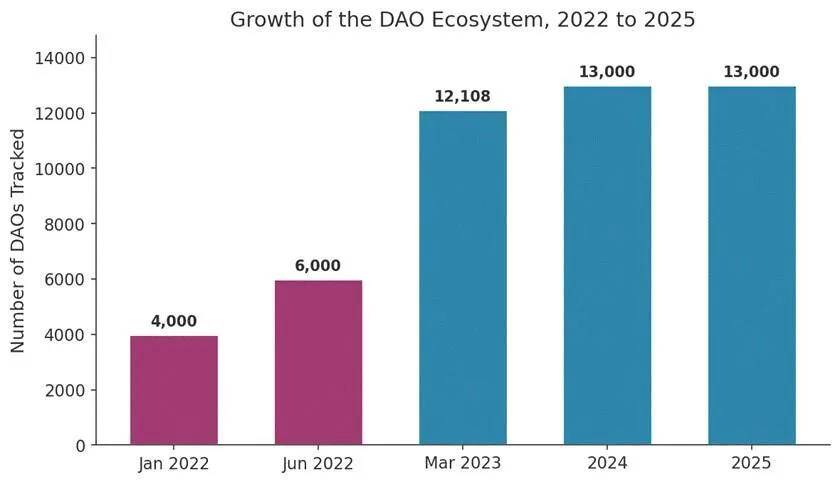
Tracked DAOs grew from roughly 4,000 in early 2022 to more than 13,000 by 2025. Source: DeepDAO and CoinLaw.
Why Traditional IT Support Breaks Down in Web3
Helpdesks built for one office, one time zone, and one device fleet were never designed for how Web3 actually runs. Three friction points keep surfacing.
Geographic and Time-Zone Fragmentation
Contributors sign in from anywhere with a steady internet. A bug raised at midnight in Lagos may need a maintainer in Berlin while a treasury signer in Seoul sleeps. Round-the-clock queues stop being a luxury and become the only workable shape.
Multi-OS and BYOD Reality
Decentralized contributors bring their own hardware. One person writes Solidity on a Linux box, another reviews proposals on a Mac, and a third moderates Discord from a Windows tablet.
Pro tip: Before you commit to any tool, list every operating system your contributors actually run. If the platform skips even one, those contributors lose coverage the moment something breaks.
Higher Security Stakes Than Ordinary IT
A breached laptop in Web3 can drain a treasury, sign a malicious proposal, or knock a validator offline. The financial blast radius dwarfs a typical office incident.
IBM's 2025 research puts the global average breach cost at $4.44 million, a 9% drop from the prior year thanks to faster AI-assisted detection. Full methodology sits in IBM's annual breach research.
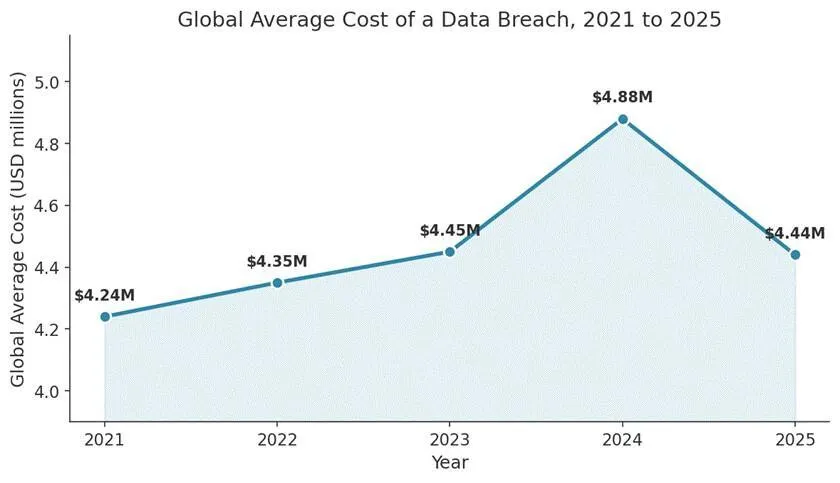
Breach costs climbed to a 2024 peak of $4.88M, then eased to $4.44M in 2025. Source: IBM Cost of a Data Breach 2025.
The dip reflects better tooling, yet the attack surface keeps widening as workforces scatter. In the United States the average rose to $10.22 million, a regional record. For teams guarding private keys, that trend reads as a warning.
The Role of Remote Support in Decentralized Operations
Modern remote support gives a technician secure, real-time visibility into a contributor's device, from anywhere, with explicit consent. The technician sees the screen, takes control when asked, transfers files, and logs every action for later review.
Three workflows stand out for decentralized teams:
Contributor onboarding, where a maintainer walks a new developer through repo access, wallet setup, and signing tools.
Treasury keeper triage, when a multisig signer cannot get a hardware wallet talking to the proposal interface.
Node operator troubleshooting, where downtime triggers slashing penalties and dents reputation.
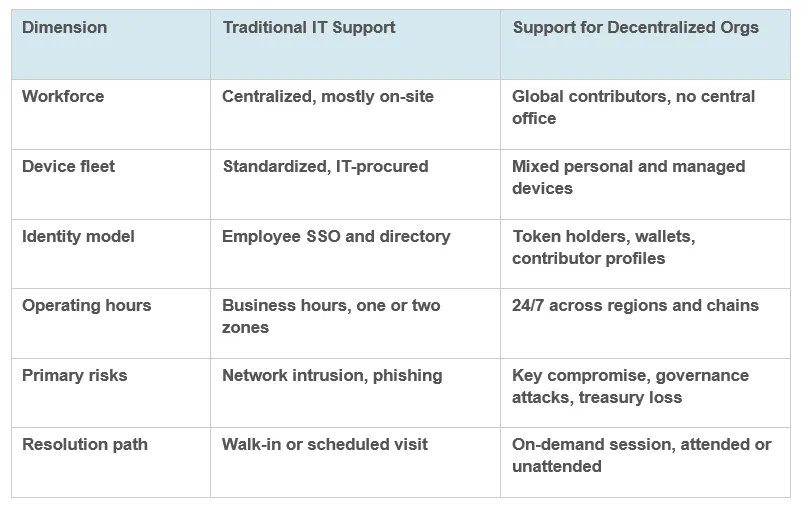
The contrast with legacy support is stark when you line the two models up side by side.
Real example: one leading remote support platform, used by more than 30 million people worldwide, shows up in MSP case studies where small teams cover thousands of endpoints across countries. As one reviewer, bluealias, noted on AlternativeTo, the SOS version lets a technician connect to every client computer at a fair price, replacing pricier rivals. The same dynamic, with sharper stakes, fits Web3 teams.
Pushing patches and resolving tickets without ever touching a device is what makes supporting a fully remote workforce realistic.
New to how DAO governance shapes these needs? This short primer helps.
Security and Compliance for Distributed Web3 Teams
Any tool that lets a stranger see your screen and move your cursor needs serious guardrails. For groups handling private keys and on-chain assets, the bar climbs higher still.
A defensible setup usually combines:
Strong session encryption from device to technician, with TLS plus 256-bit AES as the floor.
Multi-factor authentication for technicians and end users before any session opens.
Granular role-based access, so contributors grant only what the task requires.
Detailed session recording for post-incident review and governance accountability.
Device posture checks that block sessions on outdated or jailbroken hardware.
Zero-trust thinking maps cleanly onto this. Frameworks such as Fortinet's guide to zero-trust network access describe verifying identity, device, and posture on every request rather than once at login. A DAO can govern its support tooling by the same rule.
Security checklist: Confirm any support tool offers end-to-end encryption, enforced MFA, full session recording, device authentication, and an admin console that revokes signing access instantly. If a vendor cannot answer those five points clearly, keep looking.

Key Features to Look For
Not every product labeled remote support fits a decentralized workflow. Weigh the features that match how contributors really operate.
Cross-platform reach across Windows, macOS, Linux, iOS, and Android.
Unattended access for managed nodes and infrastructure that no human sits beside.
Attended on-demand sessions for moments when a contributor needs live help.
File transfer and chat inside the session, not bolted on through a separate app.
Session recording so contentious actions can be reviewed by the community later.
API and webhook hooks that let a governance forum or ticket system trigger sessions automatically.
Many of the blockchain service providers tracked across Cryptwerk already run this kind of stack internally to deliver audits and protocol monitoring for clients in half a dozen jurisdictions.
Use Cases Across the Web3 Ecosystem
One support stack covers a surprising spread of scenarios once you map it onto how Web3 runs.
Contributor Onboarding
New contributors hit the same walls: repo permissions, signing setup, gas configuration, dashboard access. A 20-minute screen share fixes what hours of async Discord threads cannot.
MSPs Serving Crypto Businesses
Managed providers increasingly cover exchanges, custodians, and Web3 startups. Per-endpoint pricing, rather than per-seat, makes covering hundreds of machines across regions affordable.
Validator and Node Operations
Validator boxes live on cloud or bare metal that nobody touches in person. Unattended sessions let an operator log in, patch, and restart services the moment alerts fire.
Field Events and Meetups
Summits and hackathons need ad hoc help for presenter laptops and pop-up registration desks. Attended sessions handle that without flying technicians around the planet. Many of these gigs tie back to the wider crypto and Web3 community coverage on Cryptwerk, where contractors plug in for short stints and need quick access without long rituals.
Frequently Asked Questions
How does remote support differ from remote access?
Remote support lets a technician temporarily view or control someone else's device to fix a problem, with consent. Remote access lets you reach your own machines from elsewhere. Support is collaborative and time-bound; access is personal and persistent.
Can DAOs use centralized support tools?
Yes. A centralized tool does not undo a decentralized organization. What matters is who controls the access policies. A DAO can set permissions, audit logs, and revocation rights so the support stack stays accountable to its community.
Is remote support secure enough for high-value crypto?
It can be, with the right configuration. Look for fully encrypted sessions, mandatory MFA, recording of every action, and device posture checks. Avoid any tool that allows silent unattended access without clear, logged contributor consent.
How does support scale across global contributors?
Modern platforms route sessions through regional relay nodes, keeping latency low whether the technician sits in Toronto and the contributor in Manila. Pricing per managed endpoint, instead of per technician seat, scales better for scattered teams.
Do open-source DAOs really need formal support?
Async forum threads work until a treasury is at risk, when governance must move faster. Even loosely structured DAOs benefit from a small, accountable support function that any contributor can call during an incident.
The Frontier Is Already Here
Decentralized organizations rewrote how work, ownership, and capital move. The IT layer beneath them is finally catching up. Support is no longer a corporate helpdesk nicety; it is the connective tissue keeping treasuries safe, validators online, and votes flowing across scattered contributors.
Whether you run a DAO, an MSP serving crypto clients, or a lean team building on Web3 rails, a thoughtful support model now is what separates projects that survive the next governance crisis from those that quietly drift offline.
