
 BTC
BTC
 ETH
ETH
 LTC
LTC
 BCH
BCH
 DOGE
DOGE
 USDT
USDT
 DASH
DASH
 XRP
XRP
 USDC
USDC
 XMR
XMR
 TRX
TRX
 BNB
BNB
 SHIB
SHIB
 DAI
DAI
 ZEC
ZEC
 SOL
SOL
 ETC
ETC
 POL
POL
 XLM
XLM
 ADA
ADA
Short-term crypto predictions feel noisy because prices react to new information fast. Yet the moves aren’t random. Major assets, such as Bitcoin, Ether, and large-cap altcoins, respond to factors that traders monitor daily.
Understanding and tracking these factors sharpens your timing and curbs emotional decisions. This article unpacks the key factors shaping short-term forecasts, from hours to weeks in the future.
Liquidity Leads
Short-term prices are less about the hype surrounding crypto trading and more about trading flow. Liquidity gauges buy/sell depth right at current levels. If there are plenty of trades, that’ll keep swings tame and gradual, while scarcity turns small trades into price movers.
Order books reflect this balance in real time. If there are few orders close to the current price, the market offers little resistance. Sudden price changes often appear in these conditions, even without major news. These swings usually reflect a lack of liquidity rather than a change in long-term belief.
Leverage uses borrowed funds (margin) to control larger positions than your own capital alone allows—for example, with $1,000, you might trade $10,000 worth of an asset, where a 1% price rise gains you $1,000 (doubling your stake) but a 1% drop wipes you out entirely.
This magnifies small price changes into big gains or losses. Derivatives, like futures or options, are contracts that track an asset’s price without requiring ownership, and many traders rely on them.
As these leveraged positions build up, prices grow more sensitive. When price swings against them, exchanges automatically liquidate the positions, often sparking rapid cascades that overwhelm regular spot trading.
Derivatives Reveal Leverage Pressure
Derivatives drive short-term crypto swings by letting traders bet on price without owning the asset. Futures and perpetuals track Bitcoin or Ether, often with leverage, controlling big positions on small capital outlays.
Leverage heightens sensitivity. Crowded positions mean tiny shifts spark automatic closures, flooding the market with instant orders that accelerate moves and chain more liquidations. This creates outsized cascades beyond normal spot trading.
Two key indicators reveal this dynamic. Funding rates show if longs (bullish price-up bets) or shorts (bearish price-down bets) pay to hold positions, signaling overcrowding. Open interest tracks active derivatives volume. When both climb together, markets turn hypersensitive to sudden swings.
Short-Horizon Signals
Short-term clues from the blockchain show what big holders and users are doing right before prices catch up. Networks reveal the buildup: coins heading to exchanges (sell signal), more frequent handoffs (rising use), or tighter fees on chains like Ethereum (demand spike). Charts then display the price reaction that follows.
Here’s a short guide to some of the signals that investors should note, and remember:
- Bullish means expecting (or seeing) prices rise: think optimism and buying pressure, like a bull thrusting horns upward,
- Bearish means expecting (or seeing) prices fall: think pessimism and selling pressure, like a bear swiping claws downward.
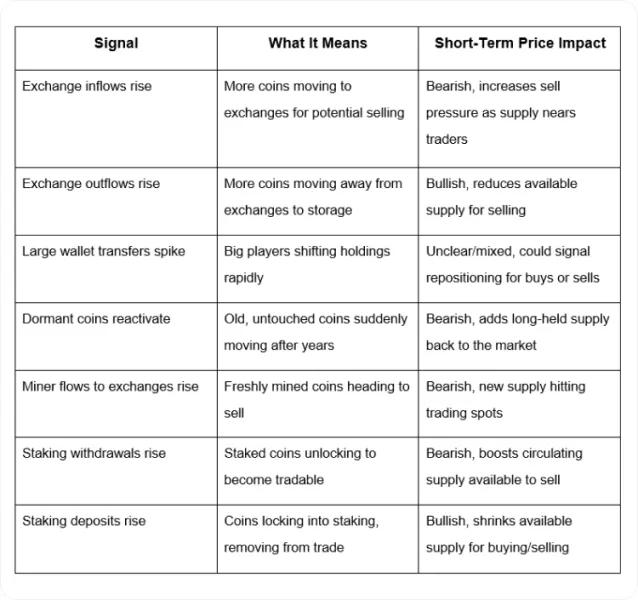
For many coins, rising congestion and fees affect usability, influencing sentiment during peak activity. Together, these clues reveal if the market is rapidly repositioning or pausing to consolidate.
Sentiment and Structure Shape The Market
Sentiment influences short-term prediction because it drives crowd behavior at turning points. Enthusiasm often rises with steep charts, upbeat narratives, and confident calls that spread across social platforms. Conversely, fear often rises after liquidation cascades, negative headlines, and an extended downside.
Extremes in either direction can align with crowded positioning and can foreshadow fast mean reversion.
Market structure translates sentiment into observable behavior. Trends show higher highs and higher lows in bullish phases, while ranges show repeated rejection and support tests. Breakouts and breakdowns gain credibility when spot participation expands.
News As a Catalyst
Short-term crypto moves often respond to fresh headlines because new information changes expectations quickly. For many of those focused on crypto prediction market platforms, like FanDuel Predicts, seeing how opinions cluster around upcoming outcomes can sharpen crypto-based predictions - and trading
Prediction markets function as a reference point that complements traditional sources of information, such as high-authority media sources, as well as regulatory and financial reporting.
Common catalysts include:
- Central bank updates,
- Inflation and jobs data,
- Dollar and bond moves,
- Exchange outages or hacks,
- Court and rule changes,
- Big company buys.
These events often trigger an immediate reaction, followed by a second phase where the price adjusts as details become clearer. In the short term, that reassessment can matter as much as the headline itself.
Leadership also shapes how the market spreads. When a cryptocurrency moves decisively, it often focuses attention on the most valuable and heavily traded assets. When Bitcoin (for example) steadies, activity more often shifts toward Ether and then into sector-specific crypto such as gaming, infrastructure, and meme-driven communities.
Correlation adds another layer. When major assets move in sync, short-term forecasts lean more on macro tone and liquidity. When correlations loosen, sector narratives can take over, especially in gaming and culture adjacent tokens, where attention can move faster than fundamentals.
Make Signals Your Short-Term Edge
Short-term crypto predictions get easier when you separate the key drivers instead of lumping them into one big story. Liquidity reveals how smoothly the price slides through important levels; thick means steady moves, thin means wild jumps. Derivatives expose crowded bets that can supercharge momentum.
On-chain flows show if coins are heading to exchanges (more supply, potential sells) or away (less supply, potential buys). Macro news and real headlines spark the immediate trigger that flips expectations.
By isolating liquidity, derivatives, on-chain flows, and macro triggers, you cut through crypto noise to spot short-term edges others miss. Bitcoin often leads the reaction, but each asset has its tells.
Practice tracking them live to sharpen timing and sidestep emotional traps. Master these patterns, and short-term forecasts shift from guesswork to probabilities you can bet on confidently.
