
 BTC
BTC
 ETH
ETH
 LTC
LTC
 BCH
BCH
 DOGE
DOGE
 USDT
USDT
 DASH
DASH
 XRP
XRP
 USDC
USDC
 XMR
XMR
 TRX
TRX
 BNB
BNB
 SHIB
SHIB
 DAI
DAI
 ZEC
ZEC
 SOL
SOL
 ETC
ETC
 POL
POL
 XLM
XLM
 ADA
ADA
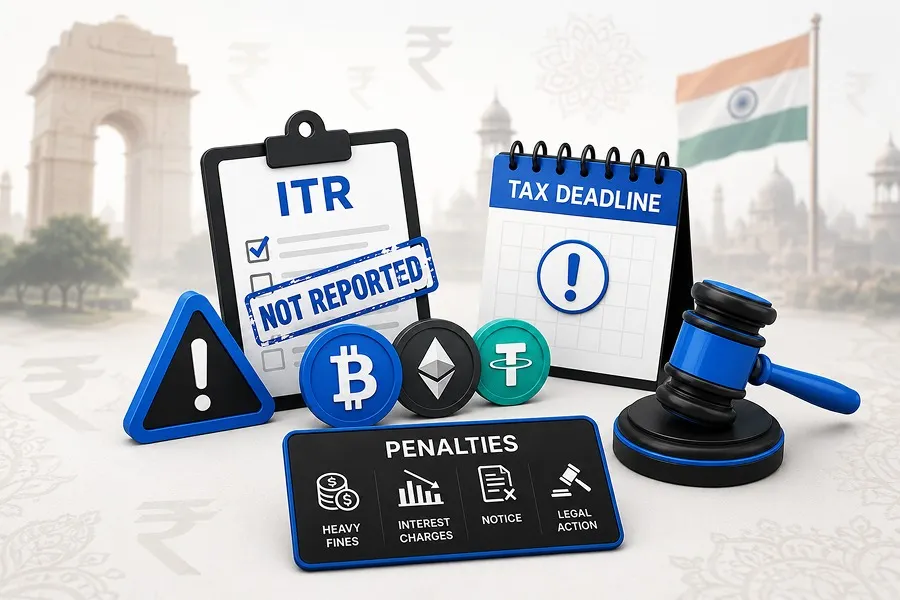
India's crypto tax enforcement has evolved far beyond traditional manual audits. Today, the 1% TDS on qualifying transactions creates a continuous data trail that feeds into the Income Tax Department's systems.
Moreover, Project Insight's AI-driven analytics are already enhancing transaction matching capabilities. Beginning in April 2026, mandatory reporting under Section 509 will further strengthen domestic oversight. In addition, the OECD Crypto-Asset Reporting Framework, scheduled for implementation in 2027, will expand visibility across foreign platforms.
Consequently, undisclosed VDA income is becoming increasingly difficult to conceal. This article explains each stage of non-compliance, from initial notices and reassessments to penalties and the available options for correcting past omissions.
Can the ITD Actually Tell If You Haven't Reported Crypto?
Understanding crypto tax law in India is the first step, but the ITD's ability to enforce it is what makes non-disclosure a genuine risk. The department uses a multilayered detection system pulling data from exchanges, banks, and international counterparts.
1% TDS Data Trail: Every FIU-registered exchange deducts 1% TDS on qualifying transfers and reports it to the ITD via Form 26QE. If your ITR does not reflect a corresponding transaction, the mismatch is automatically flagged.
Project Insight: The ITD's AI-powered analytics platform cross-references TDS filings, bank deposits, PAN-linked accounts, and ITR data. Discrepancies between these sources are identified without human intervention and can trigger automatic scrutiny.
Section 509 Exchange Reporting (From April 2026): Under Section 509 of the Income Tax Act 2025, FIU-registered exchanges must submit granular user-level transaction statements to the ITD, covering every buy, sell, swap, and withdrawal.
CARF International Data Sharing (From April 2027): India is among 52 countries joining the OECD Crypto-Asset Reporting Framework, enabling automatic sharing of Indian residents' foreign exchange transaction data with the ITD from 2027.
P2P and Foreign Exchange Enforcement: In early 2025, the ITD issued notices to thousands of investors for undisclosed P2P transactions on foreign platforms, including Binance, and this enforcement has since widened.
What Happens After You Are Flagged?
Being flagged does not result in an immediate penalty. The ITD follows a structured two-stage notice process that gives the taxpayer an opportunity to respond before any reassessment or penalty order is passed.
Section 148A Preliminary Notice: The ITO first serves a Section 148A notice, asking the taxpayer to explain why a formal Section 148 reassessment notice should not be issued, and allowing the taxpayer to respond.
Section 148 Reassessment Notice: If the ITD finds grounds to proceed after the 148A response, a Section 148 notice is issued, and income is reassessed under Section 147, with penalties and interest applied on the unreported amount.
Three-Year and Ten-Year Lookback Windows: The ITD can raise a Section 148 notice within 3 years of the end of the relevant assessment year. Where undisclosed income exceeds INR 50,00,000, this window extends to ten years.
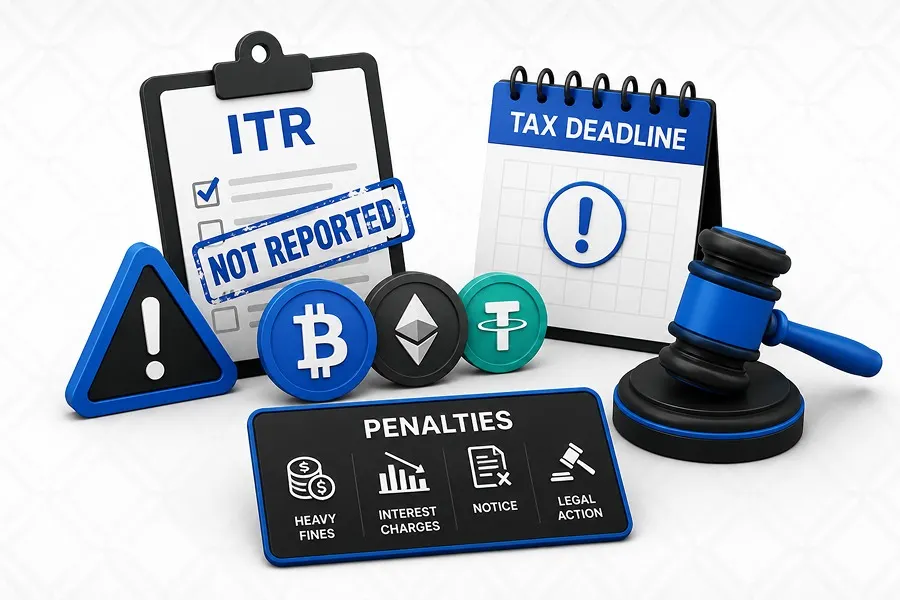
What Are the Penalties for Not Reporting Crypto in ITR?
The penalty applied depends on the nature of the non-compliance, ranging from interest charges and fines through to imprisonment and seizure-level tax rates.
Under-Reporting or Misreporting Income
Failing to declare VDA gains triggers a Section 270A penalty equal to 50% of the tax due on the under-reported amount, in addition to the base 30% tax and cess. Deliberate misreporting raises this to 200%. Sections 234A and 234B add 1% monthly interest on the unpaid tax.
Not Filing an ITR at All
Late filing attracts fees of INR 1,000 to INR 5,000 and 1% monthly interest. If the evaded tax is below INR 25,00,000, imprisonment of 3 months to 2 years may apply. Above INR 25,00,000, this period ranges from 6 months to 7 years.
Crypto Not Recorded in Books of Accounts
Crypto investments not in financial records, or where expenditure exceeds declared income without justification, are treated as taxable at an effective 78% rate: 60% base tax, 25% surcharge, and 4% cess. An additional 10% penalty applies to the same taxable sum.
TDS Non-Compliance on P2P and Foreign Exchange Trades
Traders on foreign exchanges or P2P platforms must deduct 1% TDS under Section 194S. Failing to deduct attracts 1% monthly interest and an equivalent penalty. Failing to deposit adds 1.5% monthly interest and up to 2 years imprisonment. Foreign holdings exceeding INR 20 lakh that are undeclared in Schedule FA attract the Black Money Act.
What If You Have Already Missed Past Filings?
Missing a filing deadline does not mean a notice is inevitable. Section 139(8A) provides a legal route to file your ITR correctly after the original deadline, subject to additional tax charges.
Revised or Belated Return: If the assessment year is still open, filing a revised ITR with the correct Schedule VDA entries is the simplest route to correction and preferable to waiting for an ITD notice.
Updated Return under Section 139(8A): This mechanism allows taxpayers to correct omissions within 24 months of the end of the relevant assessment year. For AY 2026-27, the window closes on 31 March 2029.
25% vs 50% Additional Tax: Filing within 12 months of the tax year end attracts a 25% additional tax on the shortfall. Filing between 12 and 24 months raises this to 50%, plus applicable interest.
Voluntary Disclosure Before a Notice: Approaching compliance before receiving an ITD notice is treated more favorably than responding to an ITD notice. For multi-year or multi-platform situations, a qualified tax professional familiar with VDA rules is advisable.
Conclusion
The enforcement infrastructure for crypto tax in India is no longer a future proposal. Instead, the TDS trail, Section 509 reporting, and the upcoming CARF framework are creating a system of continuous detection rather than random audits. Therefore, if you have missed earlier disclosures, filing an updated return under Section 139(8A) is often the lower-cost option, since correcting mistakes voluntarily is far cheaper than doing so after departmental action.
