
 BTC
BTC
 ETH
ETH
 LTC
LTC
 BCH
BCH
 DOGE
DOGE
 USDT
USDT
 DASH
DASH
 XRP
XRP
 USDC
USDC
 XMR
XMR
 TRX
TRX
 BNB
BNB
 SHIB
SHIB
 DAI
DAI
 ZEC
ZEC
 SOL
SOL
 ETC
ETC
 POL
POL
 XLM
XLM
 ADA
ADA
Corporate financial systems have become a major headache for many companies. What worked five years ago now slows down business processes and creates bottlenecks in financial operations. Organizations spend millions maintaining outdated infrastructure that can't keep pace with market developments.
Modernizing financial systems covers several directions: automating accounting, integrating payment solutions, implementing alternative assets into corporate treasury. Contemporary enterprises seek ways to diversify their financial instruments, and this presents opportunities for strategic advancement.
This article examines practical strategies for updating corporate financial systems, real company cases, and concrete implementation steps.
Auditing Existing Financial Infrastructure
The first step toward modernization requires honest assessment of current conditions. Many companies cling to systems based on outdated ERP platforms like SAP R/3 or Oracle E-Business Suite simply because "that's how it's always been done."
General Electric's CFO Carolina Happe publicly acknowledged in 2019 that the company spent over $200 million annually maintaining financial systems created in the 1990s.
Questions to ask during audit:
- How long does financial period closing take?
- Which processes still require manual execution?
- Are all divisions integrated into a unified system?
Cloud Solutions as Foundation for Modern Financial Architecture
Cloud migration isn't a trend anymore — it's a necessity. When implementing such transitions, companies often look for reliable partners to handle complex integrations, and best crypto exchange solutions provide infrastructure for working with digital assets without building everything from scratch.
NetSuite, Workday, Microsoft Dynamics 365 — these platforms offer ready-made modules for financial accounting that update automatically. Companies no longer need to spend resources maintaining servers or hiring specialists to service local infrastructure.
Automation and Artificial Intelligence in Financial Processes
Robotic process automation (RPA) changed the rules. PwC uses RPA bots for invoice processing and data reconciliation. Tasks that previously took accountants 2000 hours monthly now complete in 160 hours.
Specific application areas:
- Automatic matching of bank statements with accounting records
- Cash flow forecasting based on historical data
- Transaction anomaly detection for fraud prevention
Automation requires quality input data, though. Coca-Cola spent two years cleaning and standardizing financial data before implementing AI solutions. Without this preparatory stage, the system would produce unpredictable results.
Payment System Integration and Asset Diversification
Modern companies work with dozens of payment providers simultaneously. Stripe, PayPal, TransferWide for international transfers, local processing centers for specific markets — all require integration into a unified financial ecosystem.
Shopify integrated over 100 payment methods into its platform. Stores receive consolidated reporting regardless of whether customers pay by card, through Apple Pay, or bank transfer.
Alternative assets deserve separate attention. Companies begin considering digital currencies as part of corporate treasury. Tesla, Square (now Block), MicroStrategy publicly announced bitcoin investments. Working with such assets requires reliable infrastructure.
Financial diversification no longer limits itself to classical instruments. Companies experiment with tokenized assets, stablecoins for international settlements, DeFi protocols for liquidity optimization. Platforms like LetsExchange offer tools for secure exchange and storage of digital assets, helping businesses navigate this emerging landscape without excessive bureaucratic procedures.
Security and Compliance in New Financial Systems
Modernization without attention to security leads to catastrophe. Cyberattacks on financial systems increased 238% over the past three years, according to IBM Security.
Target lost over $200 million through a financial system breach in 2013. Hackers gained access through a vulnerability in an outdated payment system the company planned to update but postponed due to "high costs."
Key security aspects:
- Multi-level authentication for financial system access
- Data encryption at rest and during transmission
- Regular security audits involving external experts
Compliance creates separate challenges. GDPR in Europe, SOX in the United States, local financial reporting requirements in each country. Moderna Therapeutics spent $15 million adapting financial systems to different jurisdictions' requirements during international market expansion.
Solutions include implementing compliance modules directly into financial systems. SAP S/4HANA includes built-in tools for regulatory compliance across over 50 countries.
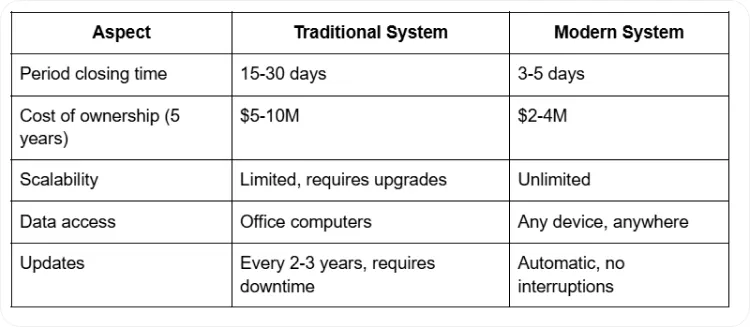
Comparing Traditional and Modern Approaches
Implementation Stages for Modernization
Successful modernization is a marathon, not a sprint. Companies attempting to change everything at once typically fail.
Johnson & Johnson spent five years on gradual financial system modernization. They started with a pilot project in one division, worked through all processes, then scaled across the entire company. The key principle: don't stop current operations during transition.
Practical steps:
- Create cross-functional team (finance, IT, operations)
- Identify critical pain points of current system
- Select technology partners with proven experience
- Launch pilot project on limited scope
- Train employees before full launch
- Ensure parallel operation of old and new systems during transition period
Nike faced problems implementing a new inventory management system in 2001. The company shut down the old system before the new one was fully ready. Result: $100 million in losses due to incorrect demand forecasting.
Challenges and Pitfalls
Technology represents the easiest part of modernization. The hardest aspects involve people and processes.
Resistance to change among employees has destroyed many modernization projects. Accountants who worked in Excel for 20 years aren't thrilled about transitioning to new ERP systems. General Motors spent $100 million on staff training during new financial system implementation — more than on the technology itself.
Another challenge involves integration with legacy systems. Banks still use COBOL code written in the 1970s. Complete replacement proves impossible; API gateways are needed to connect old and new.
Underestimating data migration scope represents a classic mistake. Lidl abandoned its SAP project after spending €500 million because migration proved far more complex than expected.
Future of Corporate Financial Systems
Blockchain technologies gradually enter corporate finance. Walmart uses blockchain to track supplier payments in real time. Reconciliation time dropped from weeks to seconds.
Embedded finance emerges as a new trend. Companies build financial services directly into their products. Uber offers drivers instant payouts through its own financial infrastructure instead of waiting for standard bank transfers.
Open banking APIs open new possibilities. Companies can automatically receive banking data through APIs instead of exporting files. Plaid processes over 8 billion transactions annually through such integrations.
Quantum computing remains a distant prospect, but JP Morgan and IBM already experiment with quantum algorithms for portfolio optimization and risk management.
Modernizing corporate financial systems isn't a choice but a necessity for survival in today's business environment. Companies postponing this process risk losing competitive positions. Success depends not on technologies themselves but on competent planning, engaging people, and gradual implementation of changes.
