
 BTC
BTC
 ETH
ETH
 LTC
LTC
 BCH
BCH
 DOGE
DOGE
 USDT
USDT
 DASH
DASH
 XRP
XRP
 USDC
USDC
 XMR
XMR
 TRX
TRX
 BNB
BNB
 SHIB
SHIB
 DAI
DAI
 ZEC
ZEC
 SOL
SOL
 ETC
ETC
 POL
POL
 XLM
XLM
 ADA
ADA
You sit on a stack of Monero, watching Ethereum gas prices, NFT floors, DeFi yields and new L2s flying past. The plan is simple: move a slice of that XMR into ETH — no delays, no paperwork, minimal trace.
Then you open a big centralized exchange and it greets you with the usual:
“Create an account.”
“Upload your ID.”
“Wait for verification.”
So much for a quick, private swap. This guide walks through how to exchange XMR for ETH fast and with as little friction as possible — what “anonymous” really means here, what to watch for, and how services like Quickex fit into the picture as no-KYC, non-custodial options.
Why People Swap XMR for ETH in the First Place
Monero and Ethereum live in different worlds:
- XMR is about privacy-first transfers and financial opacity by design.
- ETH is the ticket to DeFi, NFTs, L2s, meme coins and pretty much half of crypto culture.
Common reasons traders and investors search for “exchange XMR to ETH anonymously” or “swap Monero for Ethereum without KYC”:
- Access to DeFi: Liquidity pools, lending protocols, liquid staking — most live on Ethereum or its L2 ecosystem.
- NFTs & on-chain identity: You can’t mint, bid or trade on most NFT marketplaces with XMR.
- Rotating risk: Some users park value in XMR during noisy periods, then rotate into ETH when they see a setup they like.
- Simple portfolio rebalancing: Too heavy in privacy coins, not enough exposure to ETH and altcoins priced in ETH.
The trick is doing that rotation without turning your private Monero stack into a fully doxxed, KYC-tagged account along the way.
What “Anonymous and Fast” Really Means in XMR/ETH Swaps
Let’s unpack the two magic words everyone searches for: anonymous and fast.
Anonymous doesn’t mean invisible
When people type “anonymous XMR to ETH exchange” into a search bar, they usually want:
- No sign-up forms
- No identity upload
- No permanent customer profile sitting on some centralized server
That’s what no-KYC, no-registration exchanges and aggregators promise: you swap from your wallet to your wallet, and the service just sits in the middle routing the trade. Quickex is one of those: it allows you to swap Monero to Ethereum without creating an account or going through mandatory verification in standard cases.
But “anonymous” has limits:
- Ethereum is public. Once ETH lands in your wallet, those movements are visible on-chain.
- Services still run AML checks. If something triggers compliance systems (sanctions, fraud flags, etc.), they may pause a transaction and ask for documents.
- Local laws still apply. Privacy ≠ tax or reporting exemption. It just reduces how much personal data you hand out automatically.
So in practice, “anonymous” here usually means: no mandatory KYC by default, minimal data collection, non-custodial flow. Nothing more mystical.
Fast is mostly about confirmations
Speed in an XMR → ETH swap is a mix of:
- How many XMR confirmations the service waits for
- Network load on both Monero and Ethereum
- How the service executes the trade behind the scenes
Non-custodial swap services typically quote times like 5–10 minutes for XMR ↔ ETH conversions in normal conditions.
If blocks slow down or gas spikes, that number flexes — but compared to signing up, passing KYC and funding a big exchange, it’s still “fast” in real-world terms.
What to Look For in an XMR/ETH Exchange
When you want to exchange Monero for Ethereum anonymously and quickly, the platform matters more than the exact UI color. A few features are worth prioritizing.
1. Non-custodial, wallet-to-wallet flow
The ideal pattern:
- You specify how much XMR you want to send.
- You paste your own ETH wallet address.
- The service gives you a deposit address for XMR.
- You send Monero from your wallet.
- After confirmations, the service pays out ETH directly to your wallet.
No long-term balances held on the platform. No “internal account” that needs withdrawals later. Quickex, for example, follows this non-custodial pattern for XMR ↔ ETH swaps.
2. No mandatory registration or KYC (in normal cases)
If the entire point is a private Monero to Ethereum swap, the last thing you want is:
- photo of your passport
- proof of address
- selfie with a note
Quickex is marketed as a no-KYC exchange: users can swap coins like XMR and ETH without registration, with identity checks only appearing when AML triggers require it.
Other non-custodial swaps exist too, but their policies differ. Always read the fine print: any platform can pause and review transactions if it suspects abuse.
3. Fixed vs floating rate
You’ll see two common options when you exchange XMR for ETH:
Fixed rate:
- The service locks the XMR/ETH rate for a short window (e.g., 10–15 minutes).
- You know exactly how much ETH you’ll receive — if you send on time.
- Usually comes with a slightly higher fee.
Floating rate:
- The rate tracks the live market while your swap is in progress.
- You may end up with more or less ETH than the first preview.
- Fees are often lower.
If you’re nervous about volatility, fixed makes it easier to sleep. If you don’t mind a little rate drift, floating can be cheaper.
4. Transparent fees
Good signs:
- The service shows network fees and its own commission before you confirm.
- No “extra adjustment” lines in the final amount.
- A simple XMR ↔ ETH calculator that lets you test amounts without logging in.
Opaque fee structures are a red flag, especially when you’re trying to preserve both privacy and capital.
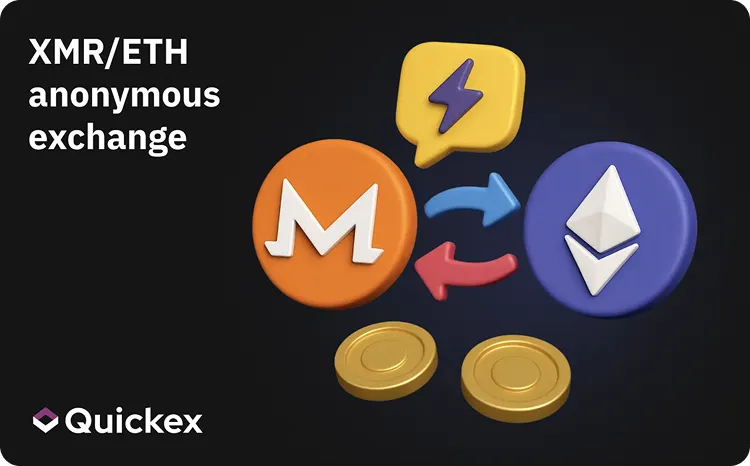
How an Anonymous XMR/ETH Swap Usually Works
The process across most non-custodial services feels surprisingly similar. Here’s the flow in plain language.
Step 1: Prepare your wallets
You’ll need:
- A funded Monero (XMR) wallet
- An Ethereum (ETH) wallet address you control (self-custody is best — e.g., hardware wallet or reputable software wallet)
Check that:
- Your XMR wallet is synced.
- Your ETH wallet is on the network you expect (mainnet, not a random testnet).
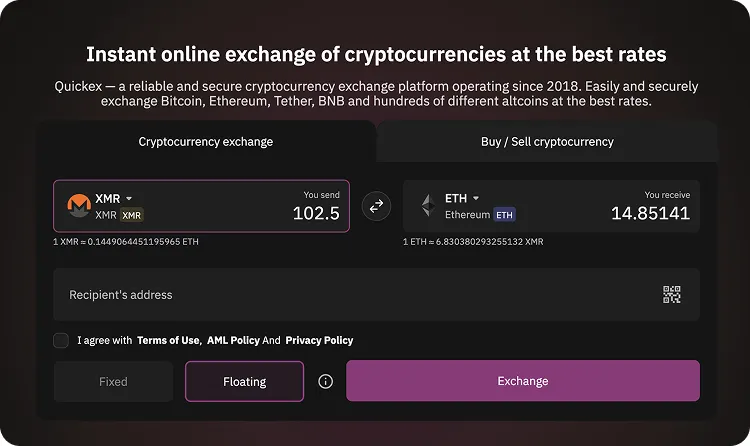
Step 2: Choose your XMR → ETH pair
On a swap site:
- Select XMR in the “You send” field.
- Select ETH in the “You get” field.
- Enter how much XMR you want to convert.
The built-in calculator will show an estimated amount of ETH, using either fixed or floating rate mode depending on what you pick.
Step 3: Paste your ETH address
Next, you’ll be asked for your destination Ethereum address.
Paste it carefully. Triple-check the first and last few characters. If you send to the wrong address, recovery is often impossible — there’s no undo button on-chain.
Once you confirm, the service generates:
- A unique XMR deposit address
- Sometimes a QR code for quick scanning
Step 4: Send your Monero
In your Monero wallet:
- Create a new transaction.
- Paste the XMR deposit address.
- Send exactly the amount you agreed to.
Non-custodial services typically start processing once they see the transaction in the network and it reaches the required confirmation count.
Step 5: Wait for confirmations and payout
Behind the scenes, the service:
- Confirms your XMR deposit.
- Executes the trade on its side.
- Sends ETH to your wallet at the agreed rate (fixed) or the current rate (floating), minus transparent fees.
In normal conditions, the whole Monero to Ethereum swap can complete in a few minutes. If networks are congested, it may take longer — but you never had to:
- open an account
- pass KYC
- store funds on an exchange
Exactly the point.
Using Quickex for XMR/ETH
Quickex is one of the better-known no-KYC swap platforms in this niche. A few things stand out if you specifically want to exchange XMR for ETH anonymously and quickly:
- No mandatory registration: You can swap XMR ↔ ETH straight from the homepage.
- No KYC in standard cases: ID checks are not part of the usual flow, only appearing when AML flags require deeper review.
- Non-custodial design: You send from your wallet and receive directly to your wallet; no long-term balances held on the site.
- Operating since 2018: It’s not a brand-new, one-week-old domain.
- XMR and ETH both supported: Monero and Ethereum are among the default currencies listed on reviews and aggregator sites.
That mix — longevity, no-KYC by default, direct wallet flows — is exactly what privacy-conscious users usually look for when typing “anonymous XMR to ETH exchange” into a browser.
Speed, Fees and Expectations
Even with a good platform, a “fast” XMR to ETH exchange isn’t magic. A few realities:
- Monero confirmations: Privacy comes with heavier cryptography. Some services wait for more confirmations to be safe, which adds a minute or two.
- Ethereum gas: If gas is cheap, your ETH lands quickly. If gas spikes, some services may batch or optimize transactions, slightly delaying payouts.
- Fixed-rate swaps: Rate-locking often implies a bit of extra fee — you’re paying for certainty.
Good practice before a larger swap:
- Test with a small XMR amount first.
- Make sure the whole pipeline works: your wallet → platform deposit → ETH payout.
- Only then move more serious size.
Privacy Tips When Exchanging Monero for Ethereum
If you care about anonymity, the swap itself is only half of the story.
1. Use self-custody wallets
Sending XMR from a fully KYC’d custodial account into a “no-KYC” service and then to an ETH wallet that’s also tied to your identity doesn’t magically erase the links.
Better pattern:
- XMR: Self-custody Monero wallet
- ETH: Self-custody Ethereum wallet
Centralized exchange accounts are fine if you accept the trade-off: convenience for less privacy.
2. Be mindful of your Ethereum footprint
Monero’s blockchain is private by design. Ethereum’s is a glass wall:
- Reusing addresses builds a big, public history.
- Interacting with KYC’d exchanges or doxxed ENS names links wallets to identities.
If your whole goal is an anonymous XMR → ETH swap, think about what you do with that ETH afterwards. That’s where most de-anonymization happens.
3. Understand local rules
Nothing here is legal or tax advice. But it’s worth remembering:
- Many jurisdictions treat crypto-to-crypto swaps as taxable events.
- Privacy-oriented coins sometimes face extra scrutiny on regulated platforms.
Even when you use a no-KYC XMR to ETH exchange, the responsibility to comply with local obligations (reporting, tax, etc.) is still yours.
4. Watch out for fake sites
Search results for “anonymous XMR ETH exchange” occasionally contain:
- Clones of real services
- Phishing pages with almost identical design
Habits that help:
- Type URLs manually or bookmark them.
- Double-check SSL and domain spelling.
- Avoid clicking random ads pretending to be your chosen platform.
Final Thoughts
Swapping XMR for ETH is basically moving between two different philosophies of money:
- From privacy-centric, opaque by design
- To programmable, transparent and plugged into a massive on-chain economy
Doing it anonymously and quickly isn’t about magic tricks. It’s about:
- Choosing non-custodial, no-registration services
- Understanding fixed vs floating rates and fee structures
- Respecting what each chain reveals — and what it hides
Study how your favorite swap platform works. Run a small test. Get comfortable with the rhythm of confirmations and payouts.
And when you’re ready to move size from Monero into Ethereum — whether for DeFi, NFTs, or just a portfolio rebalance — a privacy-friendly service like Quickex can be a smooth bridge: XMR in, ETH out, no account and no mandatory KYC in the standard flow.
