
 BTC
BTC
 ETH
ETH
 LTC
LTC
 BCH
BCH
 DOGE
DOGE
 USDT
USDT
 DASH
DASH
 XRP
XRP
 USDC
USDC
 XMR
XMR
 TRX
TRX
 BNB
BNB
 SHIB
SHIB
 DAI
DAI
 ZEC
ZEC
 SOL
SOL
 ETC
ETC
 POL
POL
 XLM
XLM
 ADA
ADA

Three months ago I sat across from David in a conference room that smelled like stale coffee. He runs a logistics company with $200 million revenue. He looked exhausted. "We're eighteen months into transformation. Spent four million dollars. You know what we have? PowerPoint decks. Consultants talking about 'digital maturity models.' But when I ask to see working software, they get vague."
This happens constantly. Firms engage strategy advisors to direct digital evolution. These advisors excel at assessing issues. But they fundamentally don't understand how to build technology systems. They can tell you what needs to change. Not how to change it. That "how" – the actual engineering – is where transformation lives or dies.
The companies that succeed don't treat engineering as something that happens after strategy gets decided and this fundamental shift separates failures from successes because when you examine how organizations like those profiled at https://innovecs.com/ approach these challenges you notice they put engineers in the room during strategy discussions not after them which means technical constraints and possibilities shape business decisions from the start rather than technical teams receiving requirements they're supposed to somehow implement despite those requirements often being impossible or at minimum extremely inefficient to build. Engineers understand systems. They understand dependencies. They know what's actually buildable versus what sounds good in presentations. That knowledge needs to drive transformation, not follow it.

Why engineers see problems differently
Sarah is VP of Engineering at a healthcare company. Former developer. Twelve years writing code. "Business leaders think linearly. They see: we need feature X, so build it, done. Engineers see: feature X requires changes to systems A, B, C, which breaks integration with D, so refactor D first, but D connects to our legacy mainframe that can't handle load, so actually we start with infrastructure."
That systems thinking is critical. Non-technical leaders see components. Engineers see ecosystems. Sarah's company wanted a patient portal. Business team spec'd it. Six months of requirements. Handed it to engineering. First question: "Where will this data live?" Nobody had thought about it. Patient data lives in seventeen different systems. Different formats. Different access controls. Understanding that reality upfront changes everything. Build infrastructure first. Then the portal.
What engineering-led transformation looks like
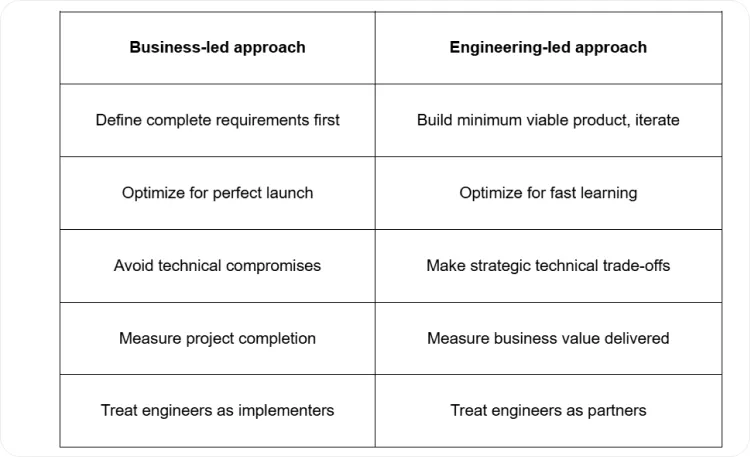
This table comes from studying twenty transformation projects over three years. The pattern is consistent. Engineering-led doesn't mean engineers make all decisions. It means engineering constraints inform business strategy. Engineering judgment gets respected.
Michael runs a manufacturing company. Last year they needed to connect factory machines to their ERP system. Business wanted everything connected immediately. Every machine. Real-time data. Engineering lead pushed back. "We can do that. Eighteen months, $3 million. Or connect the five most critical machines, prove the concept, learn what data actually matters, then expand. Six weeks, $200k." They went with option two. Turns out they didn't need real-time data from most machines. Weekly summaries were fine. The business requirements were assumptions. Engineering approach let them test those assumptions cheaply.
The iteration mindset
Software isn't like construction. You don't build half a building. But software can be partially functional. Release version 0.5. Release it, watch what users struggle with or ignore, and shape the next iteration around that reality. Engineers are used to working this way. Business leaders want perfection. Engineers know perfection comes through iteration.
Rachel leads transformation at a retail company. She's an engineer. When business pushes for complete features, she shows data. "Our initial try has errors 60% of the time. Because users don't know what they want until they see it working. We ship fast, watch usage, then fix what's broken." This feels risky to business leaders. Smart to engineers.
Technical trade-offs
Every engineering decision involves trade-offs. Speed versus reliability. Flexibility versus performance. No perfect solution. Business-led transformations want systems that are fast AND reliable AND flexible AND cheap. Engineers know that's impossible.
Kevin runs technology at financial services. Business wanted a new trading platform. Everything "critical." Kevin: "You need microsecond latency, 99.999% uptime, infinite scalability, in three months on $500k. Pick two." That conversation – forcing explicit priorities – is engineering leadership. Business chose speed over perfect reliability. Platform launched in three months. Reliability improved over the next year.
Building capability
Cultural change required. Put technical leaders in strategy meetings. Hire for systems thinking. Accept imperfect progress. Measure what matters – did you ship, do users like it?
The real transformation
David called last month. Fired consultants. Promoted engineering director. Started building small pieces. Fast iteration. "Shipped more in three months than previous eighteen. And it's being used." That's engineering-driven transformation. Stronger systems come from people who treat software as a craft, not a theory. The choice is yours.
