
 BTC
BTC
 ETH
ETH
 LTC
LTC
 BCH
BCH
 DOGE
DOGE
 USDT
USDT
 DASH
DASH
 XRP
XRP
 USDC
USDC
 XMR
XMR
 TRX
TRX
 BNB
BNB
 SHIB
SHIB
 DAI
DAI
 ZEC
ZEC
 SOL
SOL
 ETC
ETC
 POL
POL
 XLM
XLM
 ADA
ADA

Building a cryptocurrency exchange looks straightforward on the surface. Trades go in, trades come out, balances update. Yet many teams discover the hard part only after launch, when liquidity thins, users complain about latency, or regulators start asking questions no one planned for. Why do so many exchange projects stall or quietly shut down within the first year?
The gap sits between a functional prototype and an exchange that can operate safely under pressure. This article takes a practical look at cryptocurrency exchange development as an engineering and operational discipline, reflecting the realities teams face when building in-house or evaluating a cryptocurrency exchange development company. It focuses on design decisions, hidden constraints, and trade-offs that tend to matter more than feature checklists.
What users and regulators actually expect from an exchange
Most exchange failures aren’t caused by a missing feature. They come from a mismatch between expectations and reality.
Reliability under uneven load
Trading activity doesn’t grow smoothly. A quiet week can be followed by an hour of extreme volatility. During these spikes, users expect order placement, cancellation, and balance updates to behave predictably. Partial outages or delayed confirmations quickly erode trust, even if funds remain safe.
From a development standpoint, this pushes teams toward systems that can prioritize critical paths. Matching and risk checks must continue even if non-essential services degrade. Treating all components as equally important is a common early mistake.
Transparency and traceability
Regulators and institutional partners increasingly expect detailed audit trails. Every balance change, trade execution, and fee calculation should be reconstructable after the fact. This affects how databases are designed and how logs are stored.
It’s tempting to treat auditing as a reporting layer added later. In practice, it’s far easier to build traceability into the core transaction model from day one.
Predictable custody rules
Users rarely think about custody until something goes wrong. They assume deposits arrive promptly, withdrawals clear within stated limits, and internal transfers don’t fail silently. Meeting these expectations requires clear separation between hot wallets, cold storage, and internal accounting.
An exchange that blurs these boundaries often struggles during security reviews or insurance discussions.
Choosing the exchange model shapes everything else
The choice between centralized, decentralized, or hybrid exchange models isn’t philosophical. It defines technical constraints that are hard to reverse later.
Centralized exchanges: Speed with responsibility
Centralized exchanges control order books and custody. This allows fast matching and advanced order types, but it places the full security and compliance burden on the operator.
Development teams need to plan for internal ledgers that can process thousands of balance updates per second without drifting from on-chain reality. Reconciliation routines aren’t optional here; they’re part of daily operations.
Decentralized exchanges: Composability with limits
Decentralized exchanges rely on smart contracts to handle trades and custody. They benefit from transparency and composability but inherit blockchain constraints such as transaction fees and confirmation times.
For development, the challenge lies in contract design and upgrade paths. A mistake in a core contract can’t be patched with a hotfix. Many DEX teams now combine immutable cores with adjustable parameters to manage risk without breaking trust.
Hybrid approaches: Complexity squared
Hybrid exchanges aim to blend off-chain speed with on-chain settlement. They can offer a compelling user experience but often introduce two sources of truth that must stay aligned.
This model demands careful thinking about failure modes. Developers need to define what happens if off-chain matching continues while on-chain settlement pauses, or vice versa.
Core architecture decisions
Matching engine design and determinism
A matching engine decides which orders trade and at what price. Deterministic behavior matters, especially when disputes arise. Given the same input sequence, the engine should always produce the same result.
This influences language choice, concurrency models, and even timekeeping. Using wall-clock time inconsistently across nodes can create edge cases that are painful to debug.
Internal ledgers versus on-chain state
Most exchanges maintain an internal ledger that mirrors user balances. This ledger must reconcile with on-chain wallets but operate independently for speed.
Problems appear when reconciliation is treated as a background task. Development teams benefit from defining explicit invariants, such as “total internal balance must never exceed on-chain holdings for asset X,” and enforcing them continuously.
Failure isolation
Not every service should fail together. Wallet infrastructure, matching, market data feeds, and user-facing APIs have different risk profiles.
Designing clear boundaries allows parts of the system to degrade gracefully. For example, disabling new withdrawals during a wallet issue while keeping trading active can be safer than a full shutdown.
Security and compliance as engineering problems
Security and compliance often get framed as policy issues. In exchange development, they’re deeply technical.
Security beyond perimeter defenses
Firewalls and access controls matter, but many incidents originate from internal logic errors. Incorrect fee calculations, rounding bugs, or race conditions can leak value without triggering alerts.
Security reviews should include economic attack scenarios. Ask how a trader might exploit timing differences, partial fills, or withdrawal limits. These aren’t hypothetical; they’re common in post-mortems.
Compliance logic baked into workflows
KYC, AML, and transaction monitoring aren’t just checkboxes. They affect user flows and system behavior.
For instance, freezing an account mid-session should stop trading and withdrawals in a consistent way. Retrofitting this logic later often leads to brittle conditionals scattered across the codebase.
Scaling isn’t just about volume
Many teams equate scaling with handling more trades per second. That’s only part of the picture.
Market diversity and asset behavior
Adding new trading pairs introduces different behaviors. Thin markets behave differently from liquid ones. Tokens with unusual decimal rules or transfer fees can break assumptions baked into generic code.
Development teams that standardize too aggressively often end up writing exceptions later, which complicates maintenance.
Organizational scaling
As the exchange grows, more teams touch the system. Clear interfaces and ownership boundaries reduce the risk of accidental regressions.
This is where documentation and internal tooling matter. Engineers need safe ways to test changes against realistic market scenarios, not just unit tests.
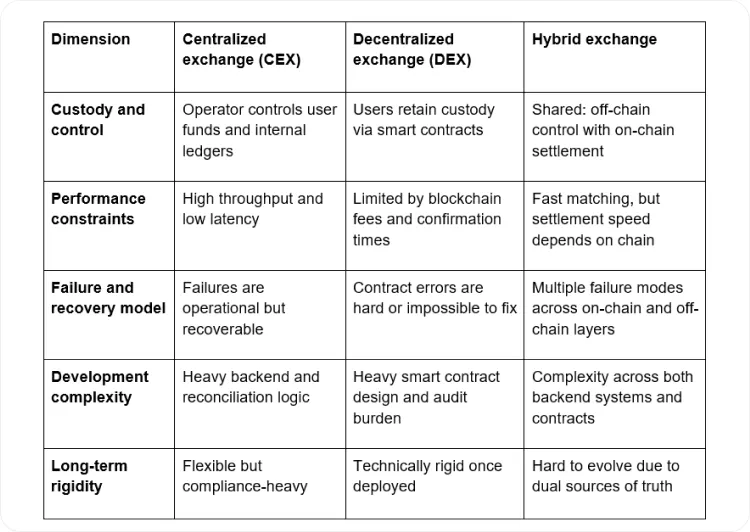
Underexplored trade-offs in exchange development
Some issues don’t get much attention until they cause friction.
- Speed versus auditability. Optimizing for raw performance can make audit trails harder to maintain. Compressing data or dropping intermediate states improves latency but reduces visibility during investigations. Teams should decide early how much historical detail they’re willing to store and for how long.
- Flexibility versus predictability. Highly configurable systems adapt quickly but can surprise operators. Fixed rules are easier to reason about but slower to evolve. Finding the right balance depends on the exchange’s target audience. Retail-heavy platforms often value predictability, while institutional users may expect tailored behavior.
Conclusion
Cryptocurrency exchange development sits at the intersection of distributed systems, financial engineering, and regulatory constraints. Success depends less on flashy features and more on disciplined design choices made early.
Teams that treat exchanges as long-lived infrastructure, rather than short-term products, tend to navigate volatility better. The work is demanding, but thoughtful architecture and clear trade-offs go a long way toward building an exchange that users and regulators can actually rely on.
