
 BTC
BTC
 ETH
ETH
 LTC
LTC
 BCH
BCH
 DOGE
DOGE
 USDT
USDT
 DASH
DASH
 XRP
XRP
 USDC
USDC
 XMR
XMR
 TRX
TRX
 BNB
BNB
 SHIB
SHIB
 DAI
DAI
 ZEC
ZEC
 SOL
SOL
 ETC
ETC
 POL
POL
 XLM
XLM
 ADA
ADA
Most crypto products don’t fail because the blockchain stops working. They fail because the wallet does. Lost keys, unclear transaction approvals, phishing links that look legitimate – these moments define whether users trust a product or abandon it forever. Crypto wallet development often looks straightforward on the surface: generate keys, show balances, send transactions. In reality, it’s one of the most unforgiving areas in Web3, where mistakes are permanent, and support can’t reverse outcomes.
For many teams, answering this challenge also means deciding whether to build internally or rely on blockchain wallet development services, a choice that directly affects security, delivery speed, and long-term ownership. So what does it really take to build a wallet that users can rely on, not just experiment with?
What crypto wallet development really means
In simple terms, crypto wallet development is the process of building software that manages cryptographic keys and safely signs blockchain transactions. A wallet does not actually store cryptocurrencies. Assets live on the blockchain. The wallet stores private keys, which are secret values used to prove ownership and authorize actions.
This distinction matters. If a private key is lost or exposed, the assets it controls are effectively gone. As a result, wallet development is less about feature velocity and more about designing systems that minimize irreversible failure.
Wallet types and when to choose each
Custodial vs non-custodial wallets
The first architectural decision is who controls the keys.
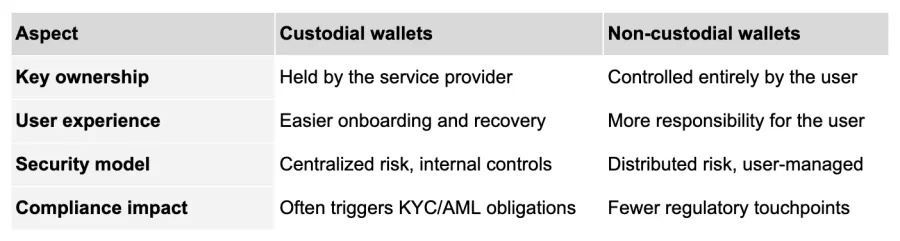
Custodial models optimize for convenience and recovery, while non-custodial models optimize for user sovereignty. The choice should follow your product’s trust assumptions, not ideology.
Hot vs cold wallets
Hot and cold wallets differ mainly by connectivity and intended use.
- Hot wallets are connected to the internet and designed for frequent transactions and daily use.
- Cold wallets keep keys offline and are used for long-term storage or high-value holdings.
Most consumer wallets are hot by default, with optional cold or hardware integrations for users who need additional protection.
Platform formats
The platform you choose shapes both security posture and user behavior.
- Mobile wallets offer strong UX and benefit from device-level secure enclaves.
- Web wallets are easy to access but highly exposed to phishing and browser attacks.
- Browser extensions provide deep dApp integration but require careful permission and update handling.
- Hardware wallets deliver the strongest isolation at the cost of usability and adoption friction.
There is no universally “best” format, only trade-offs aligned to your audience.
Security model: How wallets actually stay safe
Wallet security is not a single feature; it’s a system of controls working together.
Key management
Keys should be generated locally using strong randomness and never leave the device unencrypted. Where possible, operating system secure storage and hardware-backed isolation should be used.
Seed phrases and backups
A seed phrase is a human-readable backup that can regenerate all wallet keys. It must be treated as the highest-value secret. Good wallets expose it rarely, add friction around viewing it, and reinforce safe storage practices through UX.
Transaction signing
Signing is the moment of highest risk. Users must clearly understand what they are approving: destination, amount, fees, and potential contract effects. Blind signing is one of the most common causes of asset loss.
Encryption and device security
Keys at rest should be encrypted and protected by PINs, biometrics, or hardware security modules. At the same time, designs should assume that devices can be compromised and limit damage accordingly.
Phishing protection
Modern wallets must help users identify malicious links, spoofed addresses, and dangerous smart contract interactions before approval. Security warnings only work when they are understandable.
Architecture overview
A typical wallet architecture includes a client application where keys live and signing occurs, optional backend services for metadata or notifications, blockchain nodes or providers for reading state and broadcasting transactions, and a transaction pipeline that tracks confirmations and failures.
The guiding principle is simple: keep private keys on the client, minimize trusted dependencies, and treat all external inputs as potentially hostile.
Compliance considerations
Compliance requirements vary by jurisdiction, but wallet builders tend to face the same decision points regardless of market. The key question is what responsibility your product assumes in the transaction flow.
Where compliance typically applies
- Custodial wallets usually fall under financial regulations because the service controls user funds. This often triggers KYC (identity verification), AML (monitoring for suspicious activity), and reporting obligations.
- Non-custodial wallets generally avoid direct custody rules, but they are not “compliance-free.” If the wallet integrates fiat on-ramps, token swaps, or hosted services, those layers may still require sanctions screening or access restrictions.
- Service integrations such as staking, swapping, or bridging can introduce indirect compliance exposure even if the wallet itself never touches user keys.
Data and user responsibility
Even when assets are fully decentralized, wallets still handle user-related data. This can include device identifiers, IP addresses, usage analytics, and support logs. In many jurisdictions, that data is subject to privacy and data protection laws, regardless of where the blockchain nodes are located.
Why this matters early
Compliance decisions affect architecture. They influence whether you need a backend, how accounts are structured, what data is stored, and how recovery works. Teams that clarify these boundaries early avoid redesigning key flows later when regulators, partners, or app stores raise concerns.
Common pitfalls and how to avoid them
Treating wallets like standard applications
Wallets handle irreversible actions, but many teams design them like typical consumer apps, where mistakes can be undone. This leads to flows that are too fast or too permissive, especially for high-risk actions.
To avoid this, slow users down where it matters. Use explicit confirmations, clear risk language, and added friction for large transfers, new recipients, or contract approvals. Assume distraction and design defensively.
Overengineering the first release
Supporting many chains, tokens, and features from day one dramatically increases complexity. Different networks behave differently, and edge cases multiply quickly, making testing and audits harder.
The safer approach is a narrow MVP: one main chain, a limited set of actions, and a clear user journey. Expand only after stability and usage patterns are proven.
Weak transaction transparency
When transaction details are unclear, users approve things they don’t understand. Generic prompts and raw data encourage blind signing, which is a common cause of losses.
Mitigate this by making transaction intent readable. Clearly show what will happen, what permissions are granted, and what the user is actually authorizing, especially for smart contract interactions.
Poor backup and recovery design
If backup flows are confusing or inconvenient, users skip them. If they’re too easy, users store seed phrases insecurely. Both scenarios lead to permanent loss.
Treat backup as a core flow. Guide users step by step, require confirmation, and reinforce safe storage habits without overwhelming them.
Ignoring real-world attack patterns
Most wallet compromises come from phishing, social engineering, or malicious approvals, not cryptographic failures. Products that ignore these threats leave users exposed.
Address this by adding practical protections: warnings for suspicious domains, clearer labeling of risky actions, safer defaults for approvals, and careful control over updates and dependencies.
Conclusion
Crypto wallet development sits at the intersection of security engineering, product design, and human behavior. When done well, it helps users discover confidence in managing digital assets. When rushed or overbuilt, it becomes a source of silent risk. The strongest wallets are built with restraint, clarity, and respect for the fact that users are human. Get those fundamentals right, and you transform how people interact with crypto – safely and deliberately.
