
 BTC
BTC
 ETH
ETH
 LTC
LTC
 BCH
BCH
 DOGE
DOGE
 USDT
USDT
 DASH
DASH
 XRP
XRP
 USDC
USDC
 XMR
XMR
 TRX
TRX
 BNB
BNB
 SHIB
SHIB
 DAI
DAI
 ZEC
ZEC
 SOL
SOL
 ETC
ETC
 POL
POL
 XLM
XLM
 ADA
ADA
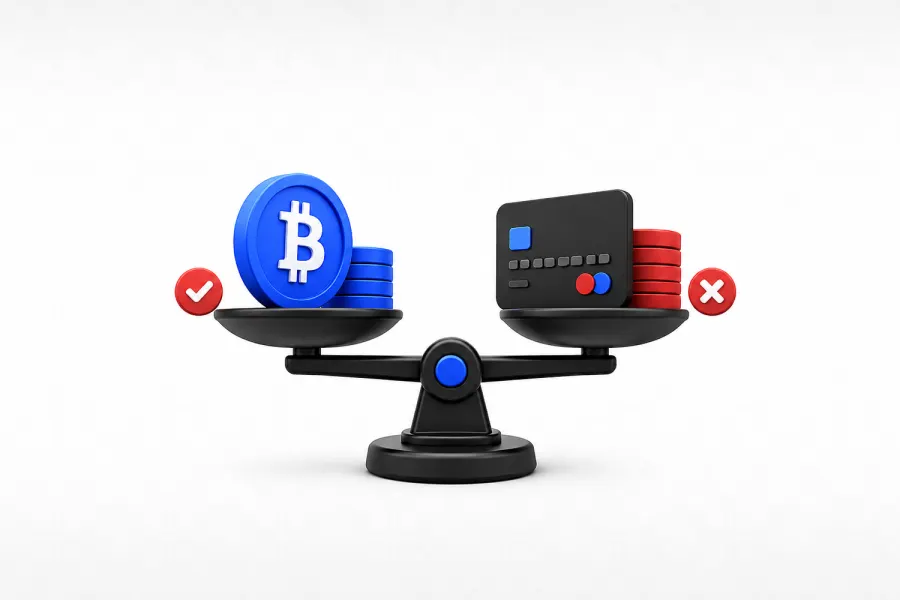
Accepting payments online has never been more complex, or more consequential. Merchants today face a widening choice between legacy card networks and crypto rails. Each has its own distinct cost structures, settlement timelines, and data requirements. Understanding those differences is a competitive decision.
The difference between crypto and traditional payments isn't just technical. It changes how much revenue a merchant keeps, how quickly funds arrive, and how much customer data is processed by third-party processors. For merchants operating across borders or in fast-moving digital markets, these factors carry real weight.
Transaction Fees and Settlement Speed Compared
Card processing fees are a persistent drain on merchant margins. Visa and Mastercard's average swipe fees sat at approximately 2.35% in 2024, typically ranging between 2% and 2.5% per transaction.
Across the U.S. merchant economy, those percentages translated into an enormous cumulative cost. Card swipe fees reached $111.2 billion in 2024, up from $100.8 billion the year before.
Crypto payments, by contrast, route value directly between wallets, cutting out the card network layer entirely. On-chain fees vary by blockchain.
For instance, Bitcoin’s network can spike during congestion, while networks like Solana or Layer 2 Ethereum solutions process transactions for fractions of a cent.
Settlement finality also differs significantly. Card transactions can take 1 to 3 business days to clear, whereas many crypto transactions settle within seconds or minutes, reducing the float merchants carry and improving cash flow predictability.
Privacy and Verification Requirements for Merchants
Traditional card payments require merchants to handle, store, or transmit cardholder data, triggering PCI DSS compliance obligations and creating liability exposure if that data is breached. Every transaction passes through multiple intermediaries, each logging identity and behavioral data.
For merchants prioritising customer privacy or operating in markets with strict data minimisation requirements, this architecture creates friction.
Crypto payments reduce that intermediary layer significantly. A merchant accepting a wallet-to-wallet transfer receives funds without collecting card numbers, billing addresses, or identity documents.
This design appeals directly to privacy-conscious operators across multiple verticals. Several no kyc casino platforms are a clear example of how crypto-native services have built entire platforms around this model. They accept digital assets without requiring the identity verification steps that card processors mandate.
Which Merchant Categories Adopt Crypto First
Not all merchant categories face the same urgency to adopt crypto. Digital goods, software subscriptions, virtual services, and online gaming are natural early adopters because they already operate without physical fulfilment constraints.
Cross-border merchants benefit most immediately. Card networks impose currency conversion fees and foreign transaction charges that crypto rails sidestep entirely.
The fintech space is also evolving quickly to meet merchants halfway. Klarna announced plans to launch a dollar-backed stablecoin aimed at delivering faster and cheaper payment settlement.
This signals that even established consumer finance players now view crypto-adjacent rails as commercially viable. When firms of that scale start building stablecoin infrastructure, it normalises the technology for a broader merchant audience.
Real Adoption Numbers Across Merchant Sectors
Crypto payment adoption is accelerating, though it remains unevenly distributed. Travel, luxury retail, electronics, and digital services lead merchant uptake.
Adoption is driven by the combination of high transaction values and international customer bases. In these verticals, the fee savings on a single large transaction can outweigh months of traditional processing costs.
Regulatory clarity is also catching up. In 2024 and into 2025, multiple jurisdictions moved to formalise crypto payment frameworks, giving merchants clearer legal ground to accept digital assets.
Global on-chain value received has grown substantially year over year, reflecting both speculative and genuine merchant-payment use cases.
As the infrastructure matures, better wallets, stablecoin settlement, and improved fiat off-ramps, the friction that once held merchants back is steadily being removed. The payment segment of the next few years will look meaningfully different from the card-dominated model that defined the last two decades.
