
 BTC
BTC
 ETH
ETH
 LTC
LTC
 BCH
BCH
 DOGE
DOGE
 USDT
USDT
 DASH
DASH
 USDC
USDC
 XRP
XRP
 XMR
XMR
 TRX
TRX
 BNB
BNB
 SHIB
SHIB
 SOL
SOL
 DAI
DAI
 ZEC
ZEC
 ETC
ETC
 POL
POL
 ADA
ADA
 XLM
XLM
In 2026, the technical foundation behind an online gambling brand affects far more than just launch quality. Casino platform architecture determines how quickly an operator can add payment rails, connect new suppliers, support different markets, and maintain clean reporting as the business grows.
65% of organisations already generate revenue from APIs. In addition, fully API-first firms are much more likely to derive a meaningful share of turnover from them.
That is why founders, investors, and product teams should not treat the technical stack as a back-room issue. Operators who look to buy gambling software often compare design, game count, and bonus tools first. Meanwhile, the more important question is whether the system can handle new integrations without expensive rewrites.
A well-built system gives an operator room to expand without requiring a full rebuild six months later. A weak setup may still go live, but it usually becomes costly once payments diversify, reporting needs increase, and regional complexity grows.
What Casino Platform Architecture Includes
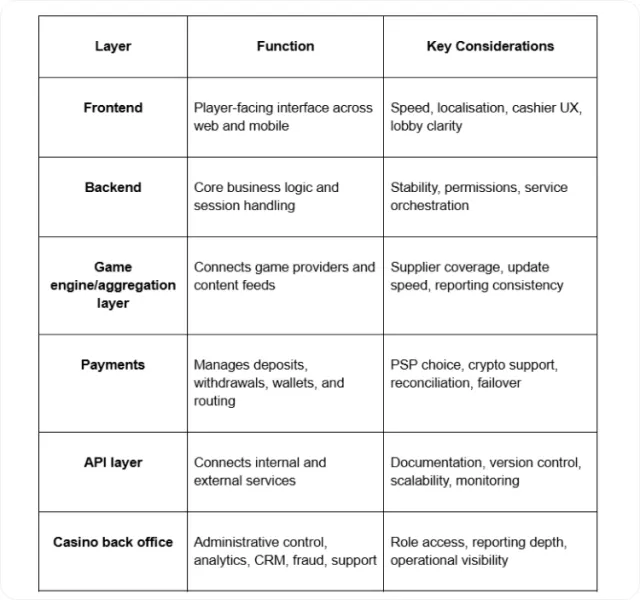
Behind the lobby, several layers work together to keep the business stable. The player only sees the visible side, yet deposits, withdrawals, content delivery, risk checks, and reporting all depend on separate components that must work together reliably. If one of these components is weak, the rest of the system becomes slower, less flexible, and harder to manage.
What components a modern casino setup usually includes:
Frontend
The player-facing side is where trust begins. Registration flow, cashier design, page speed, and mobile clarity affect whether a first-time visitor deposits or leaves. This area also reflects the brand tone, but it should not contain too much business logic, as that makes updates harder and testing slower.
Backend
The core service layer handles accounts, permissions, sessions, bonus logic, and much of the internal coordination. A clean core makes later integrations easier. A poorly structured one creates friction each time the operator adds a payment method, a KYC tool, or a new supplier.
Game Engine or Aggregation Layer
Content does not arrive as a single, simple feed. Operators often work with several studios, live casino suppliers, crash game vendors, and sometimes sports or casual products as well. That is why the aggregation layer affects how quickly titles can be added, how data is standardised, and how reporting remains consistent across providers.
Payments
The cashier is now one of the most sensitive parts of the product. Players assess speed and trust here more than anywhere else. If deposits fail, withdrawals are delayed, or wallet logic feels unclear, the rest of the experience loses value very quickly.
API Layer
This is the component that connects the entire stack. Good design reduces custom work, lowers integration risk, and gives the operator room to replace or add services later. Poor quality in this area creates dependency and slows every future change.
Casino Back Office
The administrative panel is where the business is managed. Risk teams, finance staff, CRM specialists, and support agents rely on this environment every day. When this area is weak, the operator may still have a well-designed site, but the business behind it becomes harder to manage.
API Layer in Detail
Most teams focus on games and payments first, because those parts are easy to see. However, the more important question is how all the components connect once the product enters real operation. The API layer is central to a modern casino platform architecture.
A strong operational layer should connect key services without constant custom coding. In practice, it usually sits between the operator’s core system and the tools or vendors that require data, instructions, or status updates. The cleaner this connection model is, the easier it becomes to scale, replace, or extend the stack.
What a modern API layer should usually connect to:
- game content feeds;
- payment service providers;
- crypto wallet modules;
- KYC and identity tools;
- fraud scoring services;
- CRM and bonus engines;
- analytics and BI exports;
- support and monitoring systems.
This is why API quality deserves board-level attention in a gambling business. If game suppliers are connected through one poorly structured setup and payment tools through another, the operator ends up with duplicated logic, limited visibility, and higher maintenance costs. Clean interfaces achieve the opposite. They reduce friction and make future rollout plans more predictable.
Documentation matters more than many founders expect. A well-described endpoint, clear version history, and predictable response format save time when a new partner is added. That point may sound technical, but it is directly commercial. Faster integrations mean quicker launches in new markets, lower development spend, and fewer operational issues after going live.
Monitoring matters just as much. Operators need to see which calls fail, where delays occur, and whether one connector is causing additional load or higher error rates. Without that visibility, a team may blame the wrong supplier, PSP, or even the market when the actual issue lies in a hidden interface failure.
Versioning is another major issue. Live businesses cannot stop every time a provider changes a field or introduces a new request format. Good API governance makes those transitions manageable. Weak discipline turns every supplier update into a risk event.
That is why the real API discussion is about control, speed, and resilience. Choosing the right API layer for a casino platform defines how flexible a project can become over time.
Turnkey, Direct API, or Hybrid
These routes solve different business problems. None of them is automatically right or wrong. The stronger choice depends on how much control the operator wants, how quickly the brand must launch, and how much internal product capacity exists from the start.
A turnkey route works well for teams that want faster deployment and a lower technical burden at the beginning. Much of the work is handled by the provider, which reduces time to market. The downside is that some future changes may still depend on vendor priorities.
A direct API-led build provides greater control. This model suits firms with strong product leadership, internal technical resources, and a clear reason to shape the stack more precisely. It offers flexibility, but it also brings more integration responsibility and more components to manage.
The hybrid path often suits growth-focused operators best. This structure usually combines a reliable core with flexible connectors for payments, content, or supporting tools. It allows the operator to move faster than with a fully bespoke project whilst still keeping room for market-specific adjustments.
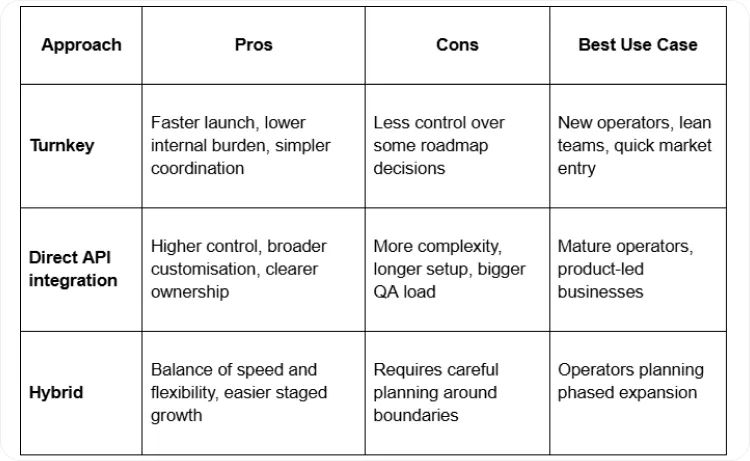
The decision should be treated as an integration strategy. A company may launch on one structure and still prepare for another later, provided the control layer is strong enough to support that evolution.
Payment Infrastructure in 2026
Money flow now affects retention, trust, and investor confidence as much as game content. A casino can operate with a modest lobby at launch. It faces greater difficulty when the cashier feels slow, limited, or unreliable. In 2026, payment flexibility is a core part of casino platform architecture.
Global ownership of digital currency exceeded 560 million people in 2024. 65% of users are estimated to prefer crypto payments. In addition, fiat-backed stablecoin purchases on Visa-branded cards surpassed other crypto purchases in the second half of 2025. Around 48% of users reported faster settlement as the main benefit, ahead of cost savings.
Why the Payment Layer Now Deserves More Attention
Cashier performance strongly affects conversion. However, it also influences fraud exposure, support workload, treasury visibility, and the speed of expansion into new geographies. If the settlement model is weak, the operator may require more manual work, more exception handling, and greater reconciliation effort.
This is where architecture matters. A payment layer should not be treated as a single checkout widget. It should be designed as a routing and wallet environment that can support local methods, international PSPs, crypto rails, and internal reporting at the same time. When these components are poorly integrated, scaling becomes difficult.
Fiat Rails Still Matter
Bank cards, transfers, local electronic systems, and regional PSPs remain essential in most markets. They provide familiarity and often drive first deposits in regulated or semi-regulated environments. Rosloto’s provider page presents the same point from a commercial perspective, describing support for bank card transfers and international electronic systems as part of a comprehensive online casino software offering.
That is why crypto should not replace fiat in the planning model. It should complement it. The most effective cashier in 2026 is usually a flexible mix of traditional and digital assets.
Why Crypto Now Belongs in Core Planning
Digital assets have moved beyond the role of being just an additional feature. This does not mean every operator should position itself as a crypto-first brand. It means that support for blockchain-based settlement, wallet logic, and stable-value instruments now has operational value.
Visa highlights always-on liquidity, faster settlement windows, shorter funding cycles, clearer real-time fund visibility, near-real-time delivery, and auditable on-chain confirmation as practical benefits. These are significant operational advantages for businesses that move funds across markets or require faster payout processes.
What a Platform with Crypto Casino Payments Should Support
A simple add-on is not enough when digital assets become part of the cashier setup. For an operator, the goal is to ensure speed, clarity, and smooth internal handling from the very start.
A modern payment stack should support the elements from the start:
- Bitcoin deposits and withdrawals;
- USDT support;
- ETH support;
- multi-currency wallets;
- fast payout logic;
- internal settlement visibility;
- PSP fallback options;
- clean reconciliation rules.
These points matter because crypto traffic is not one thing. Bitcoin may matter for brand signalling and long-hold users. USDT often matters for stability and operational ease. ETH may matter for a different wallet audience. The operator does not need every single token available. There must be the right base set, with the proper reporting and risk controls behind it.
That is why the technology choice should not be reduced to whether it is possible to add crypto later. The better question is whether the system can support mixed-value flows from the start. The addition of a crypto framework is a relevant infrastructure decision.

Multi-Payment Casino System
The strongest setups do not force players into one route. They allow fiat and crypto payments to operate within the same environment without creating confusion for users or complexity for operations. That mix is now one of the clearest signs of a mature casino platform.
What principles a multi-payment design usually follows:
- Separate cashier UX from settlement logic. The front-end experience should remain simple, even if the backend routes transactions through several processors or wallet modules. Players should see clarity, not technical complexity.
- Support fiat and crypto casino payments side by side. One group may prefer cards or transfers, while another prefers stablecoins or Bitcoin. A strong stack supports both without making either option feel secondary.
- Use PSP integrations through one stable control layer. This reduces rework when a processor underperforms, exits the market, or needs to be replaced. The operator gains flexibility and does not need to change the entire product.
- Design for regional diversity early. Payment behaviour varies by market. A launch that works in one geography may be less effective in another if the cashier reflects only global assumptions.
- Plan reconciliation and finance visibility from the start. Mixed payment systems quickly create reporting complexity. If treasury exports and internal dashboards are introduced late, the business loses clarity as it begins to scale.
The main objective is to create a cashier that can evolve without requiring significant rewrites. This is where modular casino infrastructure becomes a commercial asset rather than a technical concept.
Common Integration Mistakes
Problems usually begin well before launch. Many operators face additional cost and delays because the sequence of decisions was poorly structured. Once that happens, every new connector becomes harder to implement.
The most common problems:
- Overcomplicating the API stack too early. Some teams try to connect too many services before validating their initial business model. This creates additional QA workload, more failure points, and reduced clarity.
- Ignoring payment scalability. A cashier that works for one PSP and a single region may not support expansion effectively. The earlier routing, failover, and wallet logic are planned, the better.
- Choosing inflexible providers. A low-cost option can become expensive if the vendor delays changes, restricts access, or handles requests inflexibly. Dependency risk is often underestimated.
- Underestimating integration cost. The connector itself is only part of the work. Mapping, testing, monitoring, reporting, and post-launch fixes all require significant effort.
- Treating crypto as a cosmetic extra. When digital-asset support is added as an afterthought, reconciliation, wallet management, and user flows often become inconsistent. This weakens both the user experience and internal processes.
- Neglecting documentation and monitoring. A system with poor logging and unclear endpoint behaviour becomes much harder to manage under pressure. Small issues may remain unnoticed until they affect the player.
Security data adds another reason to take these risks seriously. Credential abuse remains the leading initial access vector at 22%, exploitation of vulnerabilities accounts for 20%, and third-party involvement in breaches has increased to 30%. In practical terms, weak Bitcoin casino integration and poorly governed partner connections can create real business risk. Good preparation helps avoid these issues. Operators who plan integrations early reduce the likelihood of costly rebuilds later.
What Investors Should Check in 2026
A polished front end can hide weak internals. That is why the operator’s review should move well past the visible site and into the operating logic of the stack itself.
A 2026 due diligence checklist:
- load resilience;
- modular service layout;
- API documentation quality;
- payment diversity;
- crypto readiness;
- back-office usability;
- reporting visibility;
- partner reliability;
- version control discipline;
- monitoring and alerting depth;
- vendor replacement feasibility;
- wallet and reconciliation logic.
This matters because architectural quality affects margin and exit value over time. A business with clean connectors, multiple payment options, and strong admin visibility is easier to scale and defend in front of investors. A weaker build may still generate traffic, but it often carries hidden friction that reduces long-term efficiency.
The security angle belongs here too. Research findings on credential abuse, vulnerability exploitation, and growing third-party exposure show why vendor governance, access control, and API discipline should be part of the investment discussion from the beginning.
Where Technology Partners Fit
Very few operators want to assemble every connector independently. Most need a partner that can provide structure at launch whilst still allowing room for expansion later. That balance is especially important for firms building an online gambling platform with multiple payment methods and a staged growth plan.
Operators often rely on partners such as Rosloto when they need a balance between structured deployment and flexible integration options. Offers are typically built around a broad software portfolio, support for common payment methods, blockchain-focused capabilities, and the operational features expected from a comprehensive casino back office. This positioning suits founders and platform teams who want a core system that supports both turnkey speed and future API-led expansion.
The best provider does not simply help a brand go live. It reduces friction around connectors, increases payment flexibility, and lowers the cost of future changes. That is the practical value of an experienced infrastructure partner. A strong casino platform architecture balances control with speed of deployment.
Conclusion
Modern casino growth depends on decisions made beyond the visible interface. The strongest platform can launch quickly and support reliable casino API integration, modular infrastructure, a robust back office, and a multi-payment system that can handle both fiat and crypto payments as the business grows.
For operators in 2026, the key point is clear. Choose the right API layer early, design the cashier as core infrastructure, and plan for staged expansion rather than short-term convenience. This approach supports casino platform architecture in 2026 with fewer rebuilds, better payment flexibility, and stronger long-term performance.
This article was prepared by Clara Hazel, an experienced iGaming specialist with expertise in casino platform architecture, API integrations, and digital payment ecosystems.