
 BTC
BTC
 ETH
ETH
 LTC
LTC
 BCH
BCH
 DOGE
DOGE
 USDT
USDT
 DASH
DASH
 XRP
XRP
 USDC
USDC
 XMR
XMR
 TRX
TRX
 BNB
BNB
 SHIB
SHIB
 DAI
DAI
 ZEC
ZEC
 SOL
SOL
 ETC
ETC
 POL
POL
 XLM
XLM
 ADA
ADA

Most companies looking into blockchain development aren’t chasing technology for its own sake. They’re trying to solve a very specific problem: how to coordinate data, assets, or transactions across multiple parties that don’t fully trust each other without putting one player in control. Yet many blockchain projects stall or fail long before launch. Why? Because teams start with tools instead of outcomes.
This article explains blockchain development in practical terms, shows when it’s actually worth the effort, and walks through a delivery process that helps you avoid expensive mistakes.
What blockchain development really means
At its core, blockchain development is about building software that runs on top of a shared, append-only ledger. That ledger is maintained by a network rather than a single database owner, and the rules for updating it are enforced by code.
That code is usually written as smart contracts – programs deployed on the blockchain that automatically execute business logic. For example, a smart contract might release funds when conditions are met, update ownership records, or enforce usage limits. Once deployed, these rules are difficult to change, which is both the main advantage and the biggest risk.
When blockchain development makes sense
Blockchain is worth considering when trust, coordination, and verification are core to the product—not add-ons. Typical signals include:
- Multiple organizations need a shared source of truth;
- Auditability and data integrity are non-negotiable;
- Digital assets or rights must move under predefined rules;
- The product needs to integrate with the wider Web3 ecosystem.
In these cases, blockchain app development can reduce reconciliation costs, disputes, and manual oversight.
When it doesn’t
If a single company owns the system, controls access, and can enforce rules centrally, a traditional architecture will almost always be faster, cheaper, and easier to maintain. Blockchain also struggles where ultra-low latency or frequent rule changes are essential. Using it “just in case” usually leads to over-engineering and slower delivery.
A realistic blockchain development process
Well-run blockchain projects don’t look chaotic or experimental. Whether built in-house or with the support of a blockchain software development company, they follow a disciplined product and engineering flow, with extra attention paid to security and governance.
1. Discovery
This phase is about deciding what should exist on the blockchain at all. Teams map business logic, participants, incentives, and failure scenarios. Just as important, they decide what stays off-chain, because most data should. Discovery typically produces a clear use-case definition, early risk assessment, and a shortlist of suitable networks.
2. Architecture
Architecture defines how on-chain components interact with off-chain systems like user interfaces, analytics, payment processors, or internal tools. Choices made here (public vs permissioned networks, wallet strategy, upgrade paths) are difficult to reverse later. This is where enterprise blockchain and Web3 models diverge most clearly.
3. Smart contract development
Smart contract development is the most sensitive part of the process. Contracts encode business rules directly into the ledger, often controlling valuable assets. Because deployed contracts are hard to change, teams must design for clarity, minimalism, and controlled upgrades from day one. Testing here goes beyond happy paths and actively tries to break the system.
4. Audits and launch
Independent security audits review the contracts for vulnerabilities and logic errors. Findings almost always lead to refactoring and re-testing. Only after this loop does production deployment make sense. Launch is gradual, monitored, and paired with clear procedures for pausing or mitigating issues.
5. Maintenance
Blockchain systems are not “set and forget.” Ongoing maintenance includes monitoring contract behavior, managing keys and permissions, upgrading components safely, and responding to ecosystem changes. This operational work is often underestimated and frequently determines long-term success.
Common pitfalls that derail projects
Treating security as a final step
Security issues rarely come from exotic attacks; they usually stem from missing access controls, unsafe upgrade paths, or flawed assumptions. When security is added late, fixes become expensive and sometimes impossible. Teams that succeed design contracts defensively from the start and treat audits as part of development, not a checkbox.
Letting token hype drive product decisions
Introducing a token before the product delivers real utility often attracts speculation rather than users. This can distort incentives and distract teams from solving actual customer problems. Strong projects earn usage first and design token mechanics only when they clearly support the business model.
Choosing the wrong blockchain
Every blockchain comes with trade-offs around cost, governance, performance, and ecosystem support. Picking a chain based on popularity alone can lock a product into high fees, limited upgradeability, or poor tooling. A short validation phase can prevent months of rework.
Ignoring compliance and privacy realities
Public blockchains are transparent by default, which can conflict with regulatory or data protection requirements. Storing sensitive data on-chain is a common mistake. Mature architectures keep personal or regulated data off-chain and use the blockchain only to verify integrity and enforce rules.
Assuming scalability will “work itself out”
What works in a pilot often breaks under real usage. Transaction fees rise, confirmation times slow, and user experience suffers. Scalability needs to be designed early, with clear assumptions tested before launch rather than after growth begins.
Enterprise blockchain vs Web3 development
The difference between enterprise blockchain and Web3 development is less about technology and more about trust models and governance.
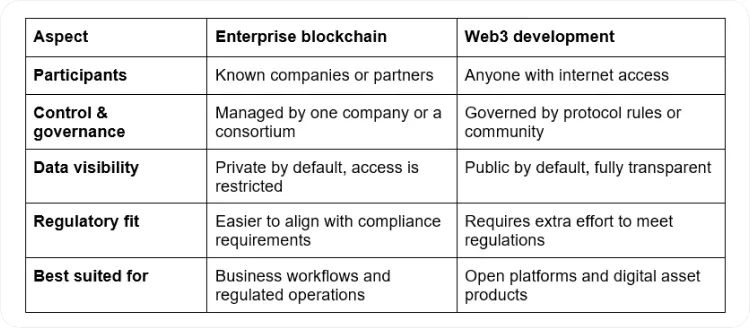
In practice, many successful products combine both approaches, keeping sensitive logic private while anchoring verification or settlement on public infrastructure. When done well, this hybrid model can transform collaboration without sacrificing control.
What actually drives cost and timelines
There’s no fixed price tag for blockchain development because cost is a function of risk, scope, and operational complexity, not just engineering hours. The factors below are what actually move timelines and budgets.
Product and use-case complexity
A simple proof-of-concept that records events on-chain is very different from a production system that manages assets, permissions, and edge cases. The more actors, workflows, and exceptions involved, the more design, testing, and coordination time is required. Complexity compounds quickly when business logic is embedded directly into smart contracts.
Smart contract risk and value at stake
The higher the value controlled by smart contracts, the higher the required assurance. Contracts that move funds, enforce ownership, or gate access demand deeper testing, multiple audits, and stricter controls. This directly affects timelines, as security reviews often require several fix-and-review cycles.
Blockchain and infrastructure choices
Different blockchains come with different tooling maturity, transaction costs, and deployment friction. Some ecosystems allow faster iteration but higher ongoing fees; others are cheaper to run but slower to develop on. Infrastructure decisions, such as wallet management, node providers, and indexing services, also influence both build time and long-term operating cost.
Integrations with existing systems
Most real-world blockchain products don’t live in isolation. Integrating with identity systems, payment providers, custody solutions, analytics tools, or internal enterprise software adds coordination overhead. Each integration introduces dependencies, testing requirements, and potential failure points that extend delivery timelines.
Security and audit requirements
Security is an ongoing process. Internal reviews, external audits, remediation, and re-audits all add time, but skipping them increases the risk of catastrophic failure. Mature teams budget for security work as a core delivery stream, not a contingency.
Compliance and regulatory constraints
If the product touches regulated data, financial flows, or identifiable users, compliance becomes a major scope driver. Designing architectures that support reporting, access controls, and data protection requirements often shapes both technical design and delivery speed.
Post-launch operations and governance
Launch is not the finish line. Monitoring, incident response, key management, upgrades, and governance processes all require planning and implementation. Teams that ignore operational readiness may ship faster, but usually pay for it later in outages, rushed fixes, or lost trust.
Conclusion
Blockchain development is not a shortcut or a marketing feature. It’s a specialized approach to solving coordination and trust problems that traditional systems struggle with. For decision-makers, the real challenge is knowing when to use it and when not to. Start with the business problem, design conservatively, invest early in security, and plan for long-term operations. Done well, blockchain can discover new efficiencies and unleash new product models. Otherwise, it becomes an expensive distraction.
