
 BTC
BTC
 ETH
ETH
 LTC
LTC
 BCH
BCH
 DOGE
DOGE
 USDT
USDT
 DASH
DASH
 XRP
XRP
 USDC
USDC
 XMR
XMR
 TRX
TRX
 BNB
BNB
 SHIB
SHIB
 DAI
DAI
 ZEC
ZEC
 SOL
SOL
 ETC
ETC
 POL
POL
 XLM
XLM
 ADA
ADA

Crypto arbitrage is a latency-sensitive, data-intensive operation. The margin between a profitable trade and a missed opportunity often comes down to milliseconds – and the quality of your network infrastructure is one of the few variables you can actually control. Proxy selection, in particular, is where most arbitrage setups either gain a decisive edge or introduce a consistent source of failure.
This guide cuts through the noise. It focuses on what actually matters for arbitrage workflows: IP exclusivity, protocol support, geographic distribution, latency profiles, and how different proxy types map to specific use cases across centralized and decentralized exchange environments.
Why Proxy Infrastructure Matters in Crypto Arbitrage
Most exchange APIs enforce rate limits per IP address. When you are running simultaneous price feeds across multiple trading pairs on different platforms, a single shared or overloaded IP becomes a bottleneck – and a risk. A rate-limited IP means delayed price data, and delayed data in arbitrage is the same as wrong data.
Beyond rate limits, many exchanges apply trust scoring to API requests based on IP history. An IP that has been associated with scrapers, bots, or previous policy violations will see elevated CAPTCHA challenges, additional authentication steps, or silent request throttling. None of these are visible in your error logs until the damage to your execution is already done.
The practical implication: your proxy layer must provide IPs that are clean, stable, exclusively assigned to you, and distributed across the geographies relevant to your exchange set. That last point is underrated. Matching your proxy's geo to the exchange's primary infrastructure region reduces round-trip latency by 15–40 ms in many cases – which at the scale of automated execution, is meaningful.
Proxy Types: How They Map to Arbitrage Requirements
Datacenter IPv4: Speed-First for CEX API Polling
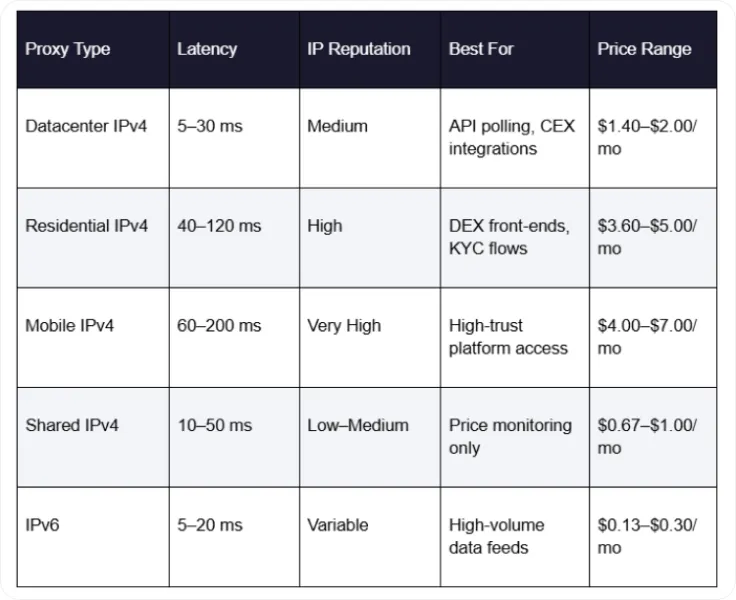
Datacenter proxies offer the lowest baseline latency of any proxy category, typically 5–30 ms on well-routed infrastructure. For centralized exchange (CEX) API integrations where your traffic pattern is predictable and professional, datacenter IPs with a clean history perform well. They are also the most cost-efficient option, making them practical for high-volume endpoint polling across dozens of trading pairs.
The limitation is reputation volatility. Datacenter IP ranges are more likely to appear on commercial blocklists, and some exchanges have tightened their policies around datacenter traffic over the past two years. For straightforward REST and WebSocket API access, this is rarely an issue – but if you are accessing front-end interfaces or triggering account-level workflows, you need to plan around this.
Residential IPv4: The High-Trust Option for Complex Workflows
Residential proxies route traffic through IPs associated with consumer internet service providers. To an exchange's detection layer, this traffic looks indistinguishable from a regular user session. That trust profile makes residential IPs the right choice for any workflow that touches KYC flows, front-end DEX interfaces, or account-level operations that are sensitive to origin classification.
The trade-off is latency and cost. Residential IPs add 40–120 ms of overhead compared to datacenter alternatives, and they carry a meaningful price premium. For pure price-feed operations that never touch the front-end, this overhead is unjustified. For multi-leg strategies that include session-based exchange access, the trust value outweighs the latency cost.
Mobile IPv4: Maximum Trust, Maximum Cost
Mobile IPs occupy the highest trust tier in exchange detection systems. They are the least likely to trigger additional verification steps and the most forgiving in terms of behavioral pattern analysis. For arbitrage teams operating at scale across high-scrutiny platforms, mobile proxies serve as a reliable backstop for the most sensitive parts of the workflow – though their latency profile (60–200 ms) and cost structure make them impractical as a primary data infrastructure.
Proxy Type Comparison for Crypto Arbitrage
The table below compares the four main proxy categories across the dimensions that matter most for arbitrage infrastructure:
Geographic Distribution and Exchange Latency
Running arbitrage across Binance, Coinbase, Kraken, and OKX simultaneously means your proxy infrastructure needs to cover multiple continents with low intra-region latency. The architectural decision here is not just about having IPs in many countries – it is about having IPs in the right countries relative to where each exchange's API infrastructure is hosted.
For example, Binance's primary API infrastructure is anchored in Asia-Pacific, with secondary presence in Europe. If your strategy depends on Binance price feeds, a proxy routing through Hong Kong or Singapore will outperform one routing through Germany on round-trip time. Coinbase and Kraken skew toward the US and EU respectively. Building a geo-matched proxy layer requires knowing where your latency is actually going, not just where your IPs say they are.
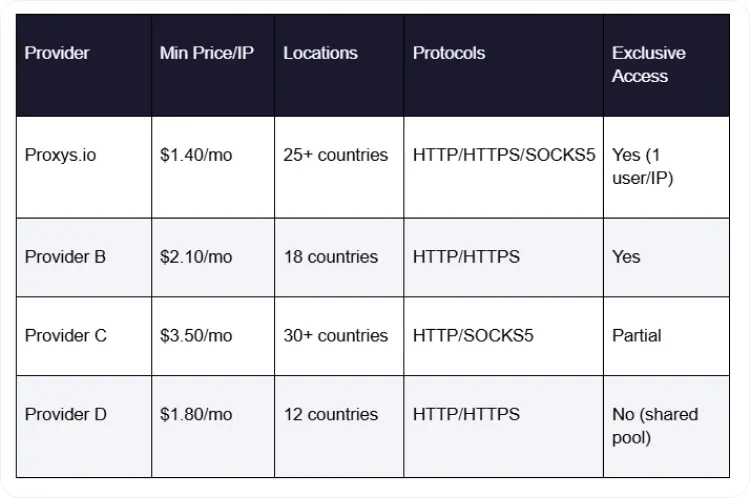
Infrastructure quality also determines consistency. Proxies hosted on well-peered datacenter ASNs with direct routes to major internet exchanges will maintain stable latency across market volatility events – exactly when your execution depends on it most. This is why provider selection matters beyond just price per IP. The team at Proxys.IO provides exclusively assigned IPs across 25+ countries with HTTPS, HTTP, and SOCKS5 protocol support – a combination that maps cleanly to the protocol diversity of modern exchange API environments.
Provider Selection: What the Data Shows
Most proxy buyers evaluate providers on price per IP, location count, and protocol support. These are necessary but not sufficient criteria for arbitrage use cases. The variables that separate performant infrastructure from unreliable infrastructure are IP exclusivity, subnet diversity, and connection stability under sustained load.
IP exclusivity is non-negotiable. Shared proxies – even those advertised as 'semi-dedicated' – introduce reputation risk from other users' traffic patterns. A single account on the same shared IP running aggressive scraping will degrade your exchange access, regardless of your own traffic behavior. For arbitrage, the rule is simple: one IP, one operator.
Subnet diversity matters because exchanges and their WAF/DDoS protection vendors increasingly track behavior at the subnet level, not just the individual IP level. Ten IPs from the same /24 block provide less protection against subnet-level rate limiting than ten IPs spread across different ASNs. Evaluate providers on their subnet distribution, not just their IP count.
The following provider comparison reflects publicly available pricing and infrastructure data as of 2025:
Protocol Configuration for Arbitrage Bots
Most arbitrage frameworks support HTTP, HTTPS, and SOCKS5 proxy configurations. SOCKS5 is the preferred protocol for low-overhead TCP connections – it operates at the transport layer and adds less overhead than HTTP CONNECT tunneling. For WebSocket-heavy exchange connections, SOCKS5 provides a cleaner path with fewer points of protocol translation.
HTTPS proxies add TLS overhead but are required for any exchange integration that enforces certificate pinning or TLS inspection at the proxy layer. The practical recommendation is to maintain separate proxy pools for different protocol requirements rather than routing everything through a single configuration.
One configuration detail that is frequently overlooked: proxy authentication method. IP-based whitelisting is more reliable than username/password authentication for high-frequency connections, as it eliminates the authentication round-trip that can add 5–15 ms per connection establishment. For a deeper technical walkthrough on proxy setup for automated systems, the guide at choosing the right proxy for trading bots covers configuration patterns that apply directly to exchange API integrations.
Operational Considerations: Rotation, Monitoring, and Failover
Static IP assignment is standard for arbitrage operations – you want a known, stable IP presenting to each exchange endpoint, not a rotating pool that changes session fingerprints on every connection. However, having a rotation capability in reserve is valuable for recovery scenarios: if an IP gets flagged, you need the ability to switch quickly without rebuilding your entire proxy configuration.
A minimal proxy monitoring stack for arbitrage should track the following signals:
- Round-trip latency to each exchange endpoint (per IP, logged continuously)
- HTTP response codes – elevated 429s signal rate limiting before your bot logs it
- Connection establishment time – increases indicate proxy-side congestion or routing degradation
- Proxy uptime – even brief outages during high-volatility periods translate to missed execution windows
Failover architecture should be built at the proxy pool level, not the application level. Maintain at least two proxy endpoints per exchange integration, with automatic cutover logic in your connection manager. This is not a resilience-theatre exercise – exchange API outages and proxy degradation events do not announce themselves in advance.
When to Upgrade Your Proxy Infrastructure
The signal that your proxy setup needs re-evaluation is usually not a hard failure – it is a gradual degradation in fill rates, an increase in unexpected authentication challenges, or latency variance that was not there three months ago. These are symptoms of IP reputation erosion, often caused by subnet-level contamination from other users on the same provider.
If you are running more than ten concurrent exchange connections, operating across more than three geographic regions, or executing strategies with execution windows under 500 ms, you have outgrown shared or budget proxy infrastructure. At that scale, the cost of proxy quality is trivially small relative to the cost of missed execution.
The evaluation criteria for upgrading are: exclusively assigned IPs from diverse subnets, sub-30 ms datacenter latency in your target regions, full SOCKS5 support, API-accessible proxy management, and a provider with documented uptime SLAs. These are not premium features – they are the baseline requirements for serious arbitrage infrastructure.
Conclusion
Proxy infrastructure for crypto arbitrage is an engineering problem, not a commodity purchase. The difference between a well-configured proxy layer and a cheap shared proxy pool is measured in execution quality, IP stability, and the absence of invisible throttling events that silently degrade your strategy's performance.
Start with exclusively assigned datacenter IPv4 for CEX API polling, add residential IPs for any workflow that requires high-trust origin classification, and build monitoring into your proxy layer from day one. Match your geo to your exchange infrastructure, prioritize subnet diversity over raw IP count, and treat proxy quality as a core component of your execution stack – not an afterthought.
