
 BTC
BTC
 ETH
ETH
 LTC
LTC
 BCH
BCH
 DOGE
DOGE
 USDT
USDT
 DASH
DASH
 XRP
XRP
 USDC
USDC
 XMR
XMR
 TRX
TRX
 BNB
BNB
 SHIB
SHIB
 DAI
DAI
 ZEC
ZEC
 SOL
SOL
 ETC
ETC
 POL
POL
 XLM
XLM
 ADA
ADA

More merchants are accepting crypto than ever before. Stablecoin transaction volume hit roughly $33 trillion in 2025, up approximately 83% from the previous year, and over 25 million businesses worldwide now process some form of cryptocurrency payment.
If you have been considering adding crypto checkout to your business, the infrastructure has matured significantly, and the setup process is far more straightforward than it was even two years ago.
What a Crypto Payment Gateway Actually Does
A crypto payment gateway sits between your customer and your business, processing digital asset transactions the same way Stripe or PayPal handle card payments.
It generates invoices, monitors the blockchain for confirmations, and either delivers crypto directly to your wallet or converts it to fiat and deposits it into your bank account.
The merchant does not need to understand how blockchains work. The gateway handles all of that in the background.
How the Transaction Flow Works
- Customer selects crypto at checkout – The gateway generates a unique payment address or QR code with a time-limited invoice
- Customer sends payment – Funds are sent from their wallet to the generated address on the selected network
- Gateway confirms the transaction – The blockchain confirms the payment, typically within seconds to minutes, depending on the network
- Merchant receives settlement – The gateway either sends crypto directly to the merchant's wallet or converts it to fiat and initiates a bank transfer
A well-organized merchant account like stashpatrick can help you keep your incoming crypto payments separated and tracked by purpose, which simplifies accounting when your settlement arrives in mixed formats.
The Business Case for Accepting Crypto
The fee structure alone makes a compelling argument. Most crypto payment gateways charge between 0.4% and 1%, compared to the 2% to 3% that traditional card processors typically charge. For a business processing $50,000 per month, that difference adds up meaningfully over a year.
Deloitte's most recent merchant survey found that 87% of merchants view crypto payments as a competitive advantage, and 77% specifically cite lower fees as the primary reason for accepting them.
Key Advantages Over Traditional Payment Processing
- No chargebacks – Crypto transactions are irreversible, which eliminates chargeback fraud, a problem that costs merchants billions annually
- Faster settlement – Nearly 80% of crypto payment gateways offered instant settlement in 2025, compared to the 1 to 3 business days typical of card processors
- Lower transaction fees – Gateway fees start at 0.5%, well below the standard card processing rate
- Global reach – Crypto removes currency conversion barriers for international customers, making cross-border sales easier to process
- New customer segment – 45% of merchants report that accepting crypto has helped them attract customers they would not have reached through traditional payment methods

Comparing the Top Gateway Options
Not every gateway suits every business. Your choice depends on your sales volume, technical setup, geographic market, and whether you want fiat settlement or direct crypto payouts.
The global crypto payment gateway market reached $2.39 billion in 2026, reflecting a market with multiple mature options across every business size.
Gateway Comparison at a Glance
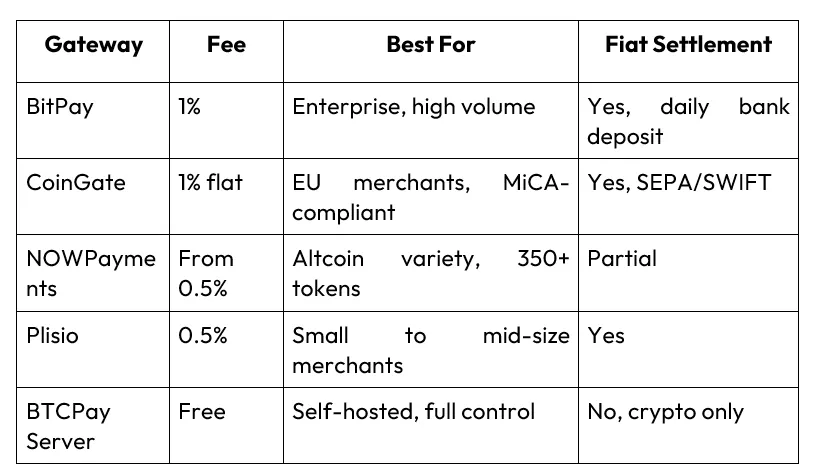
A finance tool like patrickstash can complement your gateway setup by helping you track payment inflows across multiple platforms, which becomes important when you are comparing performance across different payment channels.
How to Get Started as a Merchant
The setup process varies slightly by gateway, but the general path is consistent across most platforms. For e-commerce businesses on Shopify or WooCommerce, dedicated plugins make the process faster.
Choosing the right gateway before integrating saves you from having to switch later.
Setup Steps for New Merchants
- Choose your gateway – Match the provider to your volume, location, and technical setup. CoinGate suits EU merchants; BitPay suits high-volume US businesses; NOWPayments covers the widest range of tokens
- Complete merchant verification – Most regulated gateways require KYC documentation including business registration and identity verification
- Install the plugin or configure the API – Shopify and WooCommerce merchants can install a plugin in minutes; custom platforms integrate via the gateway's API
- Select your settlement preference – Choose between receiving crypto directly or converting to fiat automatically at the point of payment
- Run a test transaction – Send a small amount through your checkout before going live to confirm the flow works end to end
- Set up accounting records – Document your wallet addresses and settlement preferences from the start to simplify tax reporting later
What to Keep in Mind
Accepting crypto payments is a practical business decision in 2026, not an experiment. The tooling is stable, the fees are competitive, and the customer demand is real. Start with a single gateway, test it against your actual checkout flow, and expand your options once you understand how settlement works for your specific business model.
