
 BTC
BTC
 ETH
ETH
 LTC
LTC
 BCH
BCH
 DOGE
DOGE
 USDT
USDT
 DASH
DASH
 XRP
XRP
 USDC
USDC
 XMR
XMR
 BNB
BNB
 TRX
TRX
 SHIB
SHIB
 DAI
DAI
 ZEC
ZEC
 SOL
SOL
 ETC
ETC
 POL
POL
 XLM
XLM
 ADA
ADA
The digital era has arrived. Now, any click and transaction can be tracked. This has made the concept of real financial privacy important. And it has made it appealing. Cryptocurrencies were designed to be decentralized, but Bitcoin and Ethereum merely offer pseudonymity: it is still possible to track wallet addresses with sufficient effort.
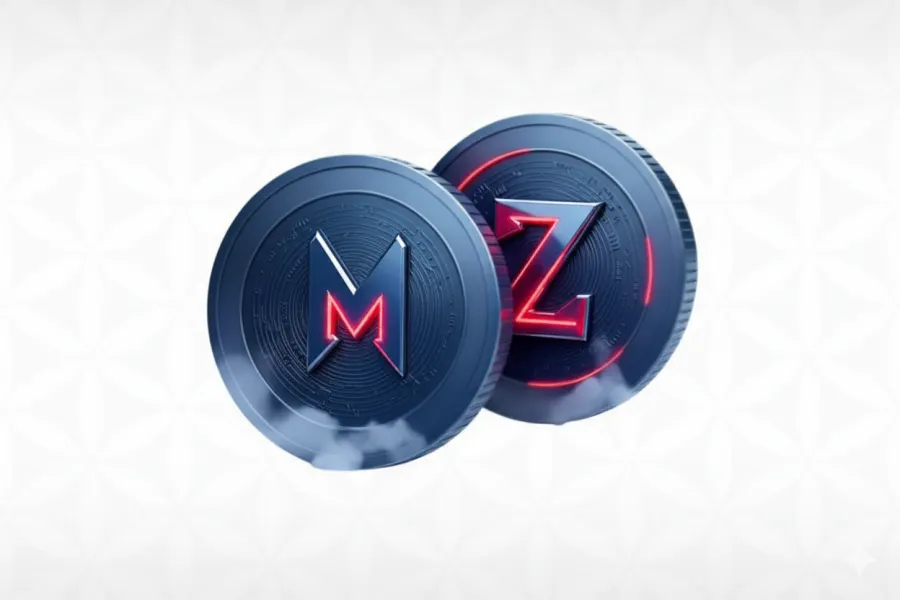
The result of that break was the development of Privacy coins, a type of virtual currency that secures both your identity and money. Two of the leaders in this field are Monero (XMR) and Zcash (ZEC), which have transformed how people make anonymous transactions. Although regulators usually complain about their possible misuse, supporters of privacy say it is a basic right. This in-depth analysis will examine the functionality of these coins and where they are applicable, as well as why the discussion on them is not yet over.
The Rise of Privacy Coins
The introduction of Bitcoin in 2009 completely changed the way we think about money. However, it wasn't long before experts and users realized that it had some problems. The transactions are documented in a transparent blockchain, which forms a permanent, publicly written ledger. To some, this was a virtue; to others, a menace. Companies, citizens in oppressive regimes, and privacy-sensitive citizens began demanding more powerful assurances.
This is where privacy coins came in. These initiatives extended into pseudonymity, using cryptographic methods to conceal the details of senders, receivers, and amounts. They provided transactions that were not transparent, meaning that only the participants were aware of them, as opposed to a money trail being visible. Monero became the leader of untraceable payments. Zcash offered optional privacy with state-of-the-art mathematics. These innovations gained supporters and opponents over the years, and also gave birth to one of the most significant debates in the world of cryptocurrency. The question was: to what extent can money provide privacy?
Monero (XMR) — Anonymous King of Payments
Monero has been called the gold standard of privacy in the crypto world. It is based on the combination of the ring signatures, stealth addresses, and Ring Confidential Transactions (RingCT) to cover all parts of identifying data. Unlike Bitcoin, where anyone can see how much money is in people's wallets and how transactions are made, the Monero blockchain keeps information secret. It is impossible to link a wallet to an individual without his or her cooperation.
This means Monero is considered a perfect form of payment as far as privacy is concerned, and users can make payments, donations and even cross-border transactions without any concern in terms of anonymity. Activists, journalists and ordinary citizens use it in order to evade their fear of being spied on.
Its effectiveness has, however, also attracted regulatory scrutiny. Some other exchanges scrubbed Monero because of government pressure due to their fear of money laundering. However, the Monero community remains strong, and some of its releases, including the so-called Bulletproofs or Seraphis, make the coin efficient and private. The anonymity that Monero has seen itself as dedicated to makes it the point of reference when the discussion concerns financial privacy.
Zcash (ZEC) — Choice and Privacy
Zcash does not do the same. Rather than having a default privacy mode, it provides two options: transparent and shielded. Transparent transactions are similar to Bitcoin and can be seen by anyone. Shielded transactions, on the other hand, use a technology called zero-knowledge succinct non-interactive arguments of knowledge (ZK-SNARKs). This enables one to authenticate a transaction without divulging information.
This flexibility is appealing to companies and organizations that need privacy and at the same time are expected to be audited. Shielded transactions have, however, been poorly implemented because of their complexity and high computational requirements. Nonetheless, Zcash plays a major role in the ecosystem. It shows that privacy is not an all or nothing kind of offer; it may be an option. Zcash provides a special middle ground to those who want to act fully within a private economy, and to yet receive the advantages of a fully transparent economy.
The Real Mechanics of Anonymous Transactions
The technological aspect that makes anonymous transactions possible is uncomplicated - in essence, the visible connection between the sender, the recipient, and the sum of money has to be broken. Monero accomplishes this through concealing methods such as ring signing in which two or more potential signers exist so that the actual signer cannot be determined. Zcash does it using zero-knowledge proofs, in which a transaction was performed, and the network is able to confirm that it occurred without being aware of the details.
Use Cases Beyond the Dark Web
Much of the criticism of privacy coins comes from the fact that criminals use them, but this is a short-sighted opinion. Covert operations are also necessary for legitimate purposes. In hostile locations, for example, media outlets can fund journalists without endangering their sources. Human rights groups use them to protect donors. People who use bank systems in countries where banking is unstable resort to using privacy coins to secure their savings.
These are just a few examples that show Monero and similar projects are not confined to the darkest depths of the internet. They are being used as a functional means of liberation and security in a highly transparent financial environment.
Privacy Coins and Online Gaming
One of the industries where privacy and speed are accorded first priority is online gaming. Players would like fast deposits, swift payout and discretion. A good example is an LTC casino: though Litecoin is not a privacy coin, it is cheap and offers instant transactions, which gamblers love. LTC casinos have particularly taken off with large volume players who enjoy the reduced transaction costs over Bitcoin particularly during peak network traffic times.
Litecoin is generally quicker in block times, resulting in the deposit being confirmed in a few minutes, instead of hours, and it lets players join games without waiting to receive blockchain confirmations. Several LTC casino platforms also provide specific bonuses and loyalty programs to users of Litecoin, as the need to use this type of cryptocurrency in gaming has become more popular. Some of the websites have already started thinking about switching to Monero or Zcash to make the privacy choice even more private. This process proves that the role of crypto in gaming is not only a new phenomenon, but an indication of an actual necessity to have safe, effective, and anonymous payments. It is a wake-up call to the industry to keep in mind that privacy is not a buzzword, but a competitive advantage.
CCN and the Media's Role
Media exposure has a gigantic impact on the perception of the privacy coins by the masses. Publications such as CCN have been instrumental in covering the technological advances that have been made in the projects such as Monero and Zcash. Unbiased journalism shows the reader it is not only about secrecy with these coins; it is about choice and freedom in a digital economy.
Crypto media makes it possible to highlight both risks and benefits to the opinion of policymakers, investors, and ordinary users to shape the opinions. Without the coverage, the privacy coins may not be understood, but they will be held in stereotypes other than seeing how they affect a wider perspective.
Conclusion
Privacy in finance is not there only to keep secrets, but to be free, autonomous and secure in the age of data collection everywhere. The two approaches, Monero and Zcash, are different yet effective ways of implementing the anonymous transactions which prove that privacy of finances is possible and worthy.
Privacy coins are used to give donations, conduct business, or even play online games, but anonymity is not in the niche segment any longer, but it is a part of the future of money.
