
 BTC
BTC
 ETH
ETH
 LTC
LTC
 BCH
BCH
 DOGE
DOGE
 USDT
USDT
 DASH
DASH
 XRP
XRP
 USDC
USDC
 XMR
XMR
 BNB
BNB
 TRX
TRX
 SHIB
SHIB
 DAI
DAI
 ZEC
ZEC
 SOL
SOL
 ETC
ETC
 POL
POL
 XLM
XLM
 ADA
ADA

MiCA has moved from deadline risk to market reality: licensing now shapes which crypto services can operate, scale and serve European users. Europe's crypto market has entered a new phase.
The important date is not that the Markets in Crypto-Assets Regulation suddenly appeared on July 1, 2026. MiCA has been developing for years, and parts of the framework already applied before that. The change is that the transition period for crypto-asset service providers has now ended. From this point, the question for exchanges, wallets, brokers, custody providers and payment platforms is no longer theoretical: can they legally serve EU users under the new regime?
For users and businesses, MiCA turns regulation into a practical access layer. A crypto service may still have a brand, an app and liquidity, but in Europe it also needs authorization, local accountability and a compliant operating model. That is why the first visible effect after July 1 is not a dramatic market crash. It is a sorting process. Some companies are moving users into regulated EU entities. Some are reducing services. Some are racing to obtain licenses. Others are using compliance as a distribution advantage.
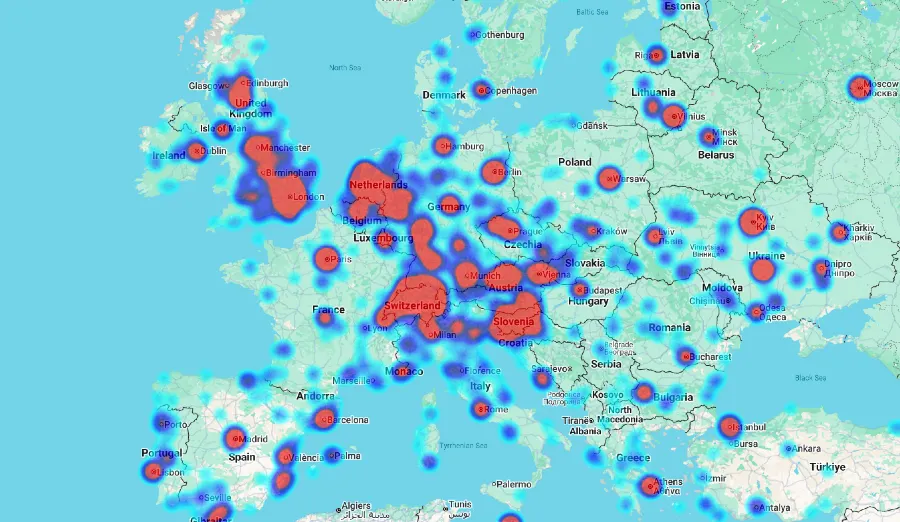
EU crypto mass adoption map by Cryptwerk Coinmap.
Licensing Has Become A Market Access Gate
MiCA's most immediate impact is simple: a provider's regulatory status now matters before a user even reaches the product. The official ESMA MiCA implementation page makes the direction clear: crypto-asset service providers are moving into a common EU framework, with supervisory expectations, registers and transitional measures replacing the patchwork that existed before.
That is a major change for Europe. Before MiCA, a crypto company could often operate through local registrations, offshore structures, or temporary national arrangements. Now the market is being pushed toward authorized Crypto-Asset Service Providers, passporting, and clearer national supervision. For a company that offers exchange access, custody, transfers, wallets, brokerage or crypto-to-fiat services, licensing is becoming part of the product itself.
This is why the first post-deadline stories are not only about regulators. They are about user access. Unlicensed platforms face pressure to wind down, limit onboarding, migrate customers, or keep only narrow functions such as withdrawals. Licensed firms can present themselves as safer homes for European users who still want to trade, hold or spend crypto without wondering whether the service will change next week.
For Cryptwerk readers, the same logic applies beyond exchanges. If a user wants crypto wallets that can connect to cards, stablecoins, merchant payouts or banking rails, the regulatory status of the provider is no longer background noise. It affects continuity, available assets, support, and the trust businesses place in the service.

The First Winners Are Licensed Platforms
The news flow around July 1 shows a clear pattern: the firms with licenses are trying to turn compliance into momentum. Several platforms announced or highlighted MiCA authorizations, European hubs, or country-level approvals. Others used the deadline to attract users from services facing restrictions.
This does not mean MiCA automatically favors only the largest companies, but it does raise the cost of operating casually in Europe. Licensing requires governance, capital, compliance teams, reporting, controls and a regulator that is willing to supervise the business. For a small crypto startup, that can be heavy. For a large exchange, wallet company, payment processor or bank-backed custody provider, it can become a moat.
The result is a more selective market. Users may see fewer unsupported products, fewer grey-zone offerings and fewer offshore services pretending to be local. At the same time, regulated providers will compete harder for users who are being moved away from unlicensed venues. This is already visible in the race among authorized exchanges and service providers to capture European customers before habits reset.
For merchants and businesses, the important takeaway is not which brand won the first week. It is that regulated distribution matters. A business that wants to accept crypto payments as a merchant will care less about hype and more about whether the payment provider can keep operating, settle reliably, support compliant assets and avoid sudden service interruptions.
Stablecoins Are Becoming The Practical Test
MiCA's next visible effect is in stablecoins. Europe is not only regulating exchanges. It is also shaping which digital dollars and euro tokens can sit inside regulated services, payment products and wallet balances. That matters because stablecoins are no longer just trading instruments. They are increasingly used for settlement, payouts, remittances, treasury movement and card-linked spending.
The first week after the deadline showed the pressure around USDT, USDC, EURC and new euro-denominated tokens. Some platforms have been updating stablecoin support for EEA users, while regulated issuers and bank-linked projects are trying to make compliant stablecoins more useful for payments. The shift is not simply "one token wins, another token loses." It is about whether a stablecoin can fit into a regulated payment and custody environment.
For users, that may change which balances are easy to hold or spend in Europe. For payment companies, it changes which assets can be routed through compliant rails. For businesses listed in Cryptwerk categories such as crypto payment gateways, the practical question becomes: which stablecoins can be supported without creating regulatory risk for merchants?
This is also why USDC and USDT are now discussed differently in Europe. The user experience still looks like holding a digital dollar, but the compliance layer behind that balance is becoming more visible. A stablecoin used for checkout, subscriptions, payouts or B2B settlement needs more than liquidity. It needs issuer clarity, redemption confidence, reserve discipline and service-provider support.

MiCA Is Already Pushing Services Toward Payments
One overlooked effect of MiCA is that it may make the European crypto market less speculative in tone. If platforms must compete on compliant services instead of loose access, the better product story becomes practical usage: wallets, cards, merchant tools, regulated custody, stablecoin settlement and crypto-to-fiat flows.
That is good for adoption. Users do not only need another exchange account. They need a way to move funds, pay, receive payouts, manage balances and use crypto in daily financial life. Merchants do not only need a token list. They need reliable settlement, refund workflows, accounting clarity and a provider that will not disappear from the market because it missed a licensing deadline.
This is where MiCA connects directly with shops accepting cryptocurrency. A clearer regulatory framework can make crypto commerce more boring in the best possible way. Fewer surprises. More predictable providers. Better due diligence. More confidence for companies that want crypto payment options but do not want regulatory uncertainty attached to checkout.
The same is true for crypto finance services. Custody, stablecoin accounts, brokerage, payment orchestration and tokenized products all become easier to evaluate when providers can point to a clear authorization route. MiCA does not remove business risk, technology risk or asset risk. But it gives European users and merchants a cleaner first question: is this provider authorized for what it is offering?
The Rulebook Is Still Not Finished
MiCA is now active as a market gate, but it is not the final version of European crypto policy. The regulation itself, available through the EU's official legal text, was built for a market that is already changing. Stablecoins are becoming payment infrastructure. Tokenized bonds and real-world assets are moving beyond experiments. DeFi, staking, NFTs and derivatives still raise questions that do not fit neatly inside the first MiCA perimeter.
That is why the early conversation after July 1 is already about what comes next. Europe has solved part of the problem: who can serve users, under what type of license, and with what supervisory responsibilities. But the harder questions remain. How should decentralized protocols be treated if there are admin keys or concentrated governance? How should staking products be supervised? What happens when tokenized securities, stablecoins and payment products blend together?
For now, the visible change is enough. MiCA has moved from policy language into operational reality. Users are being redirected. Platforms are being sorted. Licensed providers are gaining an advantage. Stablecoin support is being adjusted. Regulators now have a clearer framework for saying who can keep serving the EU market.
What This Means For Crypto Users And Merchants
The practical lesson is straightforward: in Europe, regulatory status is now part of product quality. A fast app, good liquidity or a familiar brand is not enough if the service cannot operate under MiCA. Users should check whether a provider is authorized, what entity serves their country, which assets remain supported, and whether withdrawals, custody and payment features are protected during any migration.
Merchants should ask similar questions before adding new crypto payment options. Is the gateway operating through a compliant structure? Which stablecoins are supported in the EEA? Can the provider handle refunds, settlements, records and customer support under the new rules? Does the service have a clear plan if asset availability changes?
MiCA will not make crypto adoption automatic. Regulation alone does not create demand. But it can change the quality of the market. After July 1, the European crypto sector looks less like an open field and more like regulated financial infrastructure. For users, that means choosing providers more carefully. For merchants, it means crypto payments may become easier to justify when the provider, asset and settlement path are all built for the new rules.
