
 English
 Français
 Español
 BTC
 ETH
 LTC
 BCH
 USDT
 DOGE
 DASH
 USDC
 XRP
 XMR
 TRX
 BNB
 SHIB
 SOL
 DAI
 ZEC
 ETC
 POL
 ADA
 XLM

The Martingale strategy doubles a stake after a loss and resets it after a win. Crypto dice auto-bet can automate both rules, but it cannot improve the odds or guarantee that the bankroll lasts long enough to recover a losing streak.
In Short
At 49.5% win chance and 2.00x payout (1% house edge), a 1 USDT Martingale with a 100 USDT bankroll funds six straight losses before the bet size outgrows the money left. In the model, which allows up to 100 bets, the progression fails 46.8% of the time. Its expected loss is 2.33 USDT, compared with 1 USDT for flat betting.
How does the Martingale strategy work?
The Martingale strategy doubles your stake after a loss and returns to the starting stake after a win. At a 2.00x payout, that win recovers the current cycle's losses plus one starting stake, provided you can place the required bet.
The Martingale betting system changes bet sizes, not the game's house edge. The trade-off: frequent small winning cycles come with occasional much larger losses.
The Martingale system in roulette follows the same doubling pattern on even-money bets; the zero prevents those bets from being truly 50/50.
What does the Martingale strategy cost on crypto dice?
In this example, the Martingale strategy has an expected loss of 2.33 USDT, compared with 1 USDT for flat betting over the comparison period. Neither approach beats the house edge.
The example uses dice with a 1% house edge, 49.5% win probability and 2.00x total payout. A winning 1 USDT bet returns 2 USDT, including the stake, for 1 USDT profit.
With a 1 USDT base stake and 100 USDT bankroll, six losses stake 1, 2, 4, 8, 16 and 32 USDT: 63 in total. The 37 USDT left cannot fund the next 64 USDT bet. The lesson on crypto dice odds and payouts shows the probability/payout trade-off, including a 50% win chance at 1.98x.
Measure | Setting A: 49.50% / 2.00x | Setting B: 50.00% / 1.98x |
House edge | 1.00% | 1.00% |
Losses a 100 USDT bankroll funds from a fresh start | 6 (63 USDT staked) | 6 (63 USDT staked) |
Next bet / bankroll left after six losses | 64 / 37 USDT | 64 / 37 USDT |
Chance of six losses in a row, fresh cycle | 1.66% | 1.56% |
Chance of a six-loss run within 100 outcomes | 56.5% | 54.6% |
Chance progression fails before 100 bets | 46.8% | 45.9% |
Average bankroll left at failure | 40.32 USDT | 41.45 USDT |
Expected loss, up to 100 bets | 2.33 USDT | 2.30 USDT |
Expected loss, 100 flat 1 USDT bets | 1.00 USDT | 1.00 USDT |
Cycle result: win right after six losses | 1.00 USDT profit | 0.28 USDT loss |
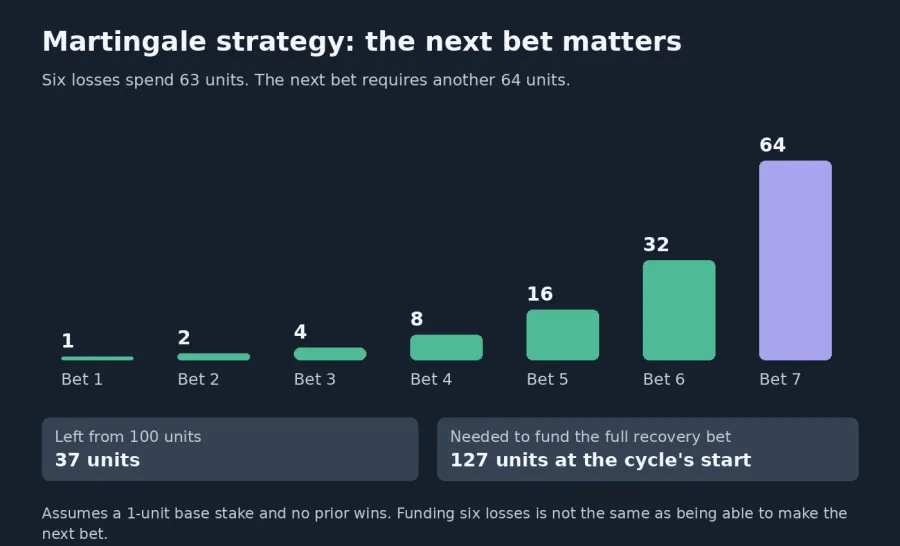
The stake doubles after every loss, so six straight losses already commit 63 USDT before the next bet is even placed.
Play stops at 100 bets or an unaffordable next stake, whichever comes first. These are exact calculated expectations for a session capped at 100 bets, not predictions for any single session's result.
What does auto-bet change in the Martingale strategy?
Auto-bet places the Martingale strategy's bets for you; it does not improve their odds or payouts. It can make the sequence run faster, which means you can risk more bets in the same amount of time.
The 100-bet limit here is simply the model's chosen stopping point. The calculation starts with 100 USDT and stops earlier if the player cannot afford the next required bet.
Where supported, the Martingale settings are On Loss: increase by 100% and On Win: reset to the base bet. Names and available limits vary by game; verify them before starting. Automation does not protect the bankroll from a losing streak.
A six-loss run and a failed Martingale strategy are different events. The 56.5% figure measures whether six losses occur anywhere in 100 independent outcomes. The 46.8% figure also accounts for the changing bankroll and play stopping early. Earlier wins can leave enough money to continue after six losses.
Failure does not mean the balance is zero: players who stop hold about 40 USDT on average, but cannot afford the next doubled bet.
A Martingale strategy depends on what a winning bet actually returns. The Wild.io originals course explains the payout models behind dice, Crash and Plinko, providing background for checking that return before choosing bet sizes.
Why does a 1.98x payout change the Martingale strategy?
At 1.98x, a winning bet after a long enough losing streak may not recover everything already lost. Doubling assumes an even-money profit; this payout returns slightly less.
Setting B changes win probability to 50% and total payout to 1.98x. Both settings have a 1% house edge: 0.50 multiplied by 1.98 equals 0.99. Six losses still spend 63 USDT, leaving 37 USDT from a fresh 100.
The difference is what a win after six losses is worth. At 2.00x, a winning 64 USDT bet earns 64 USDT profit. That covers 63 USDT in prior losses and leaves 1 USDT for the cycle. At 1.98x, that stake pays 126.72 USDT gross. Its profit is 62.72 USDT, against 63 USDT already lost. The full cycle therefore ends with a 0.28 USDT loss, despite the winning bet.
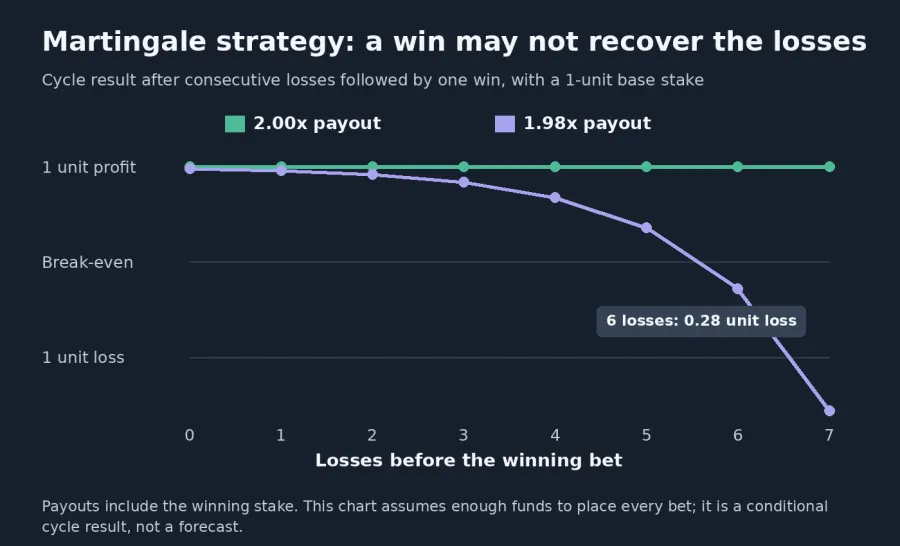
At 1.98x, even the bet meant to recover six losses falls 0.28 USDT short.
That 0.28 USDT loss assumes the player can place the 64 USDT bet. Funding all seven bets requires 127 USDT at the cycle's start, or enough gains from previous cycles. A fresh 100 USDT bankroll cannot reach this outcome: it stops after the sixth loss, with 37 USDT left.
Using the Martingale strategy with BTC or ETH
For a Martingale strategy measured in BTC, double the BTC stake after each loss; its USDT value can change with the exchange rate. For a USDT-value strategy, double that value; the BTC amount needed may change. Keep the accounting unit consistent.

When do bet limits stop a Martingale strategy?
A maximum bet stops the progression when the next required stake exceeds the limit, even if you have enough money. A profit cap can also prevent full recovery. Check whether the game applies it by limiting the stake you can place or the amount it will pay; do not assume every game handles it the same way.
How does a reverse Martingale strategy work?
A reverse Martingale strategy doubles after a win and resets to the base stake after a loss. It increases stakes during winning streaks rather than losing ones.
One common variation pairs the approach with a target for banking winnings. A later loss can still consume the larger stake built up during a winning run. Reversing the sequence does not change the game's house edge or guarantee lower losses.
Set limits before starting a Martingale strategy
Choose a loss limit, maximum stake and session length before starting a Martingale strategy. Do not place a bet that could take you beyond the loss limit. Check how any automatic stop is enforced: a stop checked only after a bet settles does not prevent that bet from exceeding the chosen limit.
A profit target only ends play after the target is reached. It does not protect against a losing streak. Use only money you can afford to lose and play only where legal.
The Martingale strategy changes bet sizes, not the house edge. Larger total wagering increases expected loss, while limited funds or bet limits can end the recovery sequence.
For practical time and money limits, see NCPG’s Responsible Play resource.
Frequently Asked Questions
Does Martingale work?
Not as a way to beat the house edge. The Martingale strategy can recover a losing cycle with an even-money win, but only if the next bet is affordable and allowed. A finite bankroll or bet limit can end the sequence before that win arrives.
How big a bankroll does the Martingale strategy need?
To cover six consecutive losses and the next doubled bet, you need 127 times your starting stake. The six losses use 63 units; the next bet requires 64 more. No finite bankroll guarantees recovery.
Why does doubling fail at 1.98x payouts?
A 1.98x payout gives less than even-money profit, so doubling eventually leaves a shortfall. At a one-unit base stake, six losses followed by a winning 64-unit bet still leave a 0.28-unit loss. That example requires enough funds to place the 64-unit bet.
What does auto-bet change about the Martingale strategy?
Auto-bet only automates placing each stake; it doesn't change the win probability, payout, or house edge behind the strategy. What changes is how many bets can happen in a given stretch of time.
Can a bet limit stop the Martingale strategy?
Yes. A maximum bet can prevent you from placing the next doubled stake, even when you can afford it. A profit limit can also prevent full recovery, but the effect depends on how the game applies that limit.
Is reverse Martingale safer?
Not automatically. A reverse Martingale strategy avoids doubling through a losing streak, but a later loss can consume the larger stake built up after wins. The house edge remains, and the risk depends on the stake and stopping rules.
