
 English
 Français
 BTC
BTC
 ETH
ETH
 LTC
LTC
 BCH
BCH
 USDT
USDT
 DOGE
DOGE
 DASH
DASH
 USDC
USDC
 XRP
XRP
 XMR
XMR
 TRX
TRX
 BNB
BNB
 SHIB
SHIB
 SOL
SOL
 DAI
DAI
 ZEC
ZEC
 ETC
ETC
 POL
POL
 ADA
ADA
 XLM
XLM
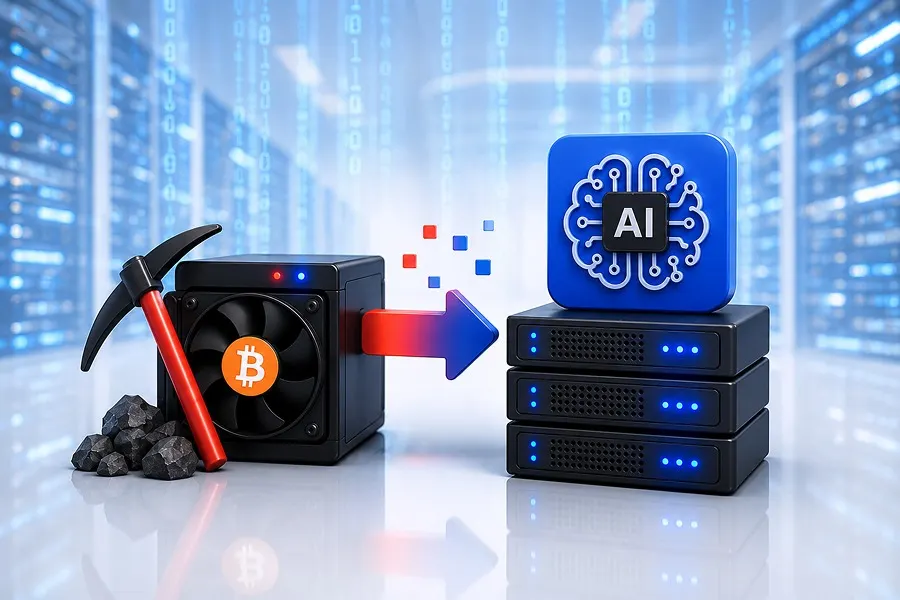
Bitcoin mining was one of the riskier businesses in the industry. The profits depended on the price of Bitcoin, as well as the cost of equipment and the electricity needed to run it. Since 2025, the industry has been changing, as equipment has been widely used to build infrastructure for AI data centers.
The timing was no accident; it's when AI began rapid expansion. There was suddenly a lot of demand for data centers, GPUs, cooling systems, and reliable energy sources. Crypto miners had all that, and many companies started to pivot.
The Pressure on Bitcoin Mining After the Halving Era
The Bitcoin halving in 2024 accelerated the move towards AI infrastructure. Every four years, Bitcoin automatically reduces mining rewards, making it harder for miners to remain profitable. After the scheduled halving, rewards dropped from 6.25 BTC to 3.125 BTC per block, thereby reducing miners' revenue.
At the same time, the market continues to expand and become much more competitive. Large mining firms invested heavily in new ASIC machines while electricity costs rose in many regions. This squeezed out the smaller providers. Several mining companies filed for bankruptcy.
Cryptos themselves have a variety of use cases, ranging from Bitcoin casinos in India to transport companies using them to settle cross-border payments. Experts such as those from CryptoManiaks claim that using Bitcoin to wager allows users to make transfers without providing personal data. Mining companies, however, didn't have many other options but to pivot to AI infrastructure.
Why AI Infrastructure Became the Perfect Opportunity
The rise of AI was pretty sudden, and it changed the mining industry in the process. The idea of LLMs has been around for a while, but it took just a few years for them to find practical applications in a variety of industries, and suddenly, everyone was using AI.
AI infrastructure requires enormous amounts of electricity and cooling capacity. Building the data centers needed to run it could take years, and demand was growing rapidly. Bitcoin mining companies realized they have the infrastructure that AI businesses are looking for.
AI infrastructure requires enormous amounts of electricity and cooling capacity. There's a difference between the hardware used for Bitcoin mining and that used for AI systems. Bitcoin miners traditionally used ASIC machines; AI infrastructure primarily relies on GPUs, particularly high-end chips from NVIDIA. However, the two are similar enough.
CoreWeave: The Blueprint Everyone Started Following
CoreWeave has become the best example of the changes in the crypto mining industry. The company was involved in crypto mining and then aggressively moved into AI as soon as the option became available. CoreWeave built large-scale GPU clusters designed specifically for artificial intelligence workloads.
The company started working with NVIDIA and rapidly expanded its cloud computing business. Soon, it became one of the largest infrastructure providers for the new industry. It showed that former crypto companies can easily profit in the new circumstances if they are willing to change.
Many smaller crypto mining businesses followed suit, as CoreWeave's success created a blueprint for navigating market changes. Rather than viewing themselves solely as cryptocurrency companies, miners increasingly presented themselves as energy and compute infrastructure operators.
The Mining Companies Making the AI Transition
Several large companies have also made the transition and moved on to the AI infrastructure market. They did so aggressively and made a profit in the process.
Core Scientific
Core Scientific was one of the companies that was closely watched by the public. It went through a bankruptcy and was restricted afterward. The company shifted part of its focus toward high-performance computing and AI colocation services. The investors regained confidence after the company signed its first deal with an AI data center.
Core Scientific began using its large-scale facilities and power infrastructure to support AI workloads while continuing to mine. This diversification strategy helped the company regain relevance.
IREN
Formerly known as Iris Energy, IREN has increasingly marketed itself as a hybrid Bitcoin and AI infrastructure company. The business also added a twist by relying on green energy sources. Bitcoin companies have long faced environmental concerns about the impact of their operations, and so do AI data centers. IREN provided a competitive advantage.
IREN has invested heavily in GPU cloud services while continuing some mining operations. The management plans to focus more on AI in the years to come and gradually phase out riskier crypto-mining work.
Hut 8 and TeraWulf
Both Hut 8 and TeraWulf have also explored AI hosting and data center expansion strategies. The companies tried to work in both areas simultaneously, but the market needed their services in energy access rather than crypto mining. After a few years, revenue from AI surpassed that from mining.
Why Wall Street Suddenly Loves These Companies Again
Institutional investors didn't invest in Bitcoin mining companies even when they were at their peak. The industry was too risky, and Bitcoin's price was too volatile. Public opinion of these companies changed only after they pivoted to AI. It seems to be a much less risky industry and one with a brighter future.
Long-term power agreements, data center facilities, GPU hosting capabilities, and AI leasing contracts are now considered highly strategic assets. All of these business deals are structured in a manner similar to those in other industries. Bitcoin, however, was a disruption to traditional finance, and institutional investors didn't know how to handle it.
Predictable long-term contracts have saved some mining companies that couldn't find a stable investment in the world of crypto. There's also a sense across the tech industry that AI could be the most important technological development in recent memory.
The Risks Behind the AI Pivot
There's a lot of excitement about the use of AI and data centers. However, there are also risks involved. Building modern AI data centers requires substantial capital, especially when purchasing expensive NVIDIA GPUs and upgrading facilities. Most mining companies also have a lot of debt, which they used to purchase the mining equipment.
Multi-billion-dollar companies are trying to build their own AI infrastructure and use it to provide services as a source of additional income. Such efforts from Microsoft, Amazon, and Google are already underway. These companies will be competitors to the former Bitcoin miners and will likely drive them out of the business.
Not all mining companies are able to transition from one industry to another. Several businesses have successfully done it, but the two industries are still very much different. There's skepticism about the companies that have already failed in mining.
The Future: Power Infrastructure May Matter More Than Bitcoin
Several Bitcoin mining companies have moved on from the business to providing infrastructure for AI companies. The two use similar technology, but while Bitcoin mining is risky, AI seems a more stable venture.
Some businesses have already done so successfully and have managed to attract the attention of institutional investors as well. They are more likely to invest in AI infrastructure businesses than Bitcoin miners. There are still risks involved, but the promise of AI is an important factor as well.
