
 BTC
BTC
 ETH
ETH
 LTC
LTC
 BCH
BCH
 DOGE
DOGE
 USDT
USDT
 DASH
DASH
 XRP
XRP
 USDC
USDC
 XMR
XMR
 BNB
BNB
 TRX
TRX
 SHIB
SHIB
 DAI
DAI
 ZEC
ZEC
 SOL
SOL
 ETC
ETC
 POL
POL
 XLM
XLM
 ADA
ADA

Something in the UK online casino market shifted over the past eighteen months, and the numbers are starting to make it hard to ignore. Crypto-native casinos that barely registered with British audiences five years ago now turn up in search data alongside household names like Bet365 and Sky Vegas, and the reason isn't bonus aggression or paid rankings. It's friction.
Roulette players, in particular, have been doing the quiet work of migrating. This piece is about why — what the UK Gambling Commission has actually done, what offshore crypto platforms actually offer, and what you give up on the way over.

The regulatory squeeze that nobody quite planned for
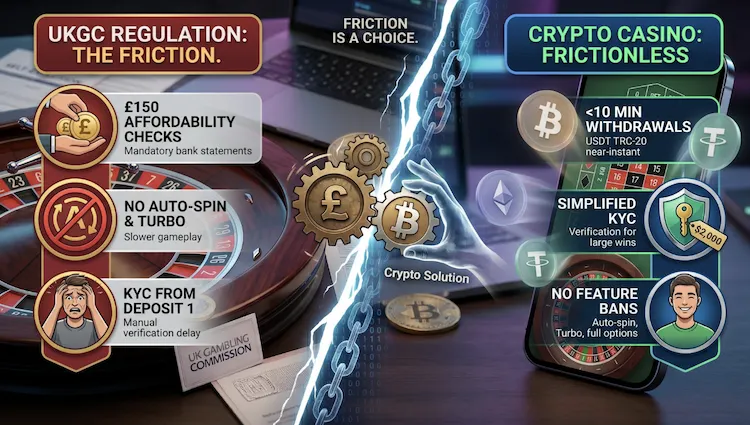
The UKGC has spent the past eighteen months layering new protections onto its licensed operators, and the cumulative effect is more than the sum of the individual rules.
Financial vulnerability checks went live at the end of August 2024, initially at a £500 net deposit threshold per 30-day rolling period, and later at a lower £150 threshold. A more intrusive system called the financial risk assessment — widely known in industry as affordability checks — has been stuck in pilot mode for over a year. It was originally due to roll out as early as May 2026, a timeline that has now slipped while industry bodies and Parliament argue over evidence from the pilot.
Then there are the feature bans. Since January 2025, UKGC-licensed sites can no longer offer auto-spin, turbo mode, bonus buy features, or near-miss animations. These were aimed primarily at slots, but the signal they sent — that the UKGC is willing to ban product features the market clearly wants — didn't stay contained to slots.
Why roulette players are the ones leaving first
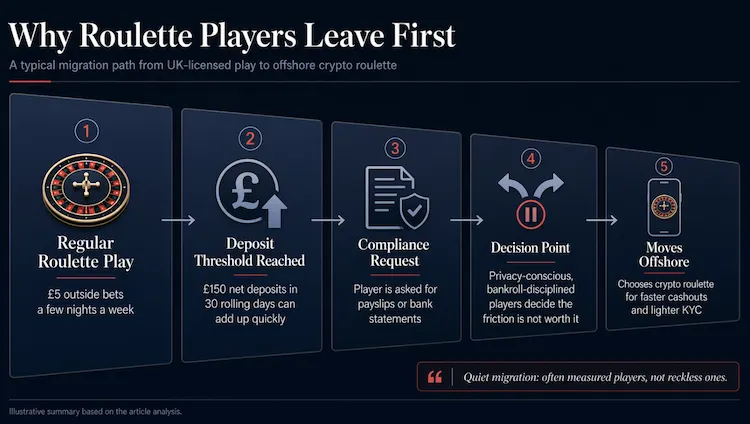
Roulette is one of the least slot-like games in an online casino. The house edge is low (2.7% on European single zero, lower still on La Partage tables), sessions tend to be long, and the profitable play is almost entirely about bankroll discipline rather than pattern-chasing. That profile clashes directly with affordability systems built around deposit volume.
A £150 net deposit in 30 rolling days doesn't take long to accumulate if you're playing £5 outside bets a few nights a week. The compliance email asks for payslips or bank statements. A certain kind of player — risk-aware, bankroll-conscious, not willing to send three months of financial records to a gambling site — simply leaves instead.
This is the quiet part of the migration story. It isn't problem gamblers ignoring interventions and fleeing offshore. It's measured players deciding the friction isn't worth it.
What crypto roulette actually offers
The pitch for crypto roulette — the one you'd hear from a decent affiliate site rather than a reflexive promoter — comes down to three things.
Withdrawals that clear before you've closed the tab
On a mainstream UK-licensed site, cashing out winnings from a live roulette session can take anywhere from a few hours to several days, and that's before any manual review is triggered by an unusually large win. On a competent crypto casino, a USDT withdrawal on the TRC-20 network clears on-chain in under five minutes, with no intermediate approval queue. For a player who's just hit green zero on a £50 straight-up bet, that difference is emotional, not just practical.
KYC thresholds that behave the way players expect
UK-licensed operators verify identity at or before the first withdrawal. Offshore crypto sites typically set the trigger far higher — often around $2,000 or equivalent — and some skip formal ID entirely below that threshold, relying on wallet-level transaction screening instead.
This is a legal grey zone, not a consumer-protection feature, and it shouldn't be oversold as one. But for players whose accounts have been frozen during routine KYC reviews at their UK-licensed casino — something that happens more often than licensed operators like to admit — the lower-friction alternative is straightforwardly attractive.
Provably fair spins and a deeper table inventory
Provably fair roulette — where the random number generation is cryptographically verifiable after each spin — is a genuine innovation, and it doesn't exist at any UKGC-licensed site. It doesn't change the house edge, but it lets technically curious players verify that the wheel hasn't been nudged, which is a meaningful assurance in a market that historically relied on trust.
Offshore crypto platforms also tend to carry more tables. European single zero, American double zero, French with La Partage and En Prison, live dealer, speed roulette, lightning variants — all under one cashier. UK-licensed sites can and do offer most of these, but the software certification pipeline is slower, and niche variants arrive late, if at all.
How the two markets compare in practice
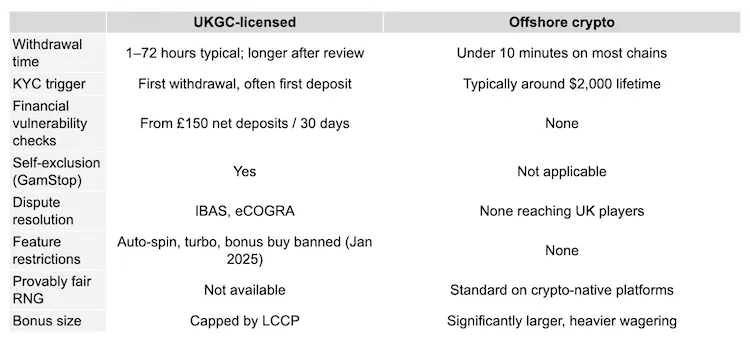
A growing number of guides comparing the best bitcoin & crypto roulette platforms now lead with withdrawal times and KYC thresholds rather than bonus size — a reasonable reflection of what British players have actually started prioritising.
The risks no operator will put on its homepage
The offshore pitch has real downsides, and they deserve to be named rather than buried at the bottom of a 3,000-word review.
- No GamStop. The national self-exclusion scheme doesn't reach offshore operators. A UK player mid-exclusion can register and deposit at a Curaçao-licensed site without hitting a single block.
- No independent dispute resolution. IBAS and eCOGRA don't arbitrate complaints against offshore operators. If a site confiscates your winnings on a vague T&C violation, your realistic recourse is an angry forum post.
- No compensation framework. If a crypto casino becomes insolvent — and several notable ones have in the past eighteen months — there is no statutory scheme to recover player balances. Crypto is also harder to claw back than fiat.
- Volatility risk. Playing in BTC or ETH rather than stablecoins means your bankroll can swing 10% on a quiet Tuesday. Experienced players stick to USDT or USDC; newer ones often don't, and learn the hard way.
Playing at an offshore crypto casino isn't illegal for a UK resident — the Gambling Act targets operators, not individual bettors, and no UK player has been prosecuted for using a Curaçao or Anjouan-licensed site. But "not illegal" is not the same as "safe."
A regulatory tide that might actually be turning
The most interesting development of 2026 is that the UKGC itself appears to be shifting.
"…a way for cryptoassets to be used as a consumer payment option…" — Tim Miller, UKGC Executive Director, speaking to the Betting and Gaming Council, February 2026
That fragment — from a longer statement about exploring a regulated path forward — marks the first time the UKGC has publicly signalled interest in bringing crypto inside the licensed perimeter rather than keeping it out. The Financial Services and Markets Act 2000 (Cryptoassets) Regulations 2025 were tabled in Parliament in December 2025, providing the legislative scaffolding that would make such a pathway feasible.
Whether this produces an actual licensed crypto-roulette product by 2027 is genuinely uncertain. The UKGC has a habit of consulting things to a slow death. But the direction of travel, for the first time, is plausible.
Where this leaves British players right now
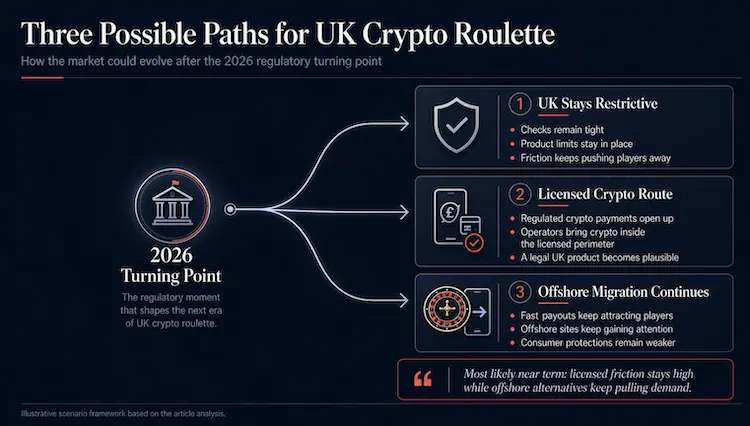
The offshore migration will continue through 2026 because the two forces driving it aren't reversing. Licensed UK casinos are getting more restrictive, not less; crypto cashiers are getting faster and more competent, not slower. Until the UKGC produces a regulated crypto product, British players who want quicker withdrawals and cleaner KYC will keep voting with their wallets.
That's not really an indictment of UK regulation, which is broadly trying to do the right thing. It's an observation about what happens when friction in one system creates demand for another. Crypto roulette in 2026 is a symptom, not a cause.
