
 BTC
BTC
 ETH
ETH
 LTC
LTC
 BCH
BCH
 DOGE
DOGE
 USDT
USDT
 DASH
DASH
 XRP
XRP
 USDC
USDC
 XMR
XMR
 TRX
TRX
 BNB
BNB
 SHIB
SHIB
 DAI
DAI
 ZEC
ZEC
 SOL
SOL
 ETC
ETC
 POL
POL
 XLM
XLM
 ADA
ADA
Perpetual futures on BYDFi let you gain leveraged exposure to crypto without expiry. This guide explains how perps track spot, how funding works, what leverage and margin really mean, which order controls matter, and how to size and manage trades responsibly. It is intended as an introduction to practical trading concepts rather than a promise of profits.
Key Takeaways
- Perpetuals have no expiry; you can hold as long as you meet margin requirements.
- Mark Price, not the last traded price, drives PnL and liquidation calculations.
- Funding payments flow between longs and shorts and can materially affect PnL on multi‑day holds.
- Conservative leverage (3-10x) and predefined risk per trade (about 0.5–1% of equity) help limit drawdowns.
Perpetual futures are margin‑based derivatives tied to an index of spot prices. They stay anchored to spot through a funding mechanism rather than an expiration date. If you are completely new, treat this as an introduction to crypto perpetuals for beginners and focus first on execution discipline, not return maximization.
What Are Perpetual Futures
A perpetual contract mirrors the price of an underlying index and settles in quote currency (often USDT). Because it never expires, your position remains open while you maintain sufficient margin. Centralized venues compute a fair Mark Price from the index and a basis; that Mark is used for unrealized PnL and liquidation checks. Linear, USDT‑margined contracts have a simple payoff: PnL in USDT equals position size in coin multiplied by the difference between exit and entry.
Funding: Why You Pay or Receive
Funding nudges the contract toward spot. At set intervals, either longs pay shorts or shorts pay longs. For instance, if you are long 0.05 BTC at 30,000 USDT and the funding rate for the eight‑hour window is +0.01%, you pay 0.15 USDT at that tick; if the rate stayed the same for three intervals, the total would be 0.45 USDT. Funding only accrues while the position is open and the rate can vary significantly across market conditions.
Leverage, Margin, and Liquidation
Leverage magnifies both outcomes and urgency. Your initial margin is a fraction of your notional exposure, but maintenance margin must be preserved to avoid liquidation. For a long, adverse moves reduce equity until the platform closes the position if maintenance cannot be met; the check references the Mark Price to reduce manipulation risk. A simple way to stay safe is to preview the liquidation level with the built‑in calculator and to place a stop‑loss that reflects your market invalidation, not your emotional discomfort.
Orders and Execution
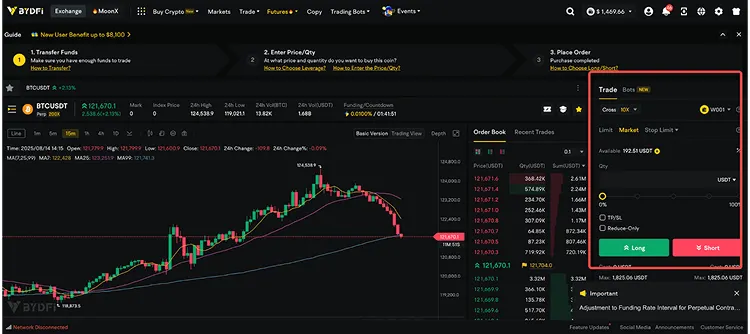
Market orders prioritize speed but may suffer slippage; limit orders prioritize price but may not fill. You can attach stop‑loss and take‑profit to automate exits. Execution flags matter: reduce‑only prevents accidental position flips on exits, post‑only targets maker fees, and time‑in‑force controls when and how orders rest or cancel. Many platforms support OCO logic so that a triggered stop cancels the take‑profit (and vice versa).
Fees and PnL Mechanics
Your realized result equals trading fees plus or minus funding and the price difference between entry and exit. While the trade is open, unrealized PnL uses the Mark Price. When you close fully or partially, PnL becomes realized and ceases to fluctuate with price, although funding posted up to that moment remains part of the outcome. Because fees and funding compound over time, they should be part of your setup selection, especially for swing holds.
Cross vs Isolated
Margin Isolated mode caps the damage to the margin you allocate to a single position and is therefore the default for beginners. Cross mode shares collateral across positions in the same asset, which can soften temporary drawdowns but also propagate losses if several trades move against you at once. If you choose cross, define a hard maximum loss and monitor positions more actively.
A Quick Walkthrough
Trade Imagine a 1,000 USDT account where you risk 1% (10 USDT) per idea. You plan a BTCUSDT long at 30,000 with a stop at 29,600, so the stop distance is 400 USDT. To keep risk near 10 USDT, a size of about 0.025 BTC works, because 0.025 times a 400 USDT move is 10 USDT.
At 5x leverage, the notional is 750 USDT and the initial margin about 150 USDT before fees. If the target at 30,800 fills, PnL is roughly 20 USDT; if the stop triggers, the loss is about 10 USDT, plus or minus fees and any funding paid or received while the trade was open.
Risk Controls You Should Actually Use
- Fix your per‑trade risk as a percent of equity and size positions from the stop distance, not from a desire for round numbers.
- Place stop‑loss and take‑profit immediately on entry; prefer reduce‑only on exits.
- Use alerts on Mark Price and funding timers; avoid trading when you cannot monitor positions.
- Start with isolated margin and conservative leverage; expand only after a stable execution record.
Slippage and Liquidity
Order book depth determines how far a market order travels to fill. Thin books can turn a tight stop into a larger‑than‑planned loss if price gaps through levels. To mitigate this, split size into tranches, place limits near liquid areas, and avoid illiquid hours or major releases unless you can watch the tape. Most platforms preview expected slippage—use that readout before confirming.
Security Basics
Enable app‑based two‑factor authentication, maintain a withdrawal allow‑list, and keep API keys read‑only unless trading automation is essential. Never enable withdrawals on API keys you share with third‑party tools. Check domains and emails carefully to avoid phishing. Operational security mistakes can erase gains faster than a losing trade.
Common Pitfalls and How to Avoid Them
- Oversizing with high leverage; instead, size from risk and stop distance.
- Averaging down into liquidation; define invalidation in advance and respect it.
- Ignoring funding on multi‑day holds; check the rate before you swing.
- Mixing up margin modes; confirm isolated versus cross before submitting.
- Using last trade price for risk decisions; rely on Mark Price where applicable.
Glossary
- Perpetual (Perp): A futures contract without an expiration date.
- Mark Price: The fair‑value price used for unrealized PnL and liquidation checks.
- Funding Rate: Periodic payment exchanged between longs and shorts to align the contract with spot.
- Isolated/Cross: Margin application modes that bound or share risk across positions.
- Reduce‑only/Post‑only: Execution flags that constrain order behavior for safety and fees.
- Maintenance Margin: Minimum equity required to keep a position open.
Getting Started on BYDFi
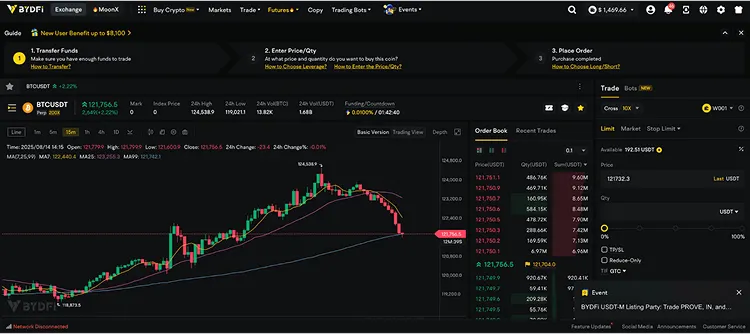
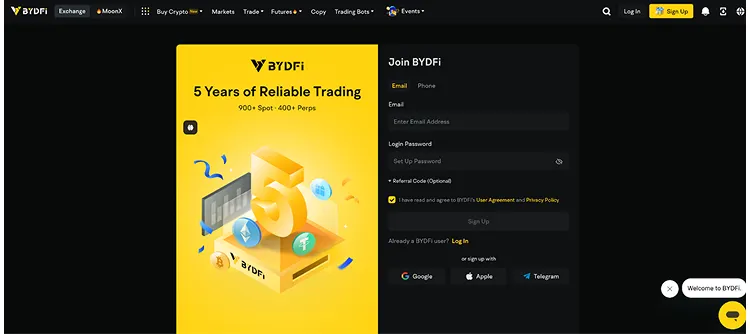
Create an account, complete any required verification, enable two‑factor authentication, and deposit USDT. In the derivatives section, select the BTCUSDT perpetual, choose isolated margin, and set modest leverage. Size the trade from your predefined risk, attach stop‑loss and take‑profit at entry, and review the contract’s specifications, funding timer, and fee schedule before you press submit. Treat your first steps as a beginner’s guide to crypto perpetuals exercise with the goal of consistent, low‑risk execution.
Conclusion
Perpetuals are powerful instruments when approached with structure: clear invalidation, disciplined sizing, and attention to funding and fees. If you keep those pillars in place, this can serve as a practical crypto perpetuals for beginners framework that emphasizes durability over drama.
