
 BTC
BTC
 ETH
ETH
 LTC
LTC
 BCH
BCH
 DOGE
DOGE
 USDT
USDT
 DASH
DASH
 XRP
XRP
 USDC
USDC
 XMR
XMR
 BNB
BNB
 TRX
TRX
 SHIB
SHIB
 DAI
DAI
 ZEC
ZEC
 SOL
SOL
 ETC
ETC
 POL
POL
 XLM
XLM
 ADA
ADA

Ordinary players who finish sessions in profit are not luckier than those who don’t. They apply three behaviors that most players never use: a pre-set win target, a hard exit at the moment that target is reached and a game selection filter based on house edge below 2%. Winning sessions are repeatable when they are built on rules rather than instinct.
Setting a Win Target Before the Session Opens
A win target is a fixed profit amount expressed as a percentage of the starting session bankroll, committed before the first bet is placed. Players who set a win target of 20% to 30% above their starting bankroll and stop the moment it is reached exit in profit more frequently than those who play without one. On a £100 session bankroll that means stopping at £120 to £130 — not continuing because the session “feels good.” Every regulated platform with Hacksaw Gaming slots allows a player to close a session at any point, and that option should be treated as the most important feature on the screen when the target is hit.
The win target functions as the upper boundary of a session the same way a loss limit functions as the lower one. Without both boundaries a session has no defined shape and no point at which a profitable outcome is locked in. Here is how to calculate and set a win target before any casino session:
- Decide on your session bankroll — the amount you are depositing or allocating for this specific session.
- Multiply that amount by 1.20 to set a conservative win target at 20% profit.
- Multiply by 1.30 if you are playing a low-volatility game with frequent small returns.
- Write both the win target figure and the loss ceiling figure before opening the game.
- Close the session and process a withdrawal the moment the balance reaches the win target.
A win target of 20% to 30% is realistic across table games with a house edge below 2%. Targets set above 50% of the starting bankroll require longer sessions and higher variance exposure, both of which work against the mathematical probability of finishing in profit.
Why Game Selection Below 2% House Edge Changes the Math
House edge is the percentage of each bet the casino retains mathematically over time. A game with a 0.5% house edge costs a player £0.50 per £100 wagered. A game with a 6% house edge costs £6.00 per £100 wagered. Restricting play to games below the 2% threshold narrows the mathematical gap between the player and the casino to a level where a 20% to 30% win target is achievable within a normal session length.
These are the casino games that consistently carry a house edge below 2% and represent the core of a viable casino profit strategy:
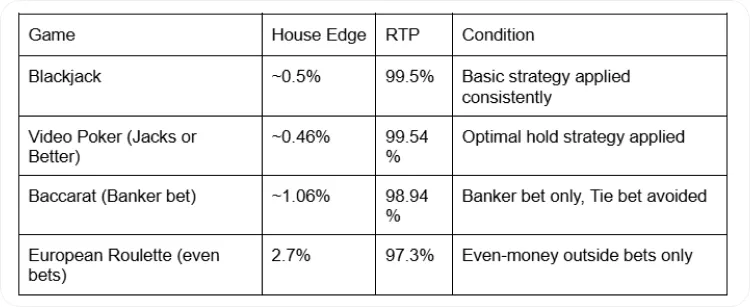
Blackjack played with basic strategy carries a house edge of approximately 0.5% — the lowest of any standard casino table game. A player who restricts every session to these four titles and applies the stated conditions reduces the mathematical cost of play to a level where short-session winning is a realistic outcome rather than an exception.
Flat Betting Versus Progressive Systems
Flat betting means placing the same wager amount on every round regardless of the previous result. Progressive betting systems increase or decrease bet size based on wins or losses. Flat betting reduces bankroll depletion speed by up to 35% compared to progressive systems over 100 rounds. That 35% preservation difference is the reason consistent winners default to bet consistency rather than chasing a system.
Why Progressive Systems Increase Variance Without Improving Odds
A progressive betting system does not alter the house edge of a game. It changes the size of the bets placed against that same house edge. The Martingale system, for example, doubles the bet after every loss. On a game with a 2.7% house edge, doubling after losses accelerates bankroll depletion when a losing streak occurs — which probability guarantees will happen within any session of meaningful length.
These are the documented drawbacks of progressive betting systems that flat betting eliminates entirely:
- Exponential bet growth during losing streaks depletes the bankroll before the streak ends
- Table bet limits prevent the system from functioning at the exact point it is mathematically needed
- A single large losing round erases multiple previous small wins
- Variance becomes unpredictable making session exit rules harder to apply consistently
How Flat Betting Supports a Win Target Structure
Flat betting makes session outcomes predictable enough to support a win target rule. When every bet is the same size the distance between the starting bankroll and the win target is always a fixed number of net winning rounds. That fixed number is calculable before the session starts. Variance control through consistent bet sizing is what makes a 20% win target achievable within a defined session rather than dependent on a single large win.
Before every session, apply these flat betting parameters in sequence:
- Set the base bet at 1% of the session bankroll — on a £100 session that is £1.00 per round.
- Confirm the table minimum is at or below that 1% figure before choosing the table.
- Do not adjust the bet size upward at any point during the session regardless of results.
- Count net winning rounds needed to reach the win target — at 1% per round on blackjack that is approximately 20 net wins to reach a 20% target.
Flat betting at 1% of session bankroll over 100 rounds preserves up to 35% more of that bankroll than a progressive system across the same number of rounds. That preservation is what keeps a session viable long enough for the win target to be reached.
Withdrawing Immediately to Lock in the Profit
Profit lock-in is the act of withdrawing session winnings immediately after the win target is reached rather than returning them to the active balance. Players who immediately withdraw profits after a session are statistically less likely to return those winnings in the same sitting. The mechanism behind that statistic is straightforward: funds that have left the active casino balance cannot be lost in that session.
Recycling winnings back into active play is the single most common way a profitable session reverses. These are the specific behaviors that cause players to erase a winning session after the win target is already hit:
- Continuing to play “just a few more rounds” after the win target is reached
- Treating the profit as an extended bankroll rather than as a completed session result
- Switching to a higher-volatility game after hitting the target to “grow the win further”
- Delaying the withdrawal while staying logged in and visible to the game lobby
The independent session mindset supports withdrawal discipline by treating each session as a closed event with a defined start and end. Previous session results — wins or losses — have no mathematical bearing on the current session’s outcome. Treating them as connected is the cognitive pattern that keeps players in sessions past their win target.
