
 BTC
BTC
 ETH
ETH
 LTC
LTC
 BCH
BCH
 DOGE
DOGE
 USDT
USDT
 DASH
DASH
 XRP
XRP
 USDC
USDC
 XMR
XMR
 BNB
BNB
 TRX
TRX
 SHIB
SHIB
 DAI
DAI
 ZEC
ZEC
 SOL
SOL
 ETC
ETC
 POL
POL
 XLM
XLM
 ADA
ADA

While global markets adjust to new realities in digital finance, three powerful developments are shaking the foundations of the monetary system. India is preparing to launch a state-backed digital currency, the U.S. has passed the GENIUS Act, promising to disrupt the banking monopoly, and global stablecoin transfers have exploded to a record $15.6 trillion — even as 71 % of that activity comes from automated trading bots.
Together, these stories form a picture of how the next era of money is emerging — fast, algorithmic, and increasingly regulated.
1. India steps into the digital currency era
India’s Commerce Minister Piyush Goyal announced that the country will soon introduce a Reserve Bank–backed digital rupee, designed to make payments faster, traceable, and transparent.
He stressed that India discourages “cryptocurrencies not backed by assets,” signaling that only asset-linked digital instruments will receive regulatory support.
Unlike speculative crypto, the digital rupee will resemble a stablecoin: pegged to the Indian rupee, built on blockchain rails, but under the full oversight of the Reserve Bank of India (RBI).
For the world’s most populous democracy — with hundreds of millions of digital payment users — this move could reshape both domestic and cross-border transfers. Analysts see it as India’s strategic response to China’s digital yuan and an attempt to maintain sovereignty over the digital financial system.
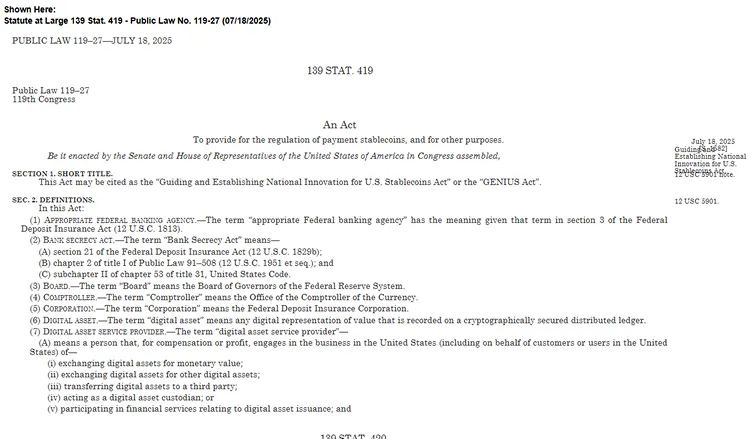
2. The GENIUS Act: The end of banking monopoly and the rise of stablecoin competition
In the United States, the GENIUS Act — recently passed by the Senate — marks a turning point in financial regulation.
According to Tushar Jain, CEO of Multicoin Capital, the act could “end bank fraud and unleash fair competition” by allowing private issuers to offer stablecoins under transparent rules.
The law could trigger a massive shift of up to $6.6 trillion from traditional bank deposits into stablecoins and digital instruments.
Banks are already voicing concerns that such migration could drain liquidity and weaken their traditional dominance.
Still, supporters argue that this “financial liberalization” will force legacy institutions to innovate and compete — rather than rely on regulatory protection.
In practice, the GENIUS Act creates clear compliance frameworks but also leaves loopholes that tech firms might use to distribute returns indirectly to users.
The new balance between regulation and innovation could set the tone for the global stablecoin industry.

3. Bots dominate stablecoin flows — but retail use hits record highs
According to Q3 2025 market data, global stablecoin transaction volume reached an unprecedented $15.6 trillion.
Yet approximately 71 % of that activity was generated by automated trading bots, MEV strategies, and high-frequency algorithms.
Only about one-fifth of transactions were organic peer-to-peer or retail-driven, with the remainder tied to internal exchange operations.
Despite that dominance, small-value transfers (under $250) surged to record levels — a sign of growing retail adoption.
Analysts now predict that 2025 could become the most active year in stablecoin history for real-world payments.
The rise of “everyday stablecoin usage” suggests that these tokens are moving beyond crypto exchanges into remittances, online commerce, and personal finance.
How the three trends connect
- State vs. private money. India’s digital rupee reflects a global trend where governments reassert control over money, while the GENIUS Act opens the door for private issuers — creating a direct clash of models.
- Regulation as acceleration. Far from killing innovation, legal clarity in the U.S. and Asia is driving a second wave of adoption, bridging fintech and banking.
- From trading to payments. While bots dominate volume, real-world use is catching up fast — the “stablecoin economy” is becoming part of everyday finance.
- Risks remain. Over-automation can distort metrics; legal loopholes may favor large players; and central bank digital currencies (CBDCs) still face challenges in privacy, trust, and infrastructure.
The big picture
What we’re witnessing is the financial convergence of three forces:
- Governments digitizing fiat,
- Regulators redefining banking, and
- Algorithms reshaping liquidity.
If 2024 was the year of regulation, 2025 is shaping up to be the year of integration — when digital currencies stop being experiments and become part of the global financial bloodstream.