
 BTC
BTC
 ETH
ETH
 LTC
LTC
 BCH
BCH
 DOGE
DOGE
 USDT
USDT
 DASH
DASH
 XRP
XRP
 USDC
USDC
 XMR
XMR
 TRX
TRX
 BNB
BNB
 SHIB
SHIB
 DAI
DAI
 ZEC
ZEC
 SOL
SOL
 ETC
ETC
 POL
POL
 XLM
XLM
 ADA
ADA
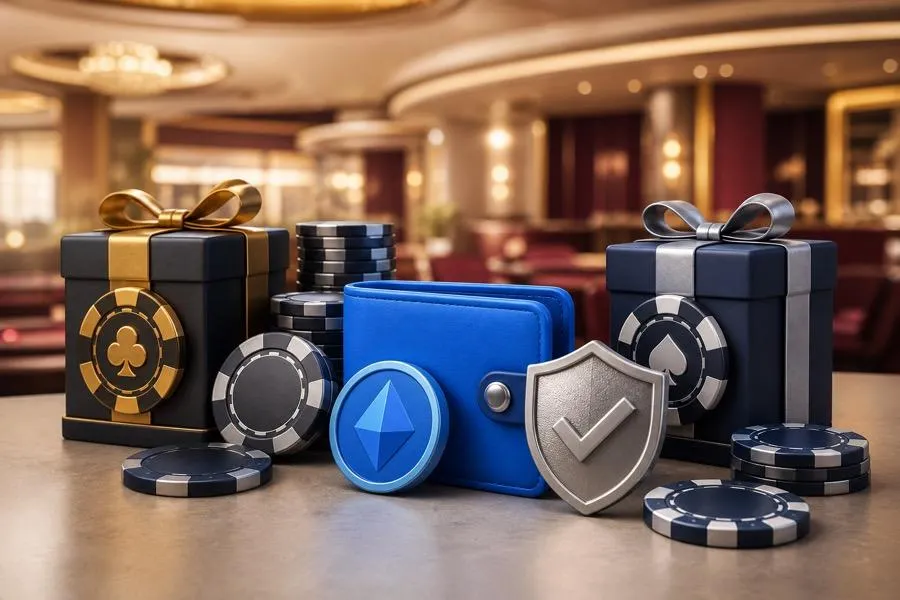
Despite their relatively straightforward nature, crypto casinos still hold a somewhat controversial status, which makes redeeming their bonuses a bit of a dilemma. Not only do they carry a bit of a question mark regarding their actual legitimacy, but their differences from traditional iGaming are unfamiliar enough to feel foreign.
A more realistic perspective will tell you that it’s not that much of a crevice. Instead, it’s a medium that requires a bit of recalibration. In turn, this process requires a bit of knowledge. Not about the crypto world itself, but more of the way that its integration helps online casinos create and develop this niche.
In this article, we will provide a big-picture analysis that has allowed us to understand the upside and limitations of crypto bonuses from a user’s perspective. We checked SlotsCalendar for casino offers since it provides a database that allowed us to compare both crypto and traditional promos: a research that informed our takeaways.
The following sections will explore definitions, explain the core signifiers underlying their differences, and discuss several bonus types native to crypto gaming.
Exploring the crypto casino concept
One of the most defining and interesting ways to understand crypto casinos is that they generally try to be comparable to fiat currency ones. Either because of familiarity, carryover platform engines or simply because it’s cheaper, aesthetic and operational differences are quite minimal.
You have a company that runs one or multiple such sites, with some of them setting them up in Telegram channels via purpose-built bots. They have terms, conditions, games, payment portals, support, and require player accounts.
What they actually do, very interestingly, is that they allow you to embed your crypto wallet as a casino user account. Instead of registering from scratch, they use these memberships as a way to also be an active, signed-up player that makes things as clear as possible.
Some of them even operate with offshore gambling licenses whose regulatory infrastructure accepts crypto payments as an equally viable alternative to fiat currency payment processors. This gives them an air of trustworthiness and attracts players more efficiently.
The concept itself boomed after the absolute rise of Stake, which proved that there is a lot of value in operating a platform with less restrictive guardrails and crypto viability. As a result, hundreds of such brands sprang up in the 2020s, with a sprawling market.
Payment quickness influences withdrawable bonus winnings
Things are quite simple and, most importantly, fast. The blockchain allows and facilitates it, and that is a very strong point of attraction for any player who may have experience with casino payments that have taken too long.

Generally, deposits are very fast regardless of market, jurisdiction, or payment method. If you give your consent to sending money to the casino, they will take it after you prove that you are of legal gambling age in your country.
Withdrawals, however, are another story at traditional casinos. In many spaces, a pending process, which includes managing the request and verifications, takes up a bit of time. Afterward, the banking method, which can be an e-wallet as well, will handle things. If it all takes under 24 hours, it’s a good scenario.
At crypto casinos, depending on the sum, the blockchain, usually via smart contracts, cuts through the times. We are talking about cases when you can get the sum instantly, with a couple of hours being closer to a worst-case scenario.
This is particularly important when you decide that you want to withdraw the winnings from a bonus received from a crypto casino. It makes the practical upside of such an incentive more viable.
Legitimacy: Established and regulated markets versus blockchain independence
Fiat currency casinos that represent the traditional establishment must have a license. There are multiple types, such as the aforementioned offshore ones that allow casinos to provide both crypto and regular payment avenues.
They have noticeably weaker reputations when compared to others, but even they have strata. An MGA license carries more weight than one from Curacao or Anjouan. Such certifications are attractive for platforms looking for a cheap recognition that legalizes their model and allows them to operate in markets that tolerate offshore gambling sites.
While this model allows both crypto and fiat currencies to be part of the payment structure, local ones rarely do. Famously strict licenses from the USA (the states where online gambling is legal), the UKGC in Britain, and most European countries are apprehensive about many details, and crypto payments are one of them.
This means that, as long as a traditionally and locally certified casino wants to maintain its status, blockchain integration is not a thing. This is what led to various bans on prediction markets in EU countries as well.
These restrictive details impact the provision of bonuses. Highly demanding jurisdictions do not want to encourage bonus abuse or problem gambling incentivized by such offers, which means that crypto bonuses, more often than not, provide more face value. The issue is that they have a tougher time operating and providing promotions legally.
Anonymity versus tight verification
The main point of contention for regulatory bodies that do not accept crypto is simple: anonymity means a lack of control over who handles the money.
There are two considerations here:
Underage gambling, which is a threat because of the lack of verification entailed by a player who maintains their anonymous profile by using crypto.
Money laundering, as nefarious actors can use decentralized funds to wash their hands of ill-gotten gains by turning them into casino winnings that have a clear and clean source.
As long as there is a tight KYC verification protocol in place, you will have to disclose exactly who you are, which negates one of crypto gambling’s main advantages.

Types of incentives native to crypto gambling (and how they differ from normal ones)
The last major part of our article will be to discuss some of the offers that we found in the crypto casino scene. Again, we used the respective database as a reference, but also cross-checked our findings with other sources.
On-deposit offers requiring crypto
This is the simplest one because it just mirrors the system of deposit bonuses found in almost any fiat currency casino. If you put money into your account above the required minimum, you get a sum of credits based on how much.
For example, if you deposit 100 USDT on a 200% deposit match welcome bonus, you would have a 300 USDT budget. A third of it is your crypto, while the other is a series of casino credits that you might be able to turn into withdrawable currency.
As for the rest of the details involved, you will probably see a cashout cap, which is completely arbitrary for the casino. It goes hand in hand with wagering requirements, which, even among crypto offers, should be around 35x.
They are easy to pick up and will usually be available for any crypto accepted by that platform. These are usually the mainstream ones: Bitcoin, Ethereum, stablecoins, Litecoin, and even Dogecoin.
NFT usage for VIP and loyalty systems
Using NFTs as a way to provide an advantage for those who bring value by depositing and playing consistently is a popular way to spice up a crypto casino. While it doesn’t directly translate into bonus usage, it can usually be part of the way the operator incentivizes you.
If the platform uses a VIP/loyalty ladder, NFTs can usually serve as something similar to a badge. You might get an actual benefit that you can redeem and play with, but the NFT itself has customization or collection value.
Tokenized cashback
Since NFTs are not the only way of tokenizing aspects that you encounter at crypto casinos, it’s important to note an application that we’ve seen at these platforms. We’re talking about cashback tokens that you can receive and trade in.
You’d be able to exchange it for a portion of your money back for a period of time, giving out value in a way that is similar to a traditional casino platform.
Conclusion
The market is quite diverse and is developing fast around the internet, especially outside the reach of regulated jurisdictions. This is why it has long been a controversial domain: because of the hardships of accountability due to the principles of decentralization.
If you decide to join and play at such a casino, you should only do so if your reputation recommends it. It requires quite a lot of legwork to do background checks. If you decide to stick around and play, don’t forget to do it responsibly!
