
 BTC
BTC
 ETH
ETH
 LTC
LTC
 BCH
BCH
 DOGE
DOGE
 USDT
USDT
 DASH
DASH
 XRP
XRP
 USDC
USDC
 XMR
XMR
 BNB
BNB
 TRX
TRX
 SHIB
SHIB
 DAI
DAI
 ZEC
ZEC
 SOL
SOL
 ETC
ETC
 POL
POL
 XLM
XLM
 ADA
ADA
The crypto-asset landscape in Asia is undergoing multiple significant shifts simultaneously. In Japan, startup JPYC Inc. is preparing to issue the nation’s first yen-pegged stablecoin across Ethereum, Avalanche, and Polygon networks.
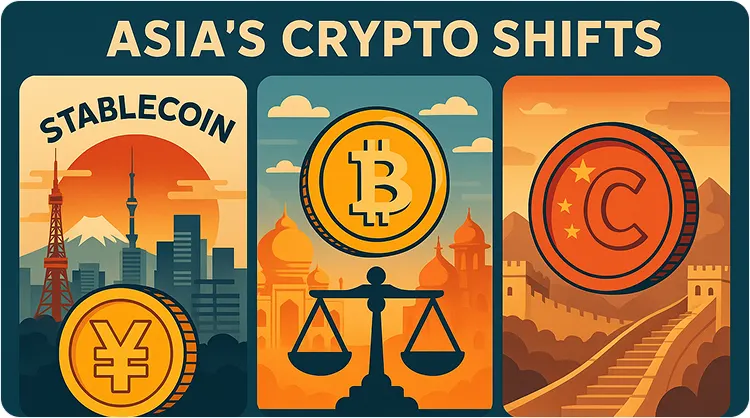
Meanwhile, in India, the Madras High Court has recognized cryptocurrency as “property” under law — a landmark ruling for digital asset ownership. At the same time, in China, senior figures at the People’s Bank of China (PBoC) warn that stablecoins pose risks to financial stability and currency sovereignty, signaling regulatory caution as stablecoin issuance expands globally.
Japan: First Yen-Pegged Stablecoin Set for Launch
Japanese fintech JPYC Inc. has received regulatory clearance to issue a yen-pegged stablecoin, signaling Japan’s entry into the regulated digital-fiat asset space. The token, called JPYC, will be fully convertible 1:1 with the Japanese yen and backed by domestic savings and Japanese government bonds (JGBs). JPYC is expected to launch in autumn 2025 and will be issued on major blockchains including Ethereum, Avalanche, and Polygon.
The company plans to begin with institutional demand from hedge funds and family offices but aims for wider retail and cross-border use over time. Under Japan’s Payment Services Act framework, JPYC has become the first entity to obtain a funds-transfer service provider license specifically for stablecoin issuance. Observers note that the controlled, infrastructure-first approach adopted by Japan may promote long-term stability rather than rapid deregulation.
India: Crypto Recognized as Property in Major Legal Ruling
In a historic decision, the Madras High Court declared that cryptocurrencies qualify as “property” under Indian law — meaning they can be owned, held in trust, or subject to judicial protection. The ruling emerged from a case involving frozen XRP holdings after a hack on the exchange WazirX, where 3,532.30 XRP tokens were at issue.
Justice N. Anand Venkatesh found that digital assets, while intangible, possess value and should be legally acknowledged as property rights. Legal analysts believe this precedent will influence how Indian courts handle disputes over digital-asset custody, insolvency, and taxation. The decision comes amid India’s broader regulatory uncertainty and is expected to boost investor confidence and institutional participation in the crypto ecosystem.
China: Central Bank Raises Red Flags on Stablecoins
The People’s Bank of China has emphasized concerns that stablecoins widen regulatory gaps in the global financial system, threaten currency sovereignty in less-developed economies, and could amplify systemic risk. Former PBoC governor Zhou Xiaochuan warned that the rapid rise of stablecoins risks undermining domestic payment systems, enabling speculative flows, and eroding capital controls.
These remarks follow reports that China is considering yuan-backed stablecoins as part of its international-currency strategy — a seeming contradiction to its cautious stance. Market commentators see Beijing’s dual approach — promoting the digital yuan while cautioning against non-sovereign tokens — as balancing innovation with control.
Why It Matters
- Japan’s imminent yen-stablecoin launch could deepen blockchain-based capital flows and enhance the international utility of the yen.
- India’s judicial recognition of crypto as property creates clearer legal frameworks, encouraging institutional adoption and protecting investors.
- China’s critical stance on stablecoins signals tougher regulation ahead — potentially shaping global norms for token-based value transfer and monetary sovereignty.