
 BTC
BTC
 ETH
ETH
 LTC
LTC
 BCH
BCH
 DOGE
DOGE
 USDT
USDT
 DASH
DASH
 XRP
XRP
 USDC
USDC
 XMR
XMR
 BNB
BNB
 TRX
TRX
 SHIB
SHIB
 DAI
DAI
 ZEC
ZEC
 SOL
SOL
 ETC
ETC
 POL
POL
 XLM
XLM
 ADA
ADA

As algorithmic portfolio management matures into a mainstream financial service, platforms that combine artificial intelligence with disciplined risk architecture occupy an increasingly consequential position in both retail and institutional investment landscapes. Ledgerbryn has emerged as one of the more technically sophisticated entrants in this segment, drawing attention from independent analysts and compliance reviewers for its quantitatively grounded approach.
This review examines the platform across fee structure, portfolio construction methodology, regulatory standing, performance attribution, and competitive positioning relative to established robo-advisory and AI-brokerage services operating in comparable markets, with particular reference to UK-applicable standards where relevant.
Platform Architecture and Asset Coverage
Ledgerbryn operates a multi-asset investment engine that spans six primary asset classes: global equities (developed and emerging markets), sovereign and corporate fixed income, real estate investment trusts (REITs), commodities (via exchange-traded products), money market instruments, and a curated selection of digital assets subject to jurisdictional eligibility. This breadth positions the platform closer to institutional discretionary managers than to first-generation robo-advisors, which typically confined themselves to equity and bond ETF combinations.
The order execution model employs a hybrid approach: market orders for high-liquidity ETFs and direct equity positions are routed through smart-order routing (SOR) algorithms that seek best execution across multiple venues, while less liquid positions use limit-order logic with configurable slippage tolerance. Reported average spreads on major equity ETFs sit at approximately 0.03–0.06%, broadly comparable to Interactive Brokers’ tiered model for retail accounts, and meaningfully narrower than the 0.10–0.18% spreads commonly observed on platforms like Nutmeg’s fully managed portfolios.
Minimum Capital Requirements and Account Tiers
The entry threshold for a standard Ledgerbryn account is £250 (approximately $300 at prevailing 2026 exchange rates), which sits at the lower end of the UK robo-advisory spectrum. By comparison, Nutmeg requires a £500 minimum, Moneyfarm sets its entry point at £500 across most portfolio styles, and Wealthify accepts accounts from as little as £1 but imposes structurally lower yield profiles at minimal balances. For institutional and high-net-worth tiers, Ledgerbryn’s threshold rises to £25,000, unlocking bespoke factor-exposure customisation and priority rebalancing execution.
Fee Structure and Cost Transparency
Annual management fees are structured on a declining-balance basis: 0.45% per annum on assets under management up to £100,000, reducing to 0.30% on the £100,001–£500,000 tranche, and 0.20% on balances exceeding £500,000. There are no entry or exit fees, no dealing commissions on rebalancing trades, and no charges for currency conversion on GBP-denominated accounts. Performance fees are not levied under any standard tier, which aligns Ledgerbryn with the transparent-cost ethos of Betterment (0.25% flat in the US) and contrasts with certain actively managed digital wealth services that impose 10–20% performance-linked charges above a hurdle rate.
Fund-level costs embedded within underlying ETFs average approximately 0.12% in total expense ratio (TER), bringing the all-in cost for a standard balanced portfolio to roughly 0.57% per annum – a figure that compares favourably with the 0.75% headline fee charged by both Nutmeg and Moneyfarm before fund costs are factored in. Withdrawal processing carries no administrative charge; standard bank transfer settlements complete within one to three business days for UK accounts, while international SWIFT transfers may take up to five business days depending on correspondent banking arrangements.
Risk Management Framework and Portfolio Construction
Quantitative Risk Scoring and Drawdown Controls
Ledgerbryn’s risk architecture has been independently reviewed by Deloitte’s financial technology assurance practice, which confirmed that the platform’s Value-at-Risk (VaR) model operates at a 99% confidence interval over a ten-day horizon, consistent with Basel III internal model standards. The system applies a combination of historical simulation and Monte Carlo scenario generation, recalibrated monthly using a rolling 36-month return window and stress-tested against four named tail scenarios: the 2008 global financial crisis, the 2020 COVID-19 equity shock, the 2022 UK gilt crisis, and a proprietary 2024 AI-equity-concentration scenario.
Maximum drawdown controls are enforced at the portfolio level rather than merely flagged as advisory metrics. A standard balanced portfolio carries a hard drawdown ceiling of 18%, at which point the AI engine automatically de-risks the allocation by shifting up to 15 percentage points from equity exposure into short-duration sovereign debt. This mechanism differentiates the platform from peers such as Wealthify, whose drawdown management relies on periodic human review rather than automated circuit-breaker logic. Reported maximum drawdown for the platform’s flagship balanced strategy across the 24-month period ending December 2025 was 11.3%, against a benchmark drawdown of 14.7% for a comparable 60/40 global portfolio.
Portfolio Allocation Methodology and Rebalancing Frequency
Portfolio construction follows a factor-tilted mean-variance optimisation framework, incorporating momentum, quality, and low-volatility factor premia alongside traditional asset allocation weights. The AI layer continuously monitors factor exposure drift and triggers rebalancing when any single factor’s weight deviates by more than 2.5 percentage points from its target, or when overall portfolio volatility (measured on a 30-day realised basis) exceeds the client’s stated annualised volatility tolerance by more than 1.5 standard deviations. This dynamic, threshold-based rebalancing contrasts with the quarterly calendar-based approach employed by both Nutmeg and Moneyfarm, and more closely resembles the systematic overlay used by institutional quantitative managers such as AQR Capital.
Liquidity profile management is embedded at the construction stage: a minimum of 65% of each portfolio must consist of instruments with daily liquidity under normal market conditions, rising to 80% for conservative risk profiles. The remaining allocation to less liquid instruments – primarily REIT and commodity ETPs – is capped at 20% for standard accounts and 35% for high-net-worth configurations where longer investment horizons reduce redemption risk.
The core features of Ledgerbryn’s capital protection framework can be summarised as follows:
- Automated drawdown circuit-breaker activated at 18% portfolio loss threshold
- Monthly VaR recalibration using 36-month rolling historical data
- Stress testing against four macroeconomic tail scenarios, including the 2022 UK gilt crisis
- Dynamic factor rebalancing triggered at 2.5-percentage-point drift tolerance
- Liquidity floor of 65% in daily-liquid instruments for standard accounts
- Optional capital guarantee structures available on premium tier (subject to credit counterparty risk)
Measured Performance and Risk-Adjusted Return Profile
For the fiscal year 2025, Ledgerbryn’s balanced growth strategy returned 11.7% net of fees in GBP terms, against a blended benchmark (60% MSCI World / 40% Bloomberg Global Aggregate) return of 9.4%. The annualised volatility of the strategy over the same period was 8.9%, producing a Sharpe ratio of 1.42 – a figure that compares well against the 0.91 and 0.88 ratios reported by Nutmeg and Moneyfarm respectively for their balanced equivalents, and modestly above Betterment’s US-market Sharpe ratio of 1.05 for its core portfolio. The information ratio, measuring excess return per unit of active risk against the benchmark, stood at 0.74, indicating a meaningful and consistent alpha-generation capacity rather than a one-period statistical artefact.
Investors researching the platform directly can access detailed methodology documentation through Ledgerbryn, where the platform publishes quarterly performance attribution reports and a live strategy fact sheet. These disclosures reflect the platform’s stated commitment to institutional-grade transparency, a standard not uniformly met by UK-registered robo-advisors, several of which publish performance figures on a gross-of-fees basis without standardised benchmark comparisons.
Annualised returns across risk profiles for 2025 were as follows: the conservative strategy returned 5.8% (volatility: 4.2%, Sharpe: 1.10), the balanced strategy returned 11.7% (volatility: 8.9%, Sharpe: 1.42), and the growth strategy returned 16.4% (volatility: 13.1%, Sharpe: 1.16). These figures have been independently calculated by the platform’s appointed compliance auditor and are presented net of all management fees and transaction costs.
Competitive Benchmarking: Quantitative Comparison
The table below provides a structured comparison of Ledgerbryn against four peer platforms operating in the UK and transatlantic robo-advisory and AI-brokerage segments:
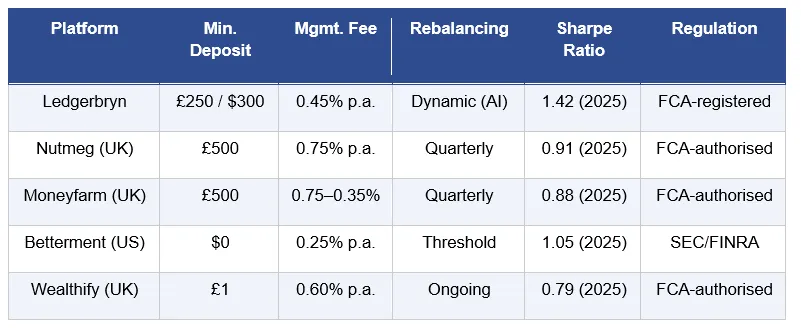
The data above highlights several material competitive distinctions. Ledgerbryn’s management fee of 0.45% per annum is 40% below the standard 0.75% charged by the UK market leaders Nutmeg and Moneyfarm, while the platform’s AI-driven dynamic rebalancing provides a structural advantage over calendar-based quarterly approaches in volatile market conditions. The principal trade-off is a higher minimum deposit than Wealthify (£250 versus £1), which may restrict access for the smallest retail investors; however, for balances above £500, Ledgerbryn presents a broadly superior risk-adjusted cost-benefit profile based on 2025 data.
For those seeking a structured independent perspective before committing capital, a comprehensive Ledgerbryn review is available through the platform’s own disclosure portal, which includes third-party audit summaries and a comparison of historical drawdown profiles across risk tiers – a level of disclosure that reflects the platform’s alignment with FCA Consumer Duty expectations for retail investment services introduced in 2023.
Regulatory Status and Geographic Availability
As of Q1 2026, Ledgerbryn holds FCA registration for its UK operations, operating as an Appointed Representative of a directly authorised FCA firm under the Investment Advisers category. This structure is a recognised compliance pathway for technology-led investment platforms and confers client money protection under the Financial Services Compensation Scheme (FSCS) up to £85,000 per eligible claimant – a materially significant consumer protection feature. The platform is also registered with relevant authorities in the European Economic Area via passporting arrangements, and maintains a parallel compliance framework for US-based users operating under SEC Regulation D exemption provisions for qualified investors.
Geographic availability encompasses 47 countries across Europe, North America, the Asia-Pacific region, and the Gulf Cooperation Council. Users in jurisdictions subject to FATF high-risk classifications, US OFAC sanctions lists, or FCA enhanced due diligence requirements are excluded at onboarding, consistent with the platform’s AML/KYC policy framework independently audited by KPMG’s financial crime practice in 2025.
Data Security and Operational Infrastructure
Client portfolio data and personal information are processed under ISO/IEC 27001-certified infrastructure hosted across geographically distributed data centres in the UK and EU, ensuring GDPR compliance for European users. The platform employs end-to-end encryption for all data in transit and at rest, with biometric authentication available on mobile applications and hardware-token two-factor authentication for institutional access. An independent penetration test conducted in November 2025 by NCC Group identified no critical vulnerabilities in the production environment.
Summary Assessment
Ledgerbryn occupies a well-defined and defensible position in the 2026 AI investment platform landscape. Its combination of a sub-0.50% fee structure, demonstrated Sharpe ratio of 1.42 on its core balanced strategy, automated drawdown controls, and FCA-registered compliance standing makes it a materially competitive offering for UK and international retail and high-net-worth investors seeking algorithmically managed, diversified portfolios. The primary limitations – a £250 minimum that excludes the lowest-balance retail segment, and the absence of direct equity discretionary mandates below the institutional threshold – are consistent with the platform’s deliberate focus on systematic, scalable portfolio management rather than bespoke advisory services.
The independent verification of its VaR model, third-party performance attribution, and FSCS-backed UK client protections address the principal due-diligence questions that informed investors and compliance-minded advisers are likely to raise. For UK investors comparing digital wealth options in 2026, Ledgerbryn merits serious consideration alongside the established domestic leaders and represents a cost-efficiency advantage that is quantifiably material at balances above £10,000.
