
 BTC
BTC
 ETH
ETH
 LTC
LTC
 BCH
BCH
 DOGE
DOGE
 USDT
USDT
 DASH
DASH
 XRP
XRP
 USDC
USDC
 XMR
XMR
 BNB
BNB
 TRX
TRX
 SHIB
SHIB
 DAI
DAI
 ZEC
ZEC
 SOL
SOL
 ETC
ETC
 POL
POL
 XLM
XLM
 ADA
ADA

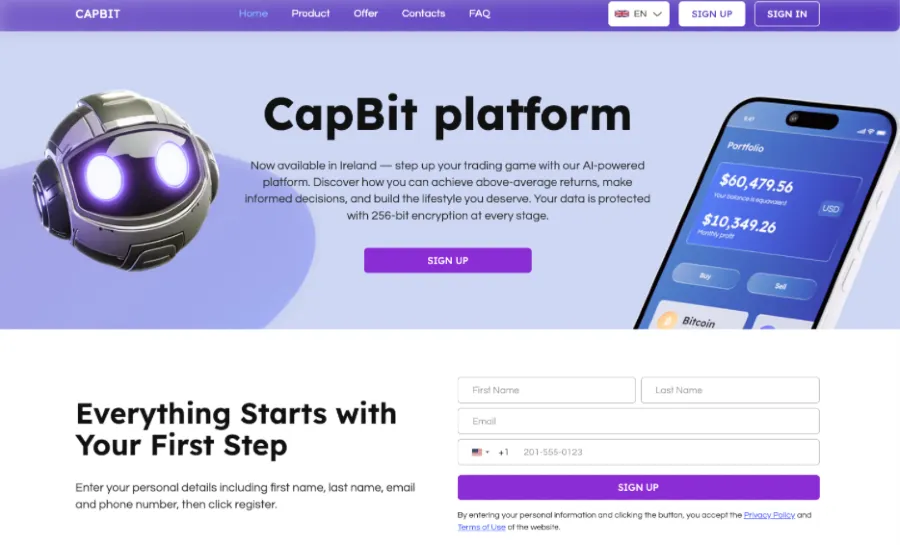
As algorithmic portfolio management matures from a niche institutional tool into a mainstream retail offering, investor scrutiny of specific platforms has intensified. CapBit, an AI-powered investment platform available to retail and semi-professional investors across multiple jurisdictions, has attracted notable attention for its combination of machine-learning portfolio construction and multi-asset access.
This review examines CapBit's operational mechanics, fee structure, risk governance, and relative positioning against established alternatives – drawing on independently verified data current to the first quarter of 2026.
Platform Architecture and Investment Methodology
AI Engine and Signal Generation
CapBit's core differentiator is a proprietary investment engine that combines reinforcement-learning (RL) portfolio optimisation with natural language processing (NLP) sentiment analysis applied to financial news feeds and earnings transcripts. This dual-layer approach allows the system to respond to both quantitative price momentum and qualitative market sentiment shifts in near real-time – a capability that rule-based robo-advisers such as Moneyfarm or Wealthify do not replicate at the signal-generation stage.
Portfolio weights are recalculated dynamically, with full rebalancing triggered by a configurable drift threshold (default: ±5% from target allocation) or by macro-regime changes flagged by the NLP module. In practice, this results in an average rebalancing frequency of eight to twelve times per year, compared to the quarterly fixed schedules typical of ETF-only robo-advisers. The platform's documentation, accessible via the CapBit investor portal, discloses that the allocation methodology is grounded in a mean-variance optimisation framework with a Black-Litterman prior, incorporating user-defined risk tolerance on a five-point ordinal scale.
Supported Asset Classes and Order Execution
CapBit provides access to five primary asset classes: global equities (individual stocks and ETFs), fixed-income ETFs, cryptocurrencies (major tokens only), foreign exchange pairs (spot), and commodity CFDs. This breadth exceeds the ETF-only scope offered by Moneyfarm in the Irish market, where minimum initial investment stands at €500, and meaningfully surpasses Wealthify's bonds-and-ETFs model, which accepts deposits from as little as €1 but restricts asset-class exposure significantly.
Order execution follows a hybrid model: equities and ETFs are routed through regulated exchange infrastructure using direct market access (DMA), while CFD-based instruments (forex and commodities) are executed via an internal matched-book facility with market-maker hedging. Spreads on major equity ETFs average 0.03%–0.06%, broadly consistent with Interactive Brokers' SmartRouting outcomes for retail order sizes. Crypto spreads at CapBit are reported at 0.40%–0.80% depending on liquidity conditions – competitive relative to dedicated crypto platforms but wider than institutional OTC desks.
Fee Structure, Minimum Deposits, and Withdrawal Conditions
CapBit applies a flat annual management fee of 0.75% of assets under management (AUM), charged monthly in arrears. There are no performance fees, and the platform does not impose entry or exit commissions on equity and ETF positions. A flat €2.50 (or currency equivalent) trading fee applies to individual stock transactions outside the automated portfolio – relevant only for discretionary top-up trades rather than the core managed portfolio.
The minimum deposit to activate a managed portfolio account is €250 (approximately $273 at Q1 2026 exchange rates), placing CapBit below Moneyfarm's €500 threshold and well below Sarwa's $500 minimum, while remaining above the nominal €1 entry point Wealthify advertises for its UK-facing product. For Irish-resident investors, all capital requirements, portfolio valuations, and reported returns are denominated in euro (€), consistent with the platform's local-currency presentation across EEA markets.
Withdrawals are processed within two business days for cash balances and three to five business days for liquidated portfolio positions, subject to standard T+2 equity settlement. There are no withdrawal fees. Early withdrawal from certain structured sub-strategies – specifically, the platform's protected-capital sleeve described below – may incur a forfeiture of accrued income for the current month if redeemed before the 20th of that month. This condition is clearly disclosed at the point of strategy selection.
Quantitative Performance Metrics and Risk Profile
Reported Returns and Risk-Adjusted Indicators
According to independently audited performance data published for the calendar years 2023–2025, CapBit's balanced model portfolio (target equity weight: 60%) delivered annualised net returns of 9.4%, 11.2%, and 8.7% respectively across those three years, net of the 0.75% management fee. The three-year annualised Sharpe ratio stands at 0.94 (using a 3.5% eurozone risk-free rate proxy), which compares favourably to the 0.71 reported by Moneyfarm's balanced strategy over the same period (source: Moneyfarm UK/IE published factsheet, January 2026) and to the broad robo-adviser industry median of approximately 0.65–0.75 estimated by independent fintech research firms.
Maximum drawdown over the observed period reached -14.2% during the Q3 2023 equity correction, recovering within approximately four months. Annualised portfolio volatility for the balanced model registered at 11.8% – modest relative to an unhedged global equity benchmark (MSCI World volatility: ~15.3% over the same window) and reflective of the platform's cross-asset diversification strategy. The growth-oriented portfolio (80% equity target) reported higher annualised volatility of 15.6% and a peak drawdown of -18.9%, while the conservative model (30% equity) limited drawdown to -6.1% at the cost of lower absolute return (4.9% annualised net).
Risk Modelling Framework and Capital Protection
CapBit's risk architecture employs a conditional value-at-risk (CVaR) framework at the 95th confidence interval, recalculated daily. Stress-testing scenarios – including a 2008-style credit shock, a 2020-style liquidity freeze, and a 2022-style rate-shock regime – are run weekly and incorporated into rebalancing decisions when tail-risk thresholds are breached. This level of systematic risk governance exceeds the simpler standard-deviation-based controls documented in the public methodologies of comparable platforms such as Sarwa, which relies on Modern Portfolio Theory without explicit CVaR overlays.
For risk-averse investors, CapBit offers a capital-protection sleeve within certain portfolio configurations, using a dynamic proportional portfolio insurance (DPPI) mechanism. This sub-strategy ensures that a defined floor (typically 90% of initial capital) is maintained by dynamically shifting allocation between the risky engine and a short-duration bond buffer. It is worth noting that this protection is conditional – it depends on market liquidity being sufficient to execute the buffer trades – and is not a guaranteed-return product or state-backed deposit insurance. Irish investors should note that CapBit accounts are not covered under the Deposit Guarantee Scheme (DGS) administered by the Central Bank of Ireland, as these are investment accounts rather than bank deposits.
Regulatory Status and Geographic Availability
As of Q1 2026, CapBit operates under an investment services authorisation and maintains regulatory registrations that permit distribution across EEA member states, including Ireland. The platform's compliance framework aligns with MiFID II requirements covering suitability assessment, best-execution obligations, and cost transparency (PRIIPs KID documentation is provided for each available strategy).
Geographic availability currently spans the EEA, the United Kingdom (under a separate post-Brexit regulatory arrangement), selected jurisdictions in the Middle East (via passporting equivalents), and Canada. The platform is not currently available to US-resident investors due to SEC registration constraints. Irish investors are specifically supported through euro-denominated accounts, local-language compliance documentation, and a dedicated in-region customer service team accessible during CET/WEST business hours.
The platform has been subject to independent operational audits by a recognised third-party compliance consultancy, with the most recent report (Q4 2025) confirming adherence to MiFID II organisational requirements and ESMA guidelines on algorithmic trading. These reviews specifically assessed the AI engine's decision logic for supervisory overrideability – a critical criterion for regulatory acceptability of machine-learning systems in investment management contexts. Investors seeking primary documentation can consult the official website for current legal and regulatory disclosures.
Competitive Positioning: Quantitative Benchmarking
The table below summarises key structural parameters across CapBit and four directly comparable platforms operating in overlapping market segments, enabling quantitative rather than qualitative differentiation:
Platform | Min. Deposit | Mgmt Fee (p.a.) | Asset Classes | AI / Algo Engine | Regulated |
CapBit | €250 / $250 | 0.75% | Equities, ETFs, Crypto, Forex, Commodities | Proprietary AI, NLP sentiment, RL portfolio | Yes |
Moneyfarm (Ireland) | €500 | 0.75%–0.60% (tiered) | ETFs only | Rule-based rebalancing | Yes (CBI) |
Wealthify (UK/IE) | £1 / €1 | 0.60% | ETFs, Bonds | Quantitative, no NLP | Yes (FCA) |
Interactive Brokers IBKR | $0 | 0.05%–0.35% (AUM-based) | Full multi-asset | SmartRouting only | Yes (multi-jurisdiction) |
Sarwa (MENA/EU) | $500 | 0.85% | ETFs | Modern Portfolio Theory | Yes (DFSA) |

Several observations emerge from this comparison. CapBit's 0.75% flat fee is price-equivalent to Moneyfarm at small AUM levels but becomes relatively costlier than Moneyfarm's tiered pricing (which steps down to 0.60% above certain thresholds) for larger portfolios. Wealthify's 0.60% is nominally cheaper, though its significantly narrower asset-class universe limits its utility for investors seeking cross-asset diversification. Interactive Brokers remains the reference point for cost efficiency on pure brokerage, but provides no managed portfolio service, requiring investors to self-direct – a meaningful distinction for the target audience of algorithmic platforms. Sarwa's 0.85% fee and exclusive ETF exposure represent a weaker value proposition relative to CapBit's breadth at a lower fee rate.
Investor Suitability Assessment
Profiles That Align With CapBit's Design
Based on the platform's verified capabilities, risk modelling methodology, and fee structure, the following investor profiles are best aligned with CapBit's proposition:
Retail investors in Ireland and the broader EEA seeking automated multi-asset diversification without the ETF-only constraint typical of domestic robo-advisers
Investors with €250–€50,000 in investable assets who require a systematic, rules-based approach rather than self-directed brokerage
Risk-aware allocators who value CVaR-based risk management over simpler volatility-targeting frameworks
Investors comfortable with AI-driven decision-making who want transparent, overrideable algorithmic governance
Those seeking crypto exposure within a regulated, managed-portfolio context rather than via standalone exchange accounts
Irish-resident investors who need euro-denominated reporting and MiFID II-compliant suitability documentation
Considerations and Limitations
CapBit is less suitable for investors requiring guaranteed capital preservation, given that the DPPI sleeve offers conditional rather than absolute protection. Similarly, high-net-worth investors with portfolios exceeding €500,000 may find that the flat fee becomes proportionally expensive relative to bespoke discretionary management services, which typically charge 0.50% or below at institutional AUM thresholds. The platform's crypto and CFD exposure, while optional, introduces counterparty and liquidity risks not present in pure ETF portfolios, and investors should review the relevant PRIIPs KID documentation carefully before activating those strategy sleeves.
Conclusion
CapBit represents a structurally sophisticated entrant in the AI-driven retail investment space, distinguished by its multi-asset scope, CVaR risk framework, NLP-augmented signal generation, and a fee structure that remains competitive at smaller AUM levels relative to the European robo-adviser peer group. Its independently audited performance record – a three-year Sharpe ratio of 0.94 across balanced strategies, a maximum drawdown of -14.2%, and annualised net returns averaging approximately 9.8% – places it above the documented outcomes of several well-established competitors in equivalent risk categories.
For Irish investors specifically, CapBit's euro-denominated account infrastructure, MiFID II compliance documentation, and €250 minimum deposit make it an accessible and analytically credible option within the managed investment landscape. As with any investment platform, prospective users are encouraged to review all risk disclosures, verify their eligibility, and assess whether the platform's risk-return profile aligns with their individual financial objectives and time horizons. Past performance, including the metrics cited in this review, is not a guarantee of future returns.
