
 BTC
BTC
 ETH
ETH
 LTC
LTC
 BCH
BCH
 DOGE
DOGE
 USDT
USDT
 DASH
DASH
 XRP
XRP
 USDC
USDC
 XMR
XMR
 BNB
BNB
 TRX
TRX
 SHIB
SHIB
 DAI
DAI
 ZEC
ZEC
 SOL
SOL
 ETC
ETC
 POL
POL
 XLM
XLM
 ADA
ADA
If you’ve spent some time in crypto, you’ve probably noticed how many platforms try to overwhelm you with features you didn’t ask for. Charts, bots, yield sections, gamified dashboards — the whole package. Quickex, which has been around since 2018, feels like the complete opposite of that trend. It doesn’t raise its voice. It doesn’t try to “lock you into an ecosystem.” It just helps you swap one coin for another and then steps aside.
Over time, that modest approach turned Quickex into a kind of quiet tool people return to when they simply want things to work — whether for a standard asset flip or something a bit more privacy-conscious like BTC to XMR. The service isn’t trying to impress you, and in an industry full of noise, that’s oddly refreshing.
What Quickex Is — and Why It Exists
Quickex is a non-custodial instant crypto swap service. It doesn’t ask for your private data, and it doesn’t store user funds. You open the page, choose what you’re sending, choose what you’re receiving, and that’s basically your whole interaction.
It supports more than a hundred coins — the big ones and a lot of smaller ones too. And because it doesn’t try to be a full exchange, it ends up being surprisingly convenient for everyday blockchain tasks. Many people use it for fee-saving or cross-network moves like Swap USDT (ERC20) to TRX Instantly — a common pattern whenever Ethereum’s gas fees start acting up.
Quickex is not positioning itself as a place where you “live.” It’s a place where you get something done and move on.
What Using It Actually Feels Like
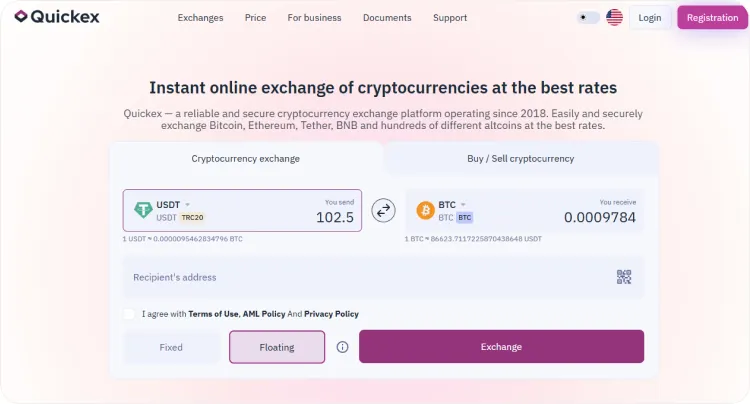
The experience is almost intentionally barebones — in a good way. Three steps: pick a pair, enter the amount and destination wallet, send your coins to the generated deposit address.
That’s it. No switches, no onboarding, no guessing. Just a simple workflow.
Most transactions land somewhere between 5 and 20 minutes, depending on blockchain load. If you’re used to waiting on CEX withdrawals or dealing with “maintenance mode,” Quickex feels pleasantly predictable. For swaps that tend to be awkward elsewhere — like Convert Litecoin (LTC) to Monero (XMR) — the simplicity genuinely saves time and nerves.
Why Non-Custodial Still Feels Right
Crypto has been through enough drama that many people now prefer holding their coins in private wallets. Quickex fits naturally into that mindset: it never stores your balance, never touches your private keys. It’s just a routing layer between your “send” transaction and you “receive” transaction.
Of course, with full control comes responsibility: you need to double-check wallet addresses and chosen networks. But that’s part of using blockchain anywhere — not something unique to Quickex.
About Rates, Fees, and Expectations
Quickex shows the expected amount upfront, including its service fee. You can let the rate float with the market or lock it temporarily. For everyday swaps, floating is usually fine. If the market suddenly “breathes heavily,” fixed-rate mode is a nice safety net.
People often use Quickex for swaps that custodial exchanges tend to complicate unnecessarily. Privacy swaps like a Private Ethereum to Monero Swap are a good example — many CEXs slow them down, while here everything runs directly wallet to wallet.
The Surrounding Tools: Widgets, API, Affiliate Features
Over time, Quickex added a few things that make it more than just a single-page tool:
The Widget
A small swap interface you can embed on your website or project. It’s easy to set up, and users don’t need accounts. Perfect for blogs, informational platforms, or crypto communities that want to let visitors make quick conversions without redirecting them elsewhere.
API V2
A cleaner, faster version of their API with signed requests, simple JSON endpoints, and methods for creating orders or validating addresses. It’s the kind of thing a wallet developer or a small crypto service might plug in when they want to offer swaps without building the whole engine themselves.
Affiliate Program
Straightforward: invite users, get a share of revenue from their swaps. Not a big corporate program, but simple enough to be useful for someone who runs a small site or community.
Support That’s Actually Useful
Most instant swap services are very hands-off — until something gets stuck. Quickex has a noticeable advantage here: its support team actually responds. They don’t leave users waiting for hours during network congestion or when someone accidentally sends a slightly different amount. In a niche where “support” often means a bot that forwards you to an FAQ, a real conversation feels surprisingly reassuring.
Where Quickex Fits Today
Crypto in 2025 is fragmented across more chains than ever. People constantly move value between networks, stablecoins, privacy coins, L2 rollups — sometimes just to save fees, sometimes to diversify, sometimes to keep things private. Non-custodial swap services quietly enable all of that.
Quickex holds its place because it’s:
- been around since 2018,
- predictable in how it behaves,
- not storing user data,
- friendly even to beginners,
- and supportive of developers and small projects.
It doesn’t try to be your trading platform, your wallet, or your DeFi dashboard. It’s a tool — and that’s enough.
Final Thoughts: A Service You Don’t Think About Until You Need It
Quickex won’t surprise you with a new “Pro Mode” or a dozen trading charts. It doesn’t feel like a platform trying to become your crypto home. Instead, it feels like one of those small, dependable things you return to when you simply want to get something done.
And whether you’re just reorganizing your assets or doing a quick cross-chain shift like Exchange ETH to XRP online, Quickex tends to stay true to its personality: quiet, simple, and helpful — almost to the point where you stop noticing how often you use it until you catch yourself coming back again and again.